


Oracle (NASDAQ:ORCL) has struggled with its share price and with investor reception of its AI strategy, even as its fastest-growing business posted one of the strongest quarters in the company’s history. What does the disconnect signal about the rest of this year?
Does Oracle deserve the treatment when its core database franchise reinvented itself as an AI multicloud powerhouse, running mission-critical workloads across every major hyperscaler?
Top Regulated Brokers
Why Oracle’s Multicloud AI Database Strategy Changes the Growth Math
Oracle’s multicloud AI database business allows customers to run Oracle databases natively in Azure, Google Cloud, and AWS. Oracle noted that it rose 404% in the most recent quarter after a 531% surge in the preceding quarter, while the massive backlog of roughly $638 billion should not be ignored, even though it relies on OpenAI for a large share of it. Still, Oracle is facing a downgrade to junk status, as outlined in last week’s item, “Oracle’s Debt Spiral: Is the Options Market Already Pricing In a Downgrade to Junk?”
Sovereign cloud demand and expanding partnerships with OpenAI, Meta, and Nvidia are layering on top of this database expansion. If enterprises are racing to embed Oracle’s database inside every major hyperscaler, is the bear case simply behind the curve?
Core Oracle Fundamentals and Technical Facts to Consider
Oracle now trades roughly 63% below its 52-week high and only modestly above its 52-week low of $121.50. It is a compression rarely seen in a company that is simultaneously posting record backlog growth. Have bears given up on the multicloud AI database business, as they solely focus on debt-driven capex, or is Oracle experiencing what Amazon (NASDAQ:AMZN) faced in its early AWS years?
Metric | Value | Verdict |
P/E Ratio | 21.68 | Bullish |
P/B Ratio | 9.70 | Bearish |
PEG Ratio | 0.71 | Bullish |
Current Ratio | 1.12 | Bearish |
Return on Assets | 6.50% | Bearish |
Return on Equity | 53.38% | Bullish |
Profit Margin | 25.37% | Bullish |
ROIC-WACC Ratio | Negative | Bearish |
Dividend Yield | 1.58% | Bearish |
Oracle Fundamental Analysis Snapshot
Price action may have formed a horizontal support zone, which it currently tests, following last week’s breakout despite challenging market conditions. The Bull Bear Power Indicator remains bearish, but a positive divergence has formed, suggesting a bullish crossover.
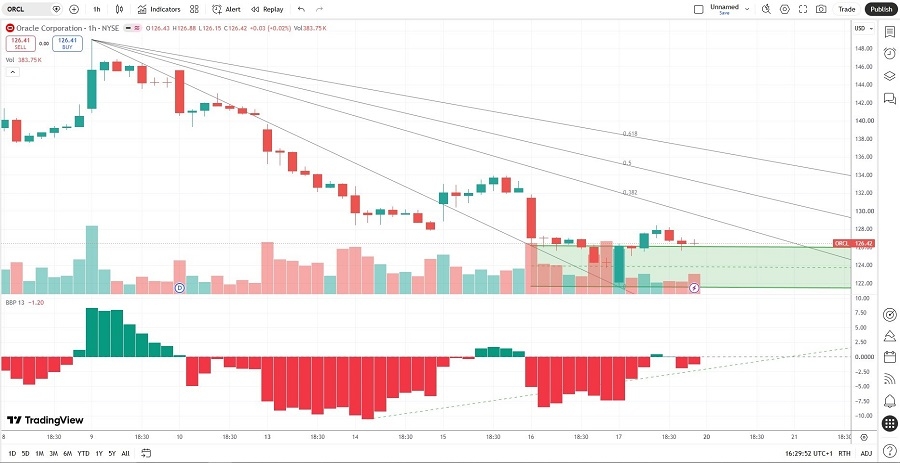
Oracle Price Chart
The Underappreciated Upside of Oracle’s Backlog
The bear case is real, and the S&P Global downgrade of Oracle’s credit rating to BBB-. The reasons were customer concentration risk tied to OpenAI, negative free cash flow of roughly $23.7 billion, and capital expenditures of nearly $55.7 billion in fiscal 2026. Adding more bearish arguing points is the expected $70 billion in capex and a fresh debt-and-equity raise for fiscal 2027, as outlined by Oracle’s management team
Still, gross margins remain near 65.8%, and GPU utilization is roughly 97.5%, while total cloud revenue soared 47% in its last quarter. Will the massive backlog, nearly twice Oracle’s current market capitalization, eventually outpace the debt-funded buildout, or is the market pricing in a funding crisis that has not yet materialized?
Is This Drawdown a Generational Buy-the-Dip Setup?
Despite concerns about Oracle’s debt-driven AI strategy, the average analyst price target of $251.85 suggests strong upside potential, though downside risks remain. Is Wall Street mispricing the upside of Oracle’s multicloud AI database?
Several analysts remain bullish throughout the correction. They argue that the sell-off reflects financing anxiety rather than demand issues, as Oracle’s database transformation reflects one of the most undervalued moats in enterprise software. Is the market confusing near-term financing risk with a broken growth story?
What’s Next for Oracle’s Price Action?
Price action pushed above its horizontal support zone and is approaching its descending 38.2% Fibonacci Retracement Fan level. Today’s session could provide more answers, especially if bulls push above it. Should Oracle’s multicloud database momentum continue to outpace headline capex fears, will today’s setup reward patient investors for buying capitulation? Watch the $133.90 level, but do bears have one more fight left in them?
Ready to trade our analysis of Oracle? Here is our list of the best stockbrokers worth checking out.