


NVIDIA's AI Moat Under Pressure: Has Wall Street Mispriced the Rising Competitive Risk?
Top Regulated Brokers
NVIDIA (NASDAQ:NVDA) has become the poster child of AI infrastructure since 2022, leading the conversation with its advanced chips that power premium AI models, but what do recent shifts in sentiment highlight about its value proposition and competitive edge?
The AI sector suffers from capex anxiety, but the surge in demand has also increased competition. How will NVIDIA counter the decline in its competitive edge, and what does it mean for its market cap and forward sentiment today?
Why NVIDIA's Competitive Pressures Matter More Now
NVIDIA is no longer the only player producing premium chips that power data centers. Does the loss in market share increase unit costs amid a volume decline and erode revenue potential? Amazon's (NASDAQ:AMZN) recent announcement to expand its Trainium chips beyond AWS, as outlined in today's note, "Amazon's Trainium Chip Expansion: Does it Point to Justified Capex Plans?," is the latest attack on NVIDIA's competitive edge and market share.
It compounds the concerning developments in B200 compute pricing, as outlined in last week's note, "Does B200 Compute Pricing Point to Underpriced Risk?," and heightens capex anxiety. How does the loss of the Chinese market influence NVIDIA's competitiveness, and does the current share price hint at a mispriced optimism given compounding risks and emerging pricing pressure?
Core NVIDIA Fundamental and Technical Facts to Consider
NVIDIA no longer justifies its premium valuation as its competitiveness faces multiple pressure points. Adding to concerns is that corporate clients are moving towards more efficient, cheaper models that outperform NVIDIA-powered alternatives, but how much of the potential downward spiral is priced into shares today across the broader AI infrastructure trade?
Metric | Value | Verdict |
P/E Ratio | 30.30 | Bearish |
P/B Ratio | 24.48 | Bearish |
PEG Ratio | 0.61 | Bullish |
Current Ratio | 3.44 | Bullish |
Return on Assets | 52.73% | Bullish |
Return on Equity | 114.29% | Bullish |
Profit Margin | 62.97% | Bullish |
ROIC-WACC Ratio | Positive | Bullish |
Dividend Yield | 0.52% | Bearish |
NVIDIA Fundamental Analysis Snapshot
Price action remains within a bearish price channel, enforced by the descending 61.8% Fibonacci Retracement Fan level. While the Bull Bear Power Indicator turned bullish as shares drifted towards the upper band of its bearish price channel, a descending trendline is guiding it lower, resulting in a potential bearish crossover that could provide the next downside catalyst.
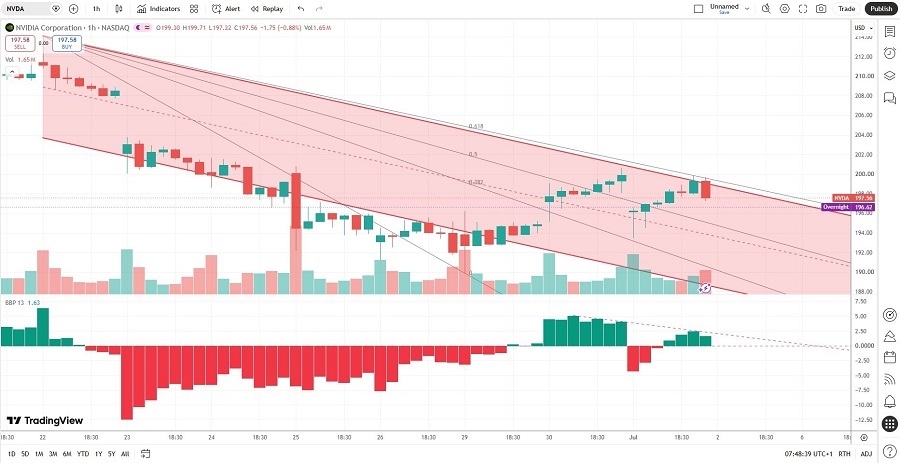
NVIDIA Price Chart
The Underappreciated Risks Behind NVIDIA's Competitive Moat
When famed short seller Michael Burry published his short recommendation on NVIDIA, many criticized it for missing the bigger picture, as NVIDIA is a core player in building the future. Since then, the issues have compounded, and the increased competition could spiral into revenue losses that would undermine the funding for the intensive research and development required to deliver premium chips like its flagship B200 GPU.
More interestingly, NVIDIA's flagship chip has seen a 30%+ decrease in the hourly rental rate, and it remains to be seen how investors will behave once they have digested ongoing developments hinting at market share losses, revenue concerns, and further competitive contraction. How will worsening unit economic factors affect NVIDIA's future market cap and longer-term margin assumptions?
What NVIDIA's Setup Suggests About Market Sentiment
Despite compounding issues affecting NVIDIA's business model, the average analyst price target of $301.62 suggests attractive upside potential. How will mispriced optimism affect sentiment, given that each issue is more significant than the previous one?
NVIDIA has underperformed its peers in recent weeks, but more noteworthy is the rotation toward competitors with greater upside potential. The Rubin platform and RTX Spark processor are potential disruptors, but how much impact will they have on sentiment and future valuation expectations?
What's Next for NVIDIA Price Action?
Price action trades at a twin-resistance area and given ongoing developments hinting at mispriced optimism about its competitive moat, the path of least resistance is to continue the current trend. Still, how will traders react to support levels that are nearing? The $193.46 level could provide more downside clarity, but the $200.63 level is worth monitoring.
Ready to trade our analysis of NVIDIA? Here is our list of the best stockbrokers worth checking out.