


NVIDIA (NASDAQ:NVDA) faces a sharp erosion of its China AI-chip position as US export controls limit access to the market and domestic competitors gain ground. CEO Jensen Huang has warned that tightening US export controls have severely curtailed NVIDIA’s ability to compete in China’s AI accelerator market, creating an opening for domestic rivals. Is the market shrugging off a loss that has not finished the economic damage?
The company’s 10-K filing concedes the loss of the Chinese AI data center market and warns that the lost opportunity will have a material and adverse impact. Should investors dismiss language that comes directly from the company itself?
Top Regulated Brokers
Why NVIDIA’s China Market‑Share Loss Matters Beyond Revenue
According to a Bernstein Research note, NVIDIA’s market share in China will crater from 66% in 2024 to just 8% this year and could continue to decelerate sharply thereafter. Huawei is filling the vacuum, accounting for roughly 50% of the market share. It reaffirms that insiders might see something the market ignores, as outlined in last week’s note, “NVIDIA’s Insider Selling Spree: Does It Signal Fading Conviction at the Top?”
With Huawei and SMIC shipping millions of highly competitive AI chips to Chinese customers, the world’s second-largest AI market has become a training ground for NVIDIA’s rivals to scale rapidly. If Chinese chipmakers use their protected domestic market to deepen their hardware, software, and developer ecosystems, how long before they begin competing more effectively for NVIDIA’s global customers?
Key NVIDIA Valuation, Fundamentals, and Technical Signals
NVIDIA trades at a price-to-sales ratio above 20 and a price-to-book ratio above 26, valuations that appear to assume near-flawless execution despite little contribution from China and rising longer-term competitive risk from Chinese rivals. Do these multiples make sense as the market for NVIDIA shrinks, while bulls might misprice the negative impact on future growth prospects?
Metric | Value | Verdict |
P/E Ratio | 32.44 | Bearish |
P/B Ratio | 26.24 | Bearish |
PEG Ratio | 0.65 | Bullish |
Current Ratio | 3.44 | Bullish |
Return on Assets | 52.73% | Bullish |
Return on Equity | 114.29% | Bullish |
Profit Margin | 62.97% | Bullish |
ROIC-WACC Ratio | Positive | Bullish |
Dividend Yield | 0.47% | Bearish |
NVIDIA Fundamental Analysis Snapshot
Price action trades within a horizontal resistance zone, and average bearish trading volume exceeds average bullish trading volume. The Bull Bear Power Indicator continues to record lower highs, forming a descending trendline, while shares are testing the strength of the horizontal resistance zone following a breakdown and reversal.
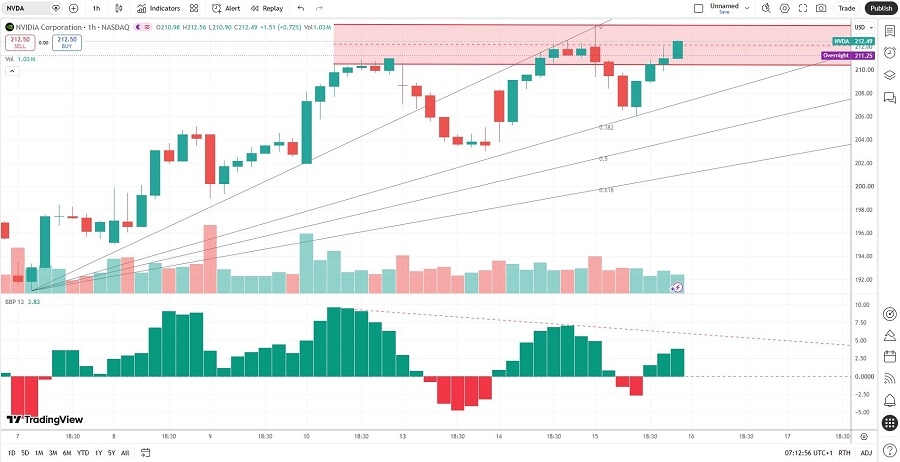
NVIDIA Price Chart
Can H200 Licenses Offset NVIDIA’s China Competitive Risk?
While the headlines about a ZTE unit receiving a license to buy H200 chips from NVIDIA were well-received by bulls, a US official noted that very few units have shipped. The US government applied a 25% tariff on imports, which NVIDIA might be unable to pass on to consumers, further harming its diminished competitive position in China. Still, bulls pin their hopes on Blackwell’s demand visibility, but how will concentration in a few hyperscalers impact NVIDIA’s growth story?
The Chinese government urges its tech companies to buy domestic chips, and the aging H200 chip trails what Huawei produces, raising the question of why Chinese firms should commit to it. Does the H200 licensing shift for a last-generation chip really feel like a victory?
What NVIDIA’s China Reset Reveals About Valuation and Market Sentiment
Despite China-related competitive and valuation pressures, the average analyst price target of $301.62 implies attractive upside potential, even as downside risks appear to be rising. Still, the market loss in China masks a more pressing issue for NVIDIA. The vacuum is filled by Chinese champions, allowing them to build massive developer and customer ecosystems that may soon challenge NVIDIA globally.
Grey-market demand for B300 servers exists, but each blocked sale of next-generation hardware increases the risk of substitution. Are bulls discounting a competitive threat that NVIDIA itself calls material?
What’s Next for NVIDIA’s China Risk and NVDA Price Action?
Today’s session could define the next move as shares trade inside a horizontal resistance zone. As Huawei and SMIC scale rapidly while NVIDIA remains constrained in China, will investors keep paying premium multiples despite the growing competitive risk? A move above $213.81 could give bulls more runway, while a break below $206.04 may strengthen the bearish case.
Ready to trade our analysis of NVIDIA? Here is our list of the best stockbrokers worth reviewing.