


Three more major central banks announce interest rate decisions within 48 hours of each other this month. The Federal Reserve announces on 16th September, the Bank of England on 17th September and the Bank of Japan on 18th September. Two of the three are considering raising rates. A year ago, most forecasters expected the Fed and Bank of England to be cutting rates by now, with the Bank of Japan tightening only gradually. Instead, September has brought rate-rise expectations back into focus across all three.
The European Central Bank has already set the tone. On 10th September, it raised rates by 25 basis points, taking its deposit rate to 2.50%, as the Middle East conflict continued to push up energy prices and inflation. The ECB said inflation is likely to remain well above its 2% target for an extended period, with its latest projections putting headline inflation at 3.0% in 2026 and 2.5% in 2027.
The common thread is inflation. Higher energy prices caused by the conflict have added to inflation pressure across the euro area, the US and the UK. In Japan, the yen fell to a 40-year low over the summer, making imports more expensive and adding to price pressure. As a result, traders have stopped asking when rate cuts will resume and started asking whether the next move is up.
The Federal Reserve: a rate rise is possible for the first time in years
The Fed has kept its target range at 3.50% to 3.75% since December 2025. At the July meeting, the committee voted 9-3 to hold. The statement said inflation was still somewhat elevated and that the next decision would depend on the data.
The data since July has pointed towards higher rates. The US economy added 162,000 jobs in August, against expectations of around 58,000, and unemployment stayed at 4.1%. Fed Chair Kevin Warsh said at Jackson Hole that underlying inflation had not meaningfully improved and that the Fed still had work to do. Fed hike odds have swung sharply, from 44.4% a month ago to around 60% now, after Jackson Hole and the strong August jobs report.
Oil prices are adding to the pressure. Brent crude passed $109 a barrel this week for the first time since July, and WTI is trading around $5 below that, after the US and Iran exchanged strikes on tankers and Saudi energy facilities were attacked.
The September meeting also includes updated economic projections and the dot plot. It’s important to watch because even if the Fed holds, a shift in where policymakers expect rates to be in 2027 may affect the dollar and bond yields in a similar way to an actual rise. The 10-year Treasury yield is close to 4.8% at the time of writing, its highest level since late 2023.
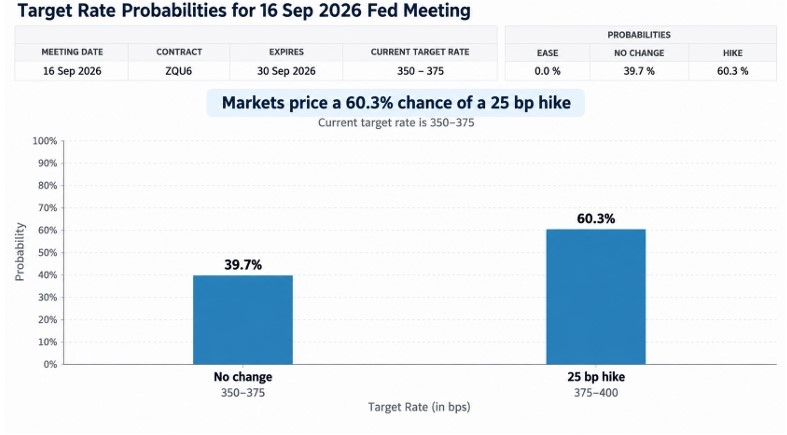
Source CME Group Fedwatch tool
CME FedWatch for the 16th September Fed decision, showing a 60.3% probability of a rate hike as of 9th September, up from 44.4% one month earlier.
The Bank of England: expected to hold, but the vote split is key
The Bank of England held the Bank Rate at 3.75% in July by six votes to three. Huw Pill, Megan Greene and Catherine Mann voted for a rise to 4%. At the previous meeting only two members had voted for a rise, so the pressure to tighten is growing.
UK inflation rose to 2.9% in July, with higher household energy bills contributing to the increase. The August inflation figure is published on 16th September, the morning before the decision. If it comes in above 3% and services inflation is also rising, it could make the vote closer. If it comes in soft, the majority will most likely hold and the debate moves to November.
By late August and early September, markets were pricing only about a 15% chance of a September rate rise. For the pound, the key factor is relative UK and US rate expectations. If the Fed raises and the Bank of England holds, the rate gap moves in the dollar’s favour, which would tend to weigh on sterling.
The Bank of Japan: the most likely of the three to raise rates
The Bank of Japan held its policy rate at 1% in July. One board member, Hajime Takata, voted for a rise to 1.25%. On the same day, Japan and the US intervened together in the currency market for the first time since 2011, buying yen after it had weakened to around 164 per dollar. It was the first coordinated yen-buying intervention since 1998.
Since then, Governor Kazuo Ueda has said the board will decide with upside inflation risks in mind, and Takata has said the bank should raise rates quickly, possibly faster than its current pace of about twice a year. The market has taken this as a signal that a rise is coming in September. USD/JPY has fallen from around 163 to a fresh seven-month low of 153.53 on 8th September, breaking below the level seen during July's intervention and marking the yen's strongest point since February.
Two things make this decision unusual. First, the yen has already strengthened a lot on the expectation of a rise, so if the bank holds, much of that move could reverse quickly. Second, the decision also comes just before a long holiday period, with Japan’s cash equity market closed from 21st to 23rd September, although some derivatives continue trading through JPX holiday sessions.
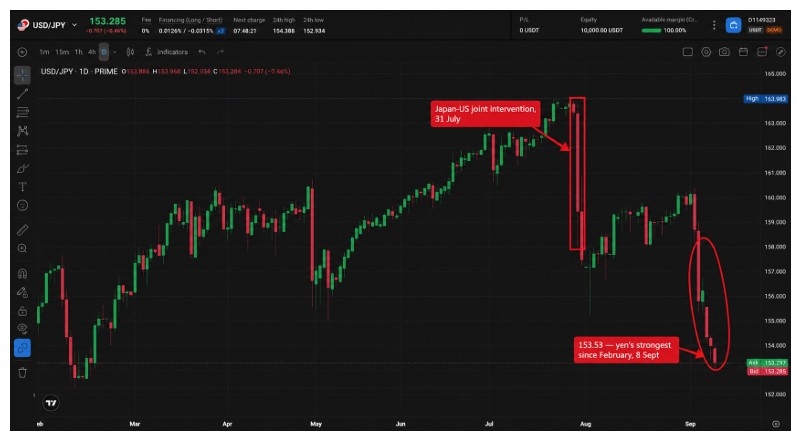
PrimeXBT USD/JPY daily chart: the 31st July Japan-US joint intervention, and the yen's slide to a fresh seven-month low of 153.53 on 8th September.
How the three decisions affect each other
Gold shows the current situation most clearly. Normally, a military conflict in the Gulf and rising oil prices would push gold higher. Instead, gold has fallen by roughly $300 from its late-August high near $4,700 to around $4,400 at the time of writing. This is because the market is treating the conflict as an inflation problem, which means higher interest rates, and higher rates make gold less attractive because it pays no interest.
The Fed and the Bank of Japan also affect each other through the yen. If the BoJ raises while the Fed holds, the gap between US and Japanese rates narrows, which would normally support the yen. If the Fed raises and the Bank of Japan holds, the rate gap widens in the dollar’s favour, which would tend to weaken the yen. If both raise by 25 basis points, the rate gap is broadly unchanged, leaving the currency reaction more dependent on what each central bank signals about future moves.
For traders, the practical point is that each decision can show up in several markets at once. Currencies, bond yields, gold and stock indices can all reprice within minutes of the announcement.
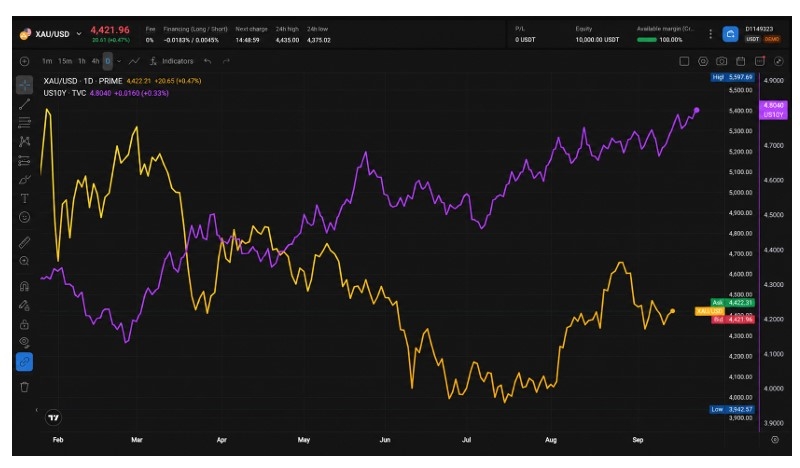
PrimeXBT chart showing Gold and the US 10-year Treasury yield, February to September 2026, with gold retreating from its late-August high as the 10-year yield climbed towards 4.8%.
How Traders Can Trade These Decisions
PrimeXBT, a global multi-asset broker, gives traders access to the markets affected by these decisions through two platforms and five account types from one integrated ecosystem.
PXTrader 2.0 offers CFDs across Forex, Commodities, Indices, Stocks and Crypto alongside Crypto Futures - all from one account, while MetaTrader 5 provides four account types designed for different experience levels and strategies. Across both platforms, traders can access more than 350 instruments, including EUR/USD, GBP/USD and USD/JPY, Gold, Oil, the S&P 500 and the NASDAQ. Depending on the platform, accounts can be held in USD, USDT, USDC, BTC or ETH, which means traders who hold crypto can trade the banks’ reactions without converting to fiat first.
Trading costs tend to be important during announcement weeks, because spreads at many brokers widen around the decision. PrimeXBT's spreads start from close to zero on EUR/USD, from $0.35 on gold and from 0.4 points on the S&P 500, and there is no commission on CFDs. Broker’s loyalty program, VIP Tiers, reduces spreads by up to 25% on forex and CFDs and by up to 50% on gold and Bitcoin, with gold spreads as low as $0.17 for the highest tier.
The Bank of Japan announces on a Friday, just before Japan’s cash equity market closes for three national holidays from 21st to 23rd September. PrimeXBT's Gold 24/7 instrument trades through the weekend, so a trader can adjust or close a gold position on Saturday instead of waiting for the Monday open.
Three scheduled decisions in three days means three separate windows where positions can move fast in either direction. Traders can attach a stop loss and take profit before each announcement rather than reacting after it, and real-time margin tracking with margin call alerts gives time to act if a position moves against expectations. Negative balance protection means a client can never owe money to the broker, whichever way the dot plot or the vote count goes.
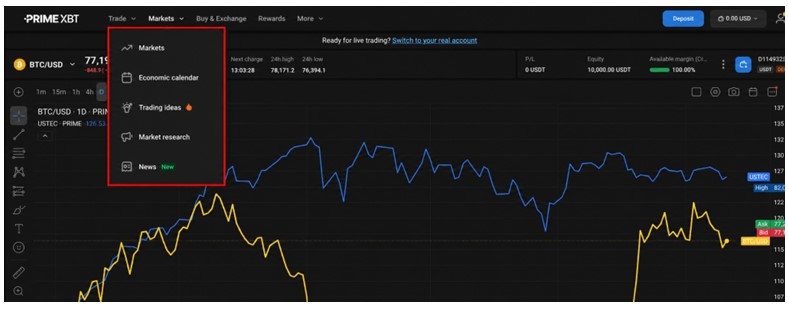
Economic events are shown directly on PrimeXBT’s TradingView chart, so traders can see when releases such as UK CPI and central-bank decisions are due without switching to a separate calendar. Traders can use a free demo account to trade through all three decisions with virtual funds first.
The Bottom Line
September's decisions will not settle the inflation debate, but they will show how far each central bank is prepared to go, and markets will adjust to that within minutes. Traders who watch the dollar, bond yields, gold and the yen together, and who set their risk limits before the announcements rather than after, will be better placed than those watching one chart.
Start trading Central Bank moves with PrimeXBT.
About PrimeXBT
PrimeXBT is a global multi-asset broker and crypto asset service provider trusted by traders in more than 150 countries. The platform bridges traditional and digital markets within one integrated environment, redefining versatility and innovation in online trading. Clients can access Forex, CFDs on indices, commodities, shares, crypto, and Crypto Futures, as well as buy, store and exchange cryptocurrencies. This unified experience extends across both the native PXTrader 2.0 platform and MetaTrader 5, supported by advanced risk-management tools and a wide range of funding options in crypto, fiat and local payment methods. Since 2018, PrimeXBT has focused on empowering traders through broad multi-asset access, fair and transparent conditions, professional-grade technology and dedicated human support. By combining expertise, trust and a client-first approach, PrimeXBT sets a benchmark of excellence in the financial industry and provides traders with the tools they need to trade, grow and succeed with confidence.
Disclaimer: The content provided here is for informational purposes only and is not intended as personal investment advice and does not constitute a solicitation or invitation to engage in any financial transactions, investments, or related activities. Past performance is not a reliable indicator of future results. The financial products offered by the Company are complex and come with a high risk of losing money rapidly due to leverage. These products may not be suitable for all investors. Before engaging, you should consider whether you understand how these leveraged products work and whether you can afford the high risk of losing your money. The Company does not accept clients from the Restricted Jurisdictions as indicated on its website / T&Cs. Some products and services, including MT5, may not be available in your jurisdiction. The applicable legal entity and its respective products and services depend on the client’s country of residence and the entity with which the client has established a contractual relationship during registration.