

The Iran conflict has delivered the most significant oil supply shock in decades. Brent crude surged from around $67 before the strikes to an intraday high of $114 in early March, a move of roughly 70% in under two weeks. The effective closure of the Strait of Hormuz, which handles approximately 20% of the world's seaborne oil, has turned what began as a geopolitical risk premium into a genuine physical supply crisis.

The numbers are stark. Tanker transits through the Strait collapsed from over 100 per day pre-conflict to near zero within days of hostilities beginning. Iraqi southern field output fell an estimated 60-70%, with exports dropping to around 800,000 barrels per day. Kuwait and the UAE have been forced to trim production as onshore storage fills up. All major container lines, including Maersk, CMA CGM, and Hapag-Lloyd, suspended transits. War risk insurance premiums surged over 1,000%, and 7 of 12 major P&I clubs cancelled coverage for Gulf shipping entirely.
OPEC+ agreed to a 206,000 barrel per day production increase for April, but spare capacity is meaningless while the Strait remains closed. The G7 is now discussing a coordinated strategic petroleum reserve release, the first such intervention since the Russia-Ukraine war.
Then came the reversal. In the days following the spike, President Trump signalled de-escalation, telling CBS the war is "very complete," the strongest such signal since
the conflict began in late February. Brent dropped from its $114 high to settle in the low
$90s within hours, one of the most volatile single-day swings in oil market history..
The bigger question for oil
Before this conflict, Brent was in a well-established higher timeframe downtrend. The EIA had forecast significantly lower prices for 2026, and the structural oversupply narrative was firmly in control. The war-driven spike has now pushed price decisively back above the weekly 200 SMA around $78-79, a level that had capped price for over
18 months, but it is worth asking the question: does this event have enough significance to permanently alter the long-term trajectory of that downtrend, or is this a temporary shock that fades once the geopolitical situation stabilises?
That is the key question for oil going forward, and the answer depends almost entirely on how long the Strait of Hormuz disruption persists. The Brent futures curve is already in steep backwardation, with near-month contracts trading at a significant premium to later months, which tells you the market expects this crisis to be temporary. But every additional week of disruption raises the risk of lasting structural damage to supply chains, insurance markets, and shipping routes that could keep a floor under prices even after tensions ease.
Brent crude: key levels to watch
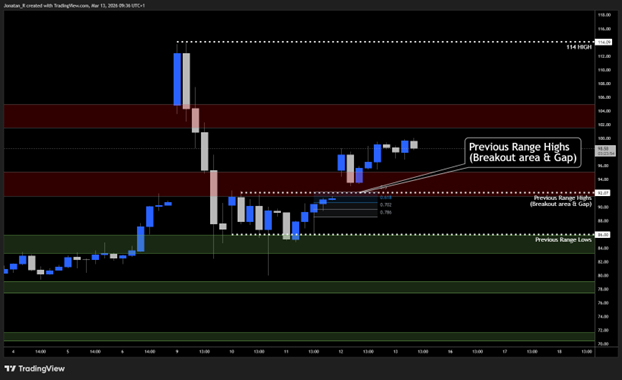
At the time of writing, Brent is trading around $98 after successfully breaking above the
$92 resistance zone that had kept price confined within a tight range following the massive sell-off from the $114 high. That breakout is significant, as it potentially confirms that the post-spike correction was a consolidation rather than the beginning of a deeper reversal.
With the situation in the Middle East continuing to deteriorate and no clear resolution to the conflict in sight, oil continues to push higher and is now approaching the high timeframe resistance zone between $101 and $105. This is the next major test for bulls, and how price reacts here could define the next leg of the move.
A rejection from the $101-105 zone could see price pull back toward the $92 area, which previously acted as resistance and now represents a potential support level and gap fill target. On the other hand, if buyers can reclaim that high timeframe resistance and establish price above it, a retest of the $114 high and potentially new highs above that level could come into play.
For now, the bias remains to the upside as long as price holds above the $92 breakout level. The key catalyst remains the same: any developments around the Strait of Hormuz and the broader conflict will likely dictate whether oil continues higher or begins to retrace.
Bitcoin: consolidation holds, but conviction is missing
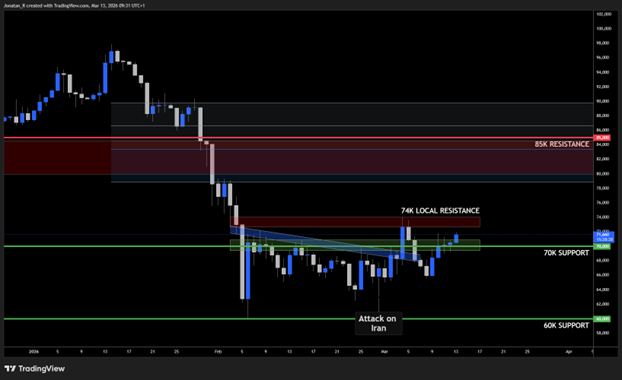
BTC has made repeated attempts to reclaim the $70,000 level, with improving risk sentiment providing support for pushes above that threshold. The key question is
whether this momentum can carry price toward the next significant resistance levels overhead, or whether it fades back into the broader consolidation range.
On 4 March, BTC briefly broke above the $70,000 level before pulling back over the weekend. Now, as risk appetite returns to markets following Trump’s de-escalation comments, we are seeing another push above that $70,000 level, with price trading around $71,000 at the time of writing.
The immediate level to watch on the upside is the $74,000 local resistance sitting just overhead. This is the first real test for bulls, and a clean break above it could open up room toward the $80,000-85,000 zone, which represents the next major resistance area. That zone carries significant confluence: it aligns with the 0.618 to 0.786
Fibonacci retracement levels of the latest impulse move to the downside, a major price action resistance level, and the weekly 20 EMA. All of these stacking together make it a likely area where sellers could step back in.
It is worth remembering that Bitcoin remains in a technical bear market. The primary trend on the daily and weekly timeframes is bearish according to the structure of lower highs and lower lows, and nothing in the current price action has changed that yet. Even a push into the $80,000-85,000 resistance zone would not invalidate the downtrend, it could simply be a retest of that structure from below.
The more telling signal right now is the volume profile behind this recovery. While price is creating higher highs and higher lows off the $60,000 low, the participation behind the bullish candles has been underwhelming. Buyers are pushing price higher, but they are doing so on declining volume, which is typically a warning sign rather than a confirmation of strength.
On the downside, a failure to hold the $70,000 support and a drop back into the consolidation range would put the $60,000 floor back in focus. A breakdown below
$60,000 would be a significant structural event, potentially opening up much lower targets.
For now, Bitcoin is caught between the broader bearish trend and a short-term recovery attempt driven by improving risk sentiment. The $74,000 resistance and the lack of volume conviction behind the current move are the two things to watch closely in the near term.
PrimeXBT: Trading across interconnected markets from one platform
Events like the current Middle East conflict highlight a simple reality of modern markets: major moves rarely happen in isolation. Oil reacts immediately to supply disruptions, currencies adjust to shifts in global risk sentiment, and Bitcoin often reflects broader liquidity conditions. When these dynamics unfold at the same time, the relationship between different markets can become just as important as the movements within any single asset.
For traders following developments such as the current oil shock and Bitcoin’s consolidation, watching multiple markets simultaneously can provide a more complete picture. Energy prices, foreign exchange markets, equity indices, and digital assets all interact within the same macro environment, and shifts in one often ripple into others.
PrimeXBT, a global multi-asset broker, is designed around this cross-market perspective. Its platform brings together foreign exchange, commodities such as oil and gold, global equity indices, popular stocks, and cryptocurrency markets within a single trading environment. This allows traders to monitor correlations and respond to macro developments without switching between separate platforms.
The structure also reflects the evolving role of digital assets within global markets. Rather than functioning only as standalone instruments, crypto assets can increasingly be used as trading capital across multiple markets. PrimeXBT’s PXTrader 2.0 platform, for example, allows crypto assets like BTC or ETH to be used as collateral to access both CFD and crypto futures markets, extending their role within a broader multi-asset trading framework.
Alongside this cross-market access, the platform offers competitive trading conditions and advanced tools designed to support active traders navigating both traditional
financial markets and digital assets.
For traders who began in crypto or forex, the current market environment serves as a reminder that the clearest signals often emerge when multiple markets are viewed together rather than in isolation.
Start trading with PrimeXBT.
About PrimeXBT
PrimeXBT is a global multi-asset broker and crypto asset service provider trusted by traders in more than 150 countries. The platform bridges traditional and digital markets within one integrated environment, redefining versatility and innovation in online trading. Clients can access Forex, CFDs on indices, commodities, shares, crypto, and Crypto Futures, as well as buy, store and exchange cryptocurrencies directly. This unified experience extends across both the native PXTrader platform and MetaTrader 5, supported by advanced risk-management tools and a wide range of funding options in crypto, fiat and local payment methods. Since 2018, PrimeXBT has focused on empowering traders through broad multi-asset access, fair and transparent conditions, professional-grade technology and dedicated human support. By combining expertise, trust and a client-first approach, PrimeXBT sets a benchmark of excellence in the financial industry and provides traders with the tools they need to trade, grow and succeed with confidence.
Disclaimer: The content provided here is for informational purposes only and is not intended as personal investment advice and does not constitute a solicitation or invitation to engage in any financial transactions, investments, or related activities. Past performance is not a reliable indicator of future results. The financial products offered by the Company are complex and come with a high risk of losing money rapidly due to leverage. These products may not be suitable for all investors. Before engaging, you should consider whether you understand how these leveraged products work and whether you can afford the high risk of losing your money. The Company does not accept clients from the Restricted Jurisdictions as indicated on its website / T&Cs. Some products and services, including MT5, may not be available in your jurisdiction. The applicable legal entity and its respective products and services depend on the client’s country of residence and the entity with which the client has established a contractual relationship during registration.