


Top Regulated Brokers
Some crypto selloffs stay concentrated in speculative or thinly traded assets. This one reached the top of the market and left few established names untouched. Bitcoin (BTC) and Avalanche (AVAX) lost less than the typical large asset, while Ethereum (ETH), XRP, and most of the broader market fell harder.
But the tension comes from the distance between those stronger exceptions and everything around them. Relative strength still exists, but it has not spread. The next phase will depend on whether the firmer pockets attract wider participation or get pulled back into a crypto market that is still losing ground.
Broad Crypto Losses Leave Little Shelter in Larger Assets
Total crypto market capitalization was near $2.19 trillion at the time of writing. The result was clearer underneath that headline: 86 of the top 100 assets were down over seven days, while only 14 were positive. A cleaned screen of 38 large, liquid risk assets produced 37 losers, one winner, and a median return of -15.52%.
That narrow spread also appeared in the cleaned cap-weighted result, which was -15.24%, only 0.28 percentage points better than the median. Larger assets therefore offered little protection from the broader decline. Bitcoin and AVAX held up better than Ethereum and XRP, but the gap between the typical asset and the cap-weighted result was too narrow to support a large-cap shelter story.
Sector performance showed the same pressure. Large layer-one assets and payment assets had median losses near 15.5%, while established meme assets lost about 17.6%. DeFi and oracle assets were down nearly 21%, and privacy assets had the deepest median loss at about 23%. Bitcoin dominance was about 59.4%, but that level did not translate into healthier participation elsewhere.
Meanwhile, dollar-pegged stablecoin supply fell by about $4.43 billion over the seven-day window, from roughly $291.48 billion to $287.05 billion. That contraction does not explain the decline by itself. It adds to the evidence that participation was shrinking rather than rotating broadly into the weaker parts of the market.
Bitcoin and AVAX Fall Less as ETH and XRP Suffer Deeper Losses
The completed-window returns below cover seven daily candles from November 8 through November 14. Each series includes a closed Saturday candle. Data provided by TradingView for current prices and moving averages.
That comparison has a common technical limit: all four current prices remained below their 20-day and 50-day averages. The smaller losses in Bitcoin and AVAX still sit inside a market structure that requires repair. Their outperformance was relative, while the absolute direction remained lower.
Bitcoin’s Smaller Decline Still Leaves Key Averages Out of Reach
Bitcoin opened the completed window near $75,754 and closed Saturday near $64,119, a decline of 15.36%. The seven-day range ran from $63,270 to $76,095. At the time of writing, Bitcoin was near $64,730, below its 20-day simple moving average around $75,032 and its 50-day average near $79,744.
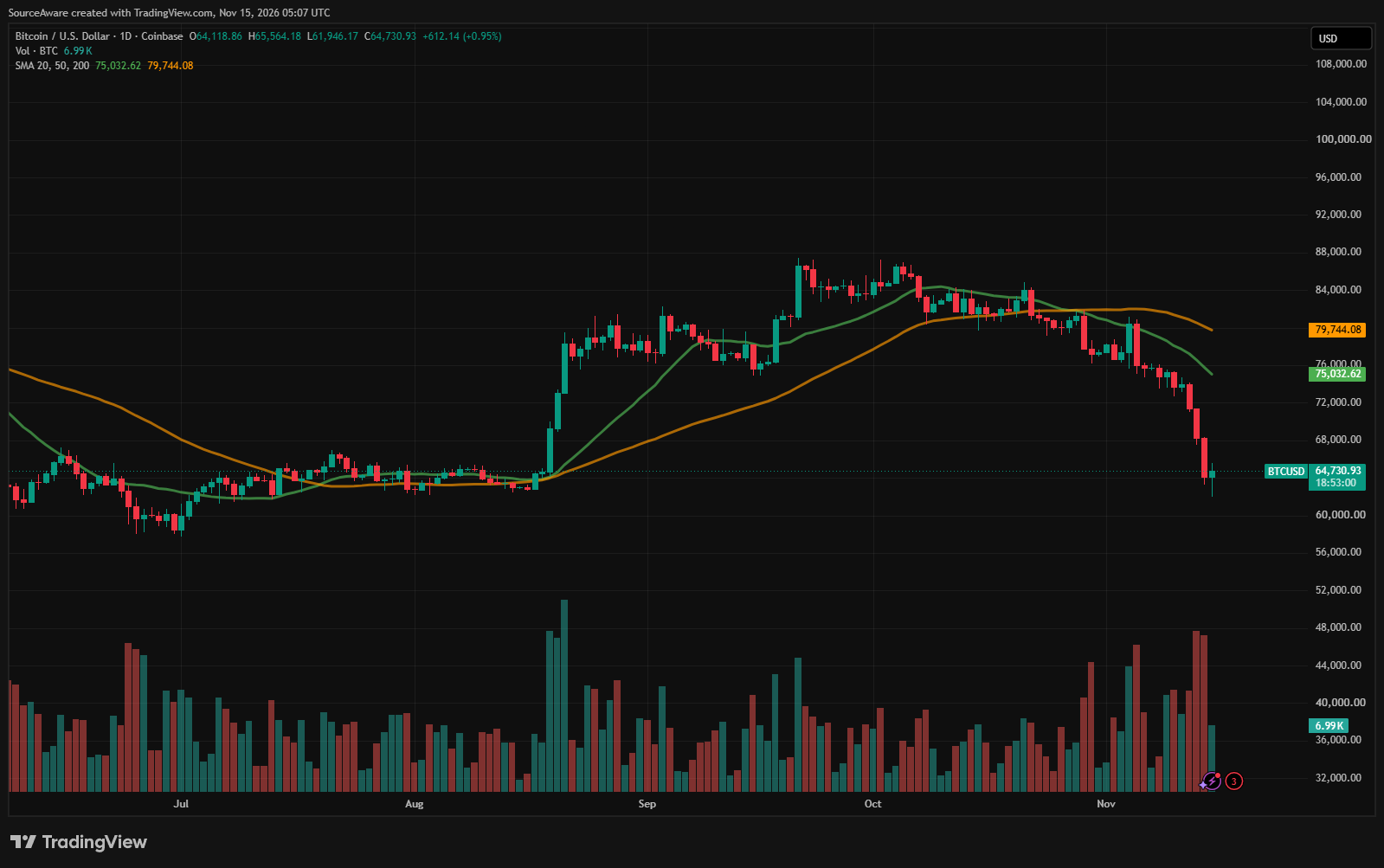
BTC/USD 1-day chart. Source: TradingView
That smaller loss made Bitcoin a relative shelter among the largest assets, slightly ahead of the cleaned market median and well ahead of Ethereum or XRP. The chart still carried substantial overhead pressure, however. Price had not reclaimed either moving average, and the weekly low near $63,270 remained the closest clear test of support. A move back through the 20-day average would be more useful evidence of repair than another week of simply falling less.
Ethereum Falls More Than 20% as It Lags Bitcoin
Ethereum opened near $2,237 and closed Saturday near $1,768, down 20.93%, with a range from $1,728 to $2,243. At the time of writing, ETH was near $1,806. Its 20-day average was around $2,162 and its 50-day average near $2,377.
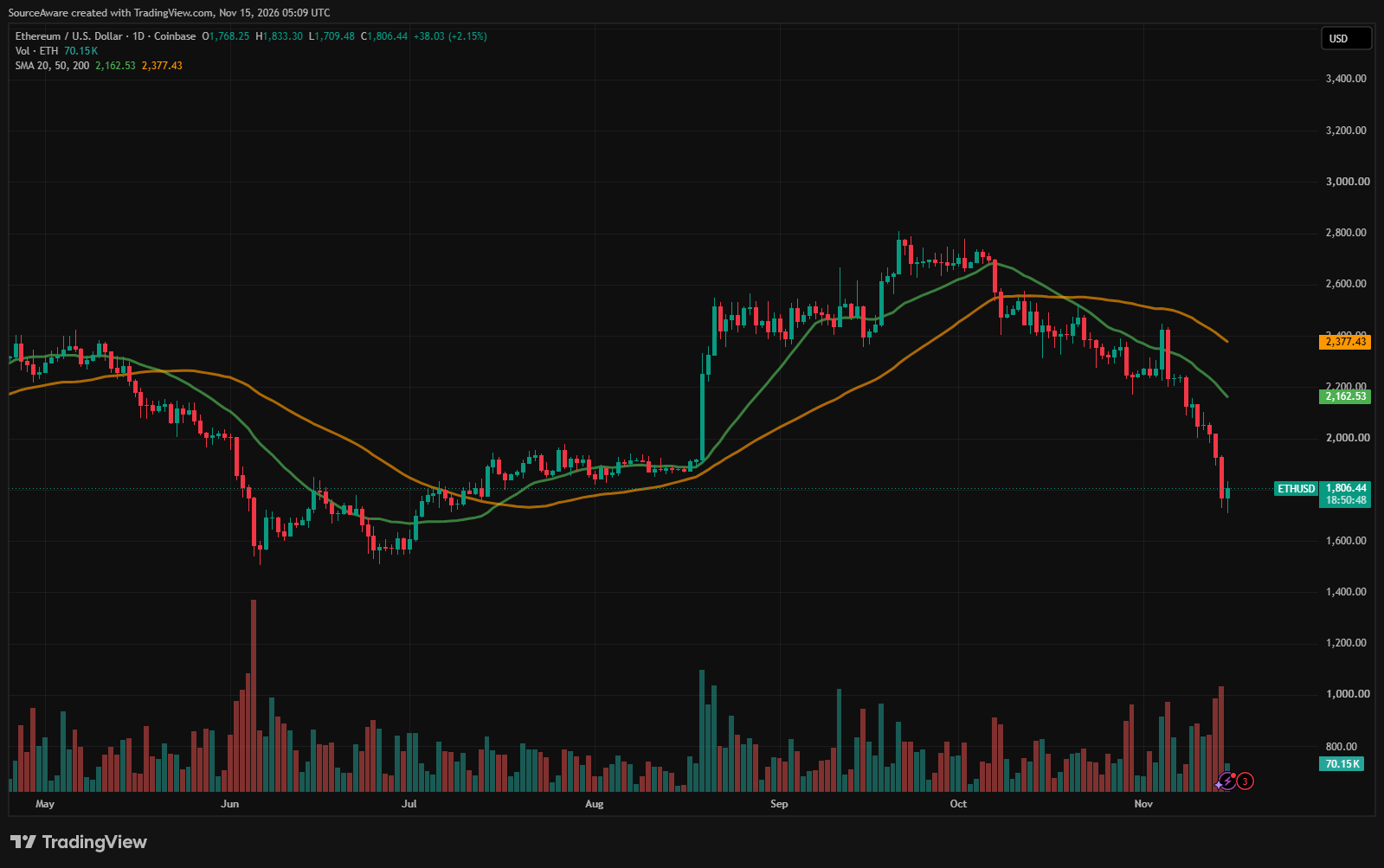
ETH/USD 1-day chart. Source: TradingView
By contrast, Ethereum's loss was more than five percentage points deeper than Bitcoin's and substantially worse than the cleaned market median. That divergence prevents Bitcoin's relative strength from becoming a broad large-cap shelter story. The weekly low near $1,728 is the immediate downside reference, while the 20-day average remains the first meaningful overhead test. Until that gap narrows, Ethereum continues to represent weakness rather than confirmation of a market repair.
AVAX Leads the Four Pairs by Losing Less, Not Gaining
AVAX was the strongest relative exception among the four pairs. It opened near $8.218 and closed Saturday near $7.104, a decline of 13.56%, after trading between $6.935 and $9.005. At the time of writing, AVAX was near $7.208, below its 20-day average around $8.332 and its 50-day average near $9.478.
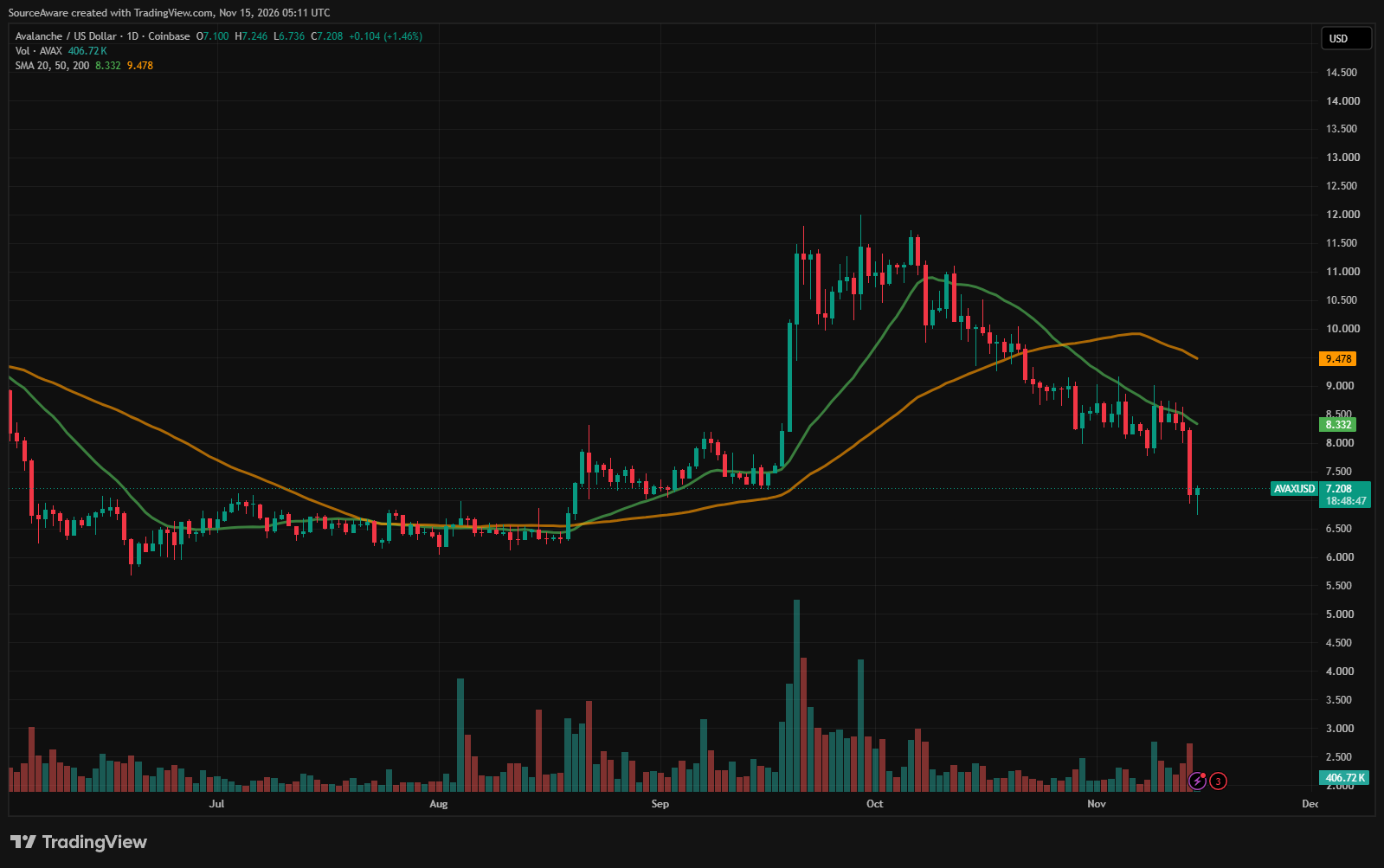
AVAX/USD 1-day chart. Source: TradingView
A loss of 13.56% is hardly a positive week, but it was shallower than the cleaned market median and nearly eight percentage points better than XRP's decline. The moving averages keep that relative strength in perspective. AVAX remained below both, and its weekly low near $6.935 is close enough to matter. Holding that low and recovering the 20-day average would make the pair's resilience more useful evidence of demand. Losing it would narrow the distinction between AVAX and the rest of the weak market.
XRP Records the Deepest Weekly Loss Among the Four Pairs
XRP opened near $1.1622 and closed Saturday near $0.9140, a decline of 21.36%. Its range ran from $0.8922 to $1.1684. At the time of writing, XRP was near $0.9703, with its 20-day average around $1.1632 and its 50-day average near $1.3005.
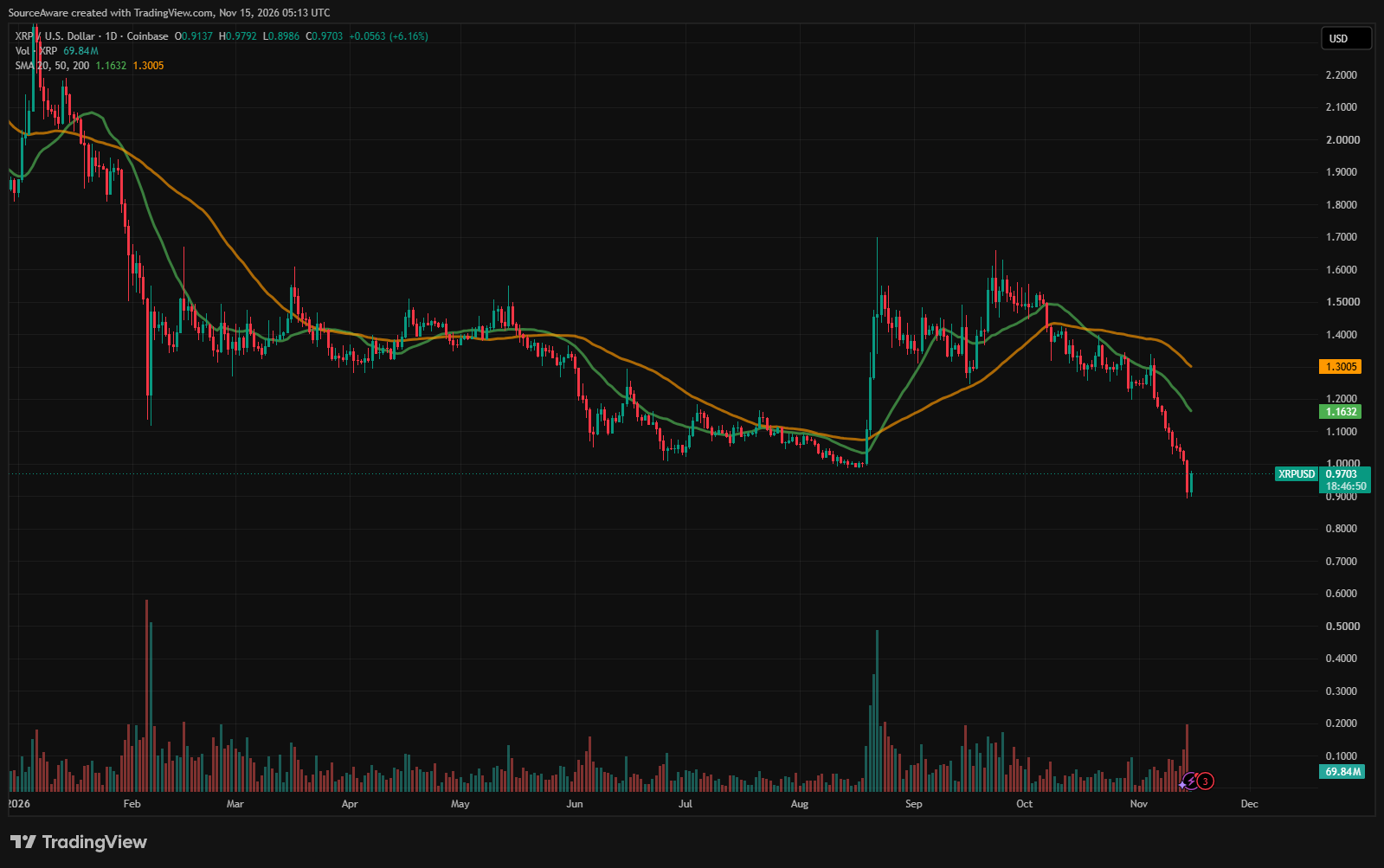
XRP/USD 1-day chart. Source: TradingView
The decline was six percentage points deeper than Bitcoin's and the weakest of the four selected pairs. XRP therefore illustrates the more damaged side of the week among established assets. Its current price had moved back above the Saturday close, but it remained below the opening level and both moving averages. Holding the weekly low would slow the deterioration. Reclaiming the 20-day average would require a much larger recovery and would carry more weight as evidence that the weaker end of the market was improving.
ETF Outflows Reinforce Signs of Weak Crypto Demand
U.S. spot Bitcoin ETFs recorded $1.07 billion in net outflows across the five completed sessions from November 9 through November 13. Spot Ethereum ETFs recorded $398.9 million in net outflows over the same period, despite a small Friday inflow. Those weekly totals moved in the same direction as price and breadth, leaving the market without a strong institutional-flow counterweight during the decline.
This flow record cannot identify what caused the selloff or whether investors were reducing long-term exposure. Its importance comes from the wider context. Negative breadth, lower stablecoin supply, and ETF outflows all describe weaker participation. Bitcoin and AVAX lost less than ETH and XRP, but their relative stability existed inside that environment rather than changing it.
The blind spot is assuming that the best-performing pairs have already found the next market direction. AVAX and Bitcoin remained below both moving averages, and each finished the seven-candle window with a double-digit loss. If the stronger charts cannot reclaim short-term levels while breadth improves, isolated resilience may remain a defensive feature rather than the start of a wider recovery.
What Would Strengthen the Case for a Broader Crypto Recovery
The broad-weakness reading would change if top 100 breadth moved closer to balance and the cleaned median began rising with the cap-weighted result. Stablecoin supply stabilizing would add another piece of evidence, especially if ETF flows returned to sustained inflows instead of producing only an occasional positive session.
The four pairs provide a second test. Bitcoin and Ethereum reclaiming their 20-day averages would show progress among the largest assets. AVAX holding its weekly low and clearing its shorter average would suggest that its relative strength was becoming more durable. XRP holding $0.8922 and narrowing the gap to its own 20-day average would show that the weaker end of the market was beginning to repair. One isolated improvement would still leave the breadth problem unresolved.
Whether Smaller Losses Can Give Way to Recovery Remains Unresolved
The coming sessions should reveal whether Bitcoin's and AVAX's smaller losses can draw participation back toward the rest of the crypto market. Better breadth would give those stronger pockets more weight. Continued ETF outflows, shrinking stablecoin supply, or new lows in ETH and XRP would keep the internal split wide.
The useful question for next week is whether several of these measures begin moving together.
Ready to trade our overview of the crypto market? Here’s our list of the best MT4 crypto brokers worth checking out.