


King Crypto's recovery is facing renewed pressure as overhead selling liquidity, absent buyers and weakening institutional demand threaten its path toward a full-blown bull run. Although buyers have supported the price around $80,000, the rebound has yet to overcome a key resistance level.
Top Regulated Brokers
Onchain data identifies potential selling pressure and liquidation clusters above the spot price, while the average cost basis of Bitcoin purchased two years ago adds another layer to Bitcoin’s upside barriers.
Meanwhile, US spot Bitcoin exchange-traded funds (ETFs) are flip-flopping between inflows and significant outflows, raising concerns about weakening institutional demand. Corporate Bitcoin treasury purchases also appear insufficient to sustain the rally.
Bitcoin’s next move will likely depend on whether fresh spot buying can absorb overhead supply and maintain support around $80,000, creating the conditions for a sustained recovery toward $90,000.
Why Bitcoin’s Recovery Is Stalling Below $87,500
Bitcoin’s recovery faces a significant obstacle between $85,000 and $87,500, where several market indicators point to concentrated selling pressure. Bitcoin’s bullishness hinges on the buyers’ ability to push it above this supply zone toward $90,000 and above.
Onchain data provider Glassnode points out that Bitcoin’s Oct. 15 decline toward $80,000 attracted buyers after briefly pushing the price below the average cost basis of US spot Bitcoin ETFs and corporate treasuries. Buying interest subsequently recovered, helping establish $80,000 as an important near-term support area.
However, the recovery has encountered a different challenge above spot price. Glassnode estimates that coins acquired six to 12 months ago have an average cost basis of approximately $86,700, down from $88,000 the previous week. Meanwhile, coins purchased one to two years ago have an average cost basis near the $100,000 psychological level.
“The first of these lines now sits inside the zone of asks and liquidation clusters near $87K,” the onchain data provider said in its latest Week On-chain report, adding:
“A daily close above $86.7K would put the 6 to 12-month buyers back in profit on average and clear the nearest band of supply overhead.”
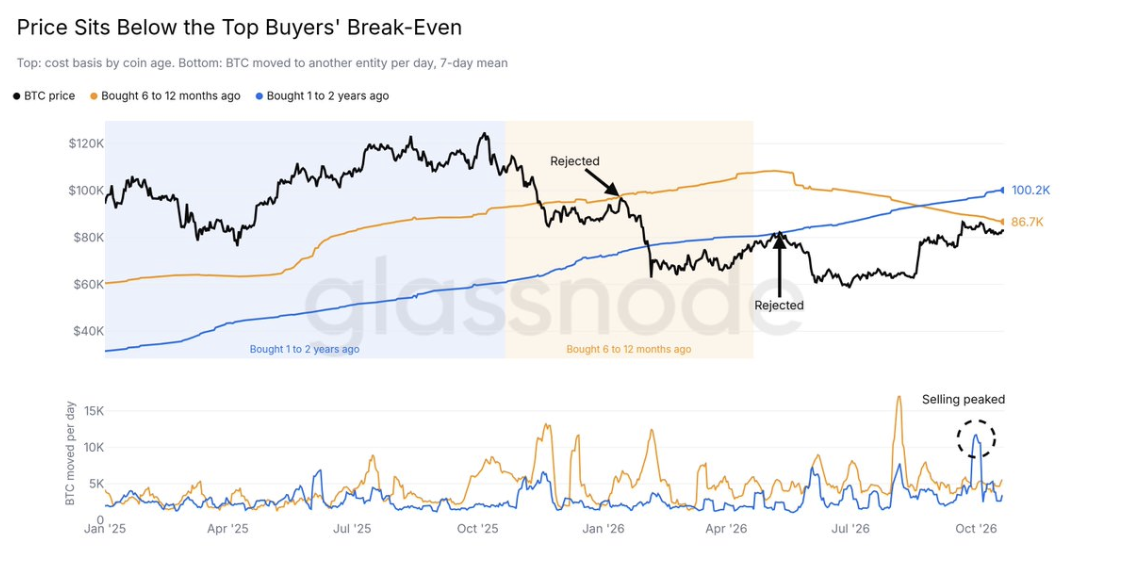
Bitcoin: Cost basis by coin age. Source: Glassnode
These cost-basis levels matter because investors who bought at higher prices may use a recovery to reduce exposure or exit near breakeven. Such behavior can introduce additional selling pressure precisely when bullish traders are attempting to push prices higher.
The $86,700 level is particularly important because it sits within the broader zone of sell orders and leveraged liquidation clusters between $85,000 and $87,500, as shown in the liquidation heatmap below.
A rally into these areas could trigger the forced closure of short positions, potentially accelerating upward momentum.
“A move toward $87K could gain speed as short positions are forced shut, but it would meet the asks on the order book at the same price,” Glassnode added.
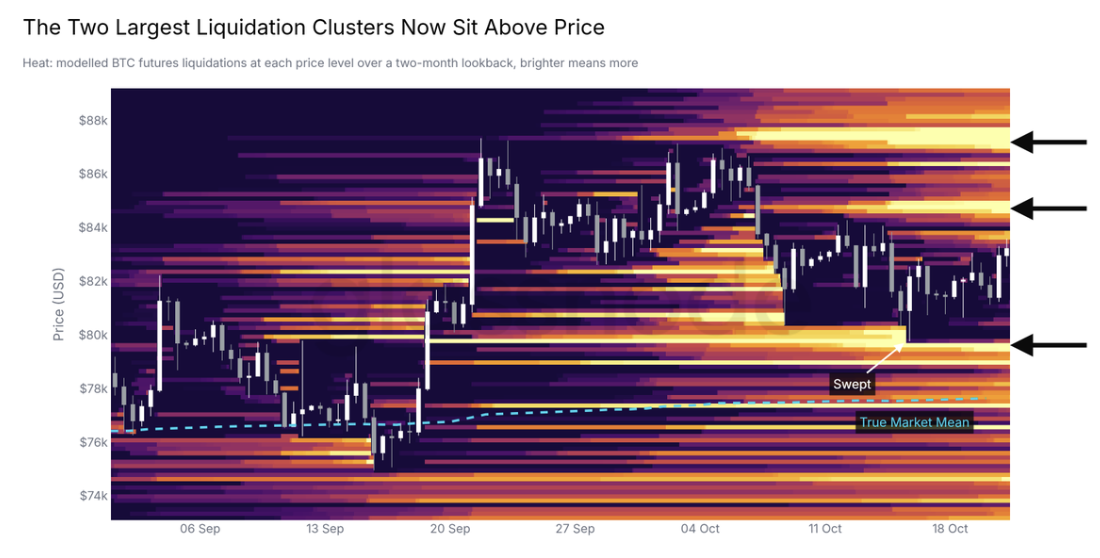
Bitcoin liquidation heatmap. Source: Glassnode
This makes the $85,000-$87,000 zone a key test of whether Bitcoin’s recovery has enough underlying demand to absorb supply. A decisive daily close above $87,500 would strengthen the case for a renewed attempt at $90,000, while a rejection could leave BTC consolidating below resistance.
The broader implication is that Bitcoin’s next advance requires more than a temporary squeeze in derivatives markets: spot buyers must absorb selling from holders looking to exit near their cost basis.
ETF Flows Leave Bitcoin’s Recovery Short of Buyers
Bitcoin’s overhead resistance becomes more difficult to overcome when fresh demand weakens. US spot Bitcoin ETF flows illustrate this challenge, with substantial withdrawals following a brief period of strong institutional buying.
Data from Farside Investors shows that flows into US-based spot Bitcoin ETFs have been shifting between inflows and outflows over the last two weeks, suggesting indecision among ETF investors.
These investment products have recorded net outflows of approximately $635.6 million on Oct. 22, followed by another $137.9 million on Oct. 23. The Thursday withdrawal more than erased the previous session’s $524.8 million inflow, while Friday’s additional outflow extended the negative streak to two sessions.
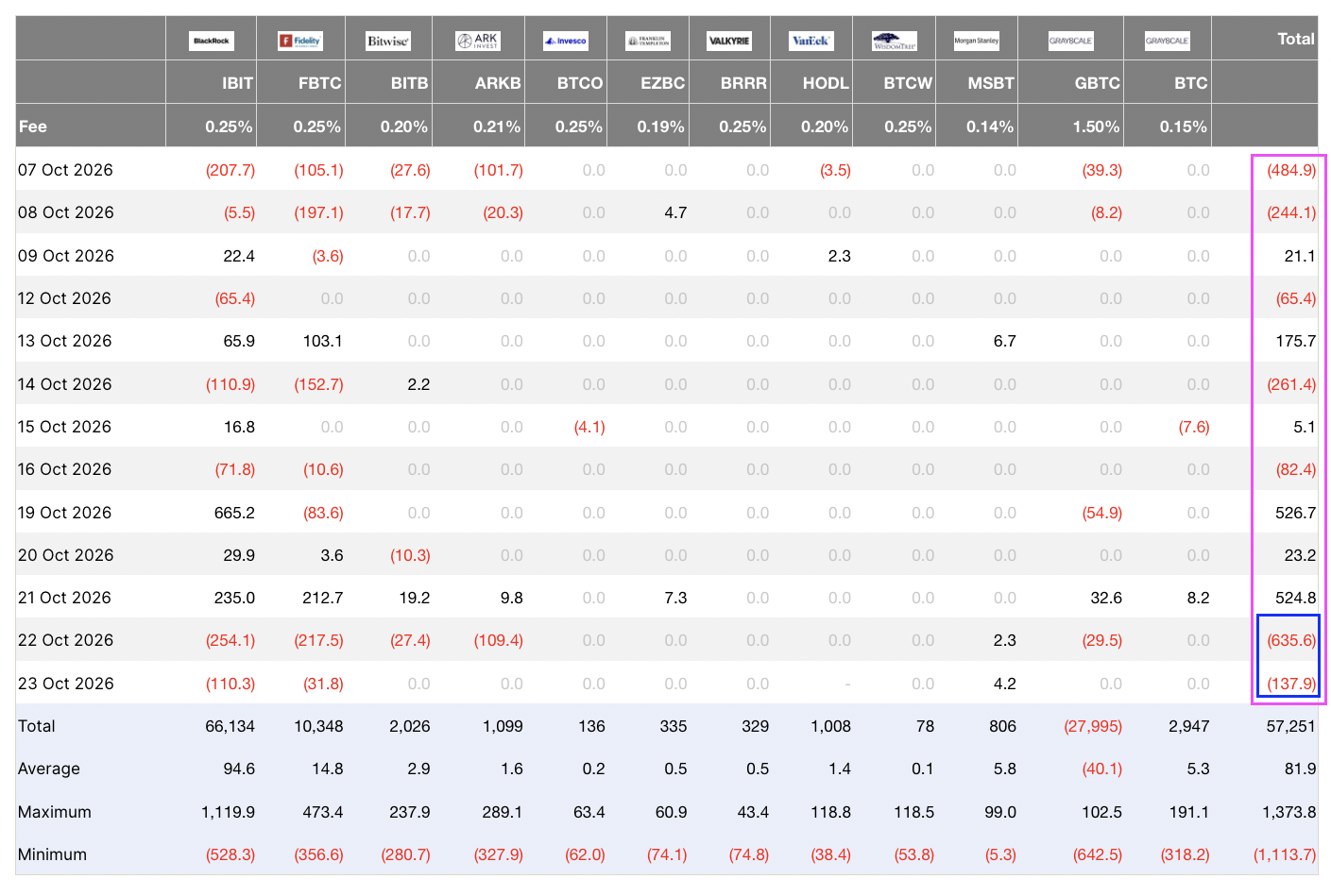
Spot Bitcoin ETF flows table. Source: Farside Investors
The reversal is significant because ETF flows are a useful measure of institutional demand for Bitcoin exposure. When inflows persist, fund purchases can support the market by adding demand for the underlying asset. Sustained outflows, by contrast, can weaken this source of buying pressure.
The broader picture is more nuanced than the two days of withdrawals alone suggest. ETF inflows on Oct. 19 and Oct. 21 reached approximately $526.7 million and $524.8 million, respectively. Despite the subsequent outflows, the four sessions from Oct. 19 through Oct. 22 still produced a combined net inflow of approximately $439.1 million.
Nevertheless, the rapid reversal highlights the instability in demand from institutions. If outflows continue, Bitcoin may struggle to absorb the sell orders clustered above the price, making a sustained breakout toward $90,000 more difficult.
Corporate treasury demand presents another potential constraint. Additional data from Glassnode indicates that Bitcoin found support around the average acquisition costs of ETFs and corporate treasuries near $80,000-$81,500.
Despite the presence of this support, treasury companies have not continued, which adds weight to BTC/USD’s inability to rise higher.

Bitcoin price vs. treasuries’ cost basis. Source: Glassnode
Note that treasury holdings and new purchases are different measures: companies can remain profitable in their Bitcoin positions without adding materially to demand. If corporate accumulation remains subdued while ETF investors withdraw capital, the market may lack the buying pressure required to overcome overhead resistance.
For Bitcoin bulls, the combination of ETF outflows and limited treasury accumulation creates an unfavourable short-term backdrop. Even if leveraged short covering pushes the price higher, that rally could fade unless sustained spot demand emerges to absorb selling from existing holders.
The next test is whether ETF flows stabilize and whether Bitcoin can hold the $80,000 support zone. A return to consistent inflows would improve the recovery outlook, while further withdrawals alongside a break below support would suggest the market remains vulnerable to another leg lower.
What Would Change Bitcoin’s Recovery Outlook
Bitcoin’s recovery remains fragile as selling pressure between $85,000 and $87,500 combines with inconsistent institutional demand. Bitcoin needs sustained spot buying to overcome overhead resistance and extend its rebound. A recovery in ETF inflows, combined with a daily close above $87,500, would improve the prospects of a move toward $90,000.
Conversely, continued institutional withdrawals and a breakdown below $80,000 could weaken bullish momentum and expose BTC to further downside. Although liquidation clusters may accelerate price movements, they do not guarantee a breakout. Until buying pressure strengthens and resistance is decisively cleared, Bitcoin remains vulnerable to rejection and further consolidation.