


Top Regulated Brokers
Precious metals face competing forces that reveal an unresolved tension between rising real yields and persistent safe-haven demand. The divergence between Federal Reserve hawkishness and European Central Bank timing creates a structural anomaly: traditional inverse relationships between dollar strength and Gold are breaking down, leaving traders uncertain which narrative will dominate. This indecision masks a deeper question about whether geopolitical risk premiums can override the gravity of higher real rates.
The Counterweight is Geopolitical Risk
The Federal Reserve's recent hawkish messaging creates an immediate headwind for Gold, as real yields climb higher on expectations for sustained rate maintenance. However, the ECB operates on a different timeline: Thursday's press conference will test whether European policymakers can afford to slow rate increases without sacrificing credibility on inflation control. This timing divergence between the Fed and ECB opens a window where EUR/USD volatility could amplify saf -haven flows into Gold. Simultaneously, Middle East geopolitical tensions sustain crude oil near $80 per barrel, embedding an inflation premium into energy markets that complicates the central bank picture. Gold absorbs this complexity - simultaneously pushed down by higher real yields and supported by persistent risk-off demand, creating a bottleneck where neither force dominates decisively.
Technical Levels and the 200-Day Moving Average
Gold's positioning below its 200-day exponential moving average at $4,680 signals that longer-term trend followers are defensive. This level functions as an institutional anchor: institutions that enter on mean-reversion signals typically establish positions once price confirms either a break below or a recapture above this zone. The $4,600 to $4,700 band represents the current battleground: $4,600 acts as behavioral support where retail and algorithmic participants tend to accumulate defensively, while $4,700 signals the threshold where institutional buyers would reassess commitment to higher prices. Volume concentration near these zones indicates order flow hesitation rather than conviction in either direction. A sustained daily close below $4,600 would indicate that real-yield gravity has overcome geopolitical support, opening downside toward $4,500. Conversely, a daily close above $4,700 would suggest that safe-haven demand is reasserting, with $4,800 as the next institutional resistance where profit-taking typically emerges.
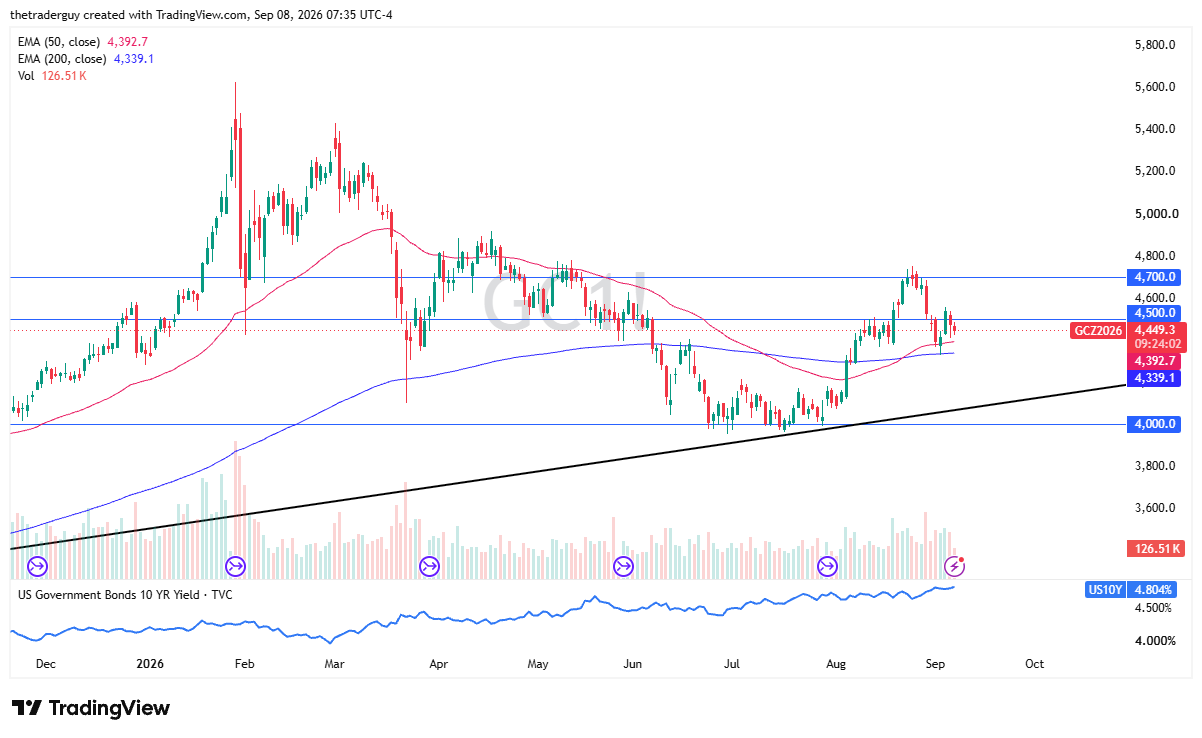
Gold Price Chart
Understanding the Rate Hike Crossfire
Central bank divergence is not abstract—it determines the allocation flow between currencies, bonds, and commodities in real time. The Fed's current trajectory points to sustained higher rates as long as labor data remains resilient, anchoring real yields at levels that historically suppress Gold valuations. The ECB, by contrast, faces political and economic constraints that may force a slower adjustment schedule: eurozone growth remains fragile, and tightening too aggressively risks a debt crisis in peripheral economies. This timing mismatch creates a capital flow vacuum. Investors rotating out of EUR-denominated assets to capture higher USD real returns depresses the euro, which should theoretically strengthen Gold (inverse currency effect). Yet Gold remains pressured, which indicates that real-yield gravity is overriding traditional currency mechanics. This inversion is the anomaly traders must resolve: either real yields fall sharply (invalidating the Fed's commitment), or geopolitical premiums collapse (removing the safe-haven bid), or Gold enters a sustained consolidation until one force breaks.
Reading Institutional Commitment Through Price Structure
Gold's technical setup reveals hesitation at multiple scales. The 200-day EMA at $4,680 represents the dividing line between institutional trend-following protocols—algorithms that respect longer-term averages often re-initiate short positions or reduce long exposure once price settles below this anchor. The $4,600 to $4,700 consolidation band is where order flow reveals the true contest: retail safe-haven demand accumulates near $4,600 (a round number that attracts algorithmic buy-stops), while institutional profit-takers establish resistance near $4,700 (where the 50-day moving average often clusters). Volume concentration in this band without directional resolution signals that large participants are positioning defensively—taking profits on rallies, covering shorts on dips—rather than committing capital in either direction. A daily close below $4,600 would constitute a structural breakdown, indicating that real-yield headwinds have eroded the safe-haven thesis enough to trigger systematic de-risking. A daily close above $4,700 would signal institutional conviction that geopolitical premiums and portfolio hedging demand justify holding Gold despite higher rates.
The Dollar Weakness Trap
Market consensus assumes that if USD real yields stabilize and the dollar appreciates, Gold should decline—a relationship that has held for decades. Yet Gold remains supported near key levels despite dollar strength, which suggests consensus is underestimating the force of geopolitical safe-haven flows. This divergence masks a vulnerability: retail traders and many discretionary managers are betting on a dollar rally to eventually break Gold lower, but they may be misinterpreting the timing and magnitude of real-yield repricing. If the Fed maintains hawkishness for longer than markets currently price (pushing real yields even higher), the consensus trade (long dollar, short Gold) becomes crowded, and a reversal in Fed expectations could trigger violent unwinding. Alternatively, if Middle East tensions escalate materially or credit stress emerges elsewhere, the safe-haven bid could overwhelm real-yield headwinds, surprising bullish traders who have been too patient. The trap: positioning is divided between mean-reversion buyers (betting on a Gold bounce as rates stabilize) and structural bearish shorts (betting that real yields permanently depress Gold). This split indicates neither group is confident, which points to a bottleneck resolution ahead.
When the Thesis Breaks
The sideways consolidation narrative invalidates immediately under three conditions. First, a decisive daily close below $4,600 would signal that real-yield gravity has overcome geopolitical support decisively, breaking the technical anchor and likely extending declines toward $4,500 and $4,450 on an intraday basis. Second, should the ECB press conference on Thursday deliver surprising hawkishness (matching or exceeding Fed messaging), the divergence thesis collapses, and rate expectations repricing would crush the safe haven bid rapidly. Third, if Friday's CPI print comes in materially below consensus (suggesting inflation progress and lower rate duration), real yields could compress sharply, which would validate upside movement above $4,700 toward $4,800. Conversely, a CPI print significantly above expectations would reinforce Fed credibility on rate maintenance, likely pushing Gold below $4,600 as real yields spike. The key invalidation window is Thursday–Friday: a combination of dovish ECB language and weak CPI data would force the consolidation thesis to break upward; hawkish ECB plus hot CPI would break it downward.
Gold consolidates between competing central bank rate trajectories and persistent geopolitical safe-haven demand, with institutional commitment divided between real-yield bearishness and risk-off support. The technical setup at the 200-day EMA and the $4,600–$4,700 band masks an unresolved friction: whether the Fed's hawkishness will sustain long enough to override geopolitical premiums, or whether escalating Middle East tensions will reassert safe-haven demand before rate expectations stabilize. Thursday's ECB press conference and Friday's CPI print will signal which force prevails—and whether Gold breaks decisively from its current range or extends consolidation into early next week.
Ready to trade our Gold analysis? Here is our list of the best Gold brokers worth checking out.