


Top Regulated Brokers
The precious metal has found some buyers again, but this is not necessarily a market that has suddenly become easy to read. The biggest central bank events have passed, removing one layer of uncertainty, yet the forces that matter most for Gold are still very much in play.
The recent selling pressure has eased, and traders are now watching to see whether the market can build on that resilience. With the Federal Reserve, Bank of Japan, and Bank of England decisions behind us, attention is shifting back to interest rates, the U.S. dollar, and the geopolitical backdrop.
That change in focus could give Gold a chance to challenge resistance, but it also leaves plenty of room for volatility as the market heads into the weekend.
Central Banks Leave a Mixed Signal
The Federal Reserve is now out of the way, which removes the immediate risk of a surprise change in its policy message. Gold has responded by attracting buyers after its earlier pullback, as traders no longer have to position around that particular event.
The Bank of Japan also raised rates, but the decision was not unanimous. The 7-2 vote did not carry the aggressively hawkish tone that some market participants had feared. That matters because a more forceful signal from Japan could have created concerns about tighter global liquidity and pressured risk-sensitive markets.
Meanwhile, the Bank of England left rates unchanged, as expected. With those decisions absorbed, Gold is once again behaving like an asset focused heavily on the interest-rate environment.
The 4,500 Level Draws Attention
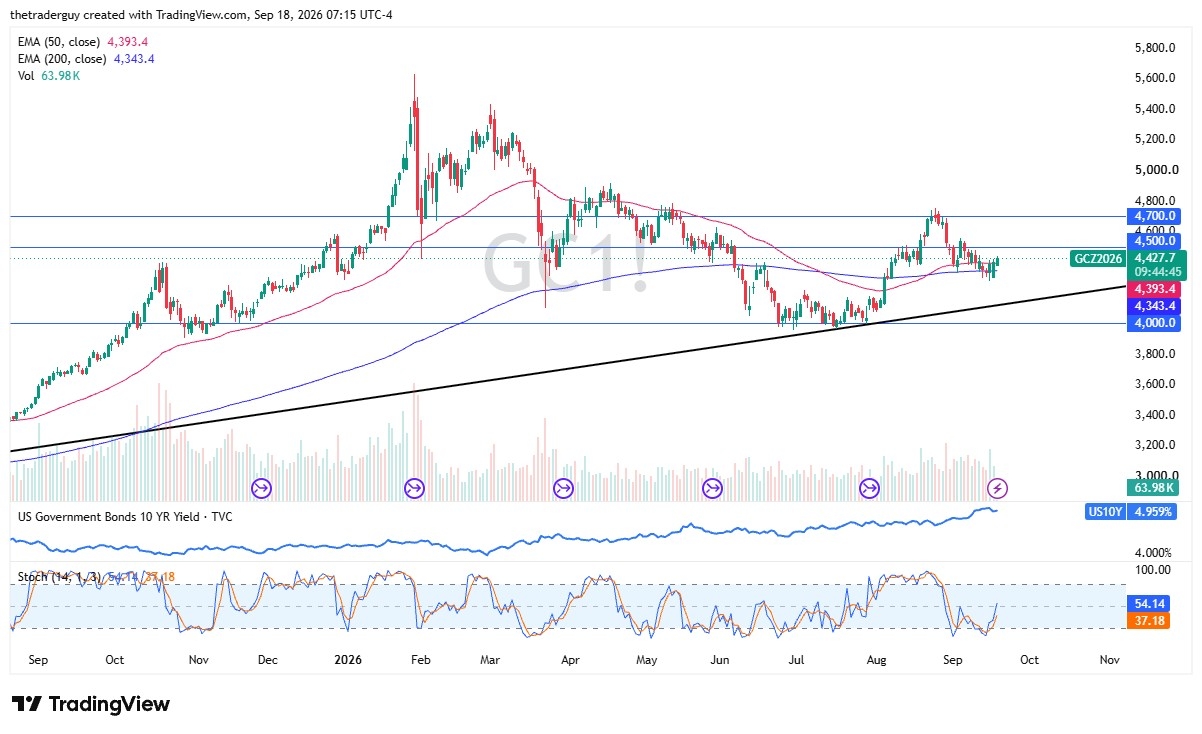
The 4,500 level remains the obvious technical barrier. It has been difficult for Gold to clear for some time, and a test of that area looks increasingly likely if buyers can maintain control.
A sustained move above 4,500 could open the door to a much stronger advance. Until that happens, the more practical near-term setup may be a buy-the-dip market, provided that support continues to hold.
The 200-day EMA is acting as a short-term floor. If Gold breaks below this week’s lows, however, the market could drift lower toward the prior uptrend line. That is the key downside scenario to monitor.
Gold Price Chart
Yields Still Create a Headwind
Gold will continue to pay close attention to the bond market. Elevated interest rates remain a headwind, because they increase the appeal of yield-bearing assets relative to holding metal.
The 10-year Treasury yield is particularly important. If it can remain below 5%, that could give Gold some breathing room. A renewed push higher in yields, on the other hand, would make it more difficult for the metal to sustain any rally.
Geopolitics and the Dollar Matter Too
Headlines from the Middle East remain another major consideration. Traders should not automatically assume that geopolitical tension will send Gold higher. If energy-inflation fears push yields upward, the reaction can be more complicated than a simple flight to safety.
The U.S. dollar is equally important. Gold and the dollar can rise together, so the reason behind dollar strength matters. A move driven by interest-rate differentials, including flows in pairs such as USD/CHF, is different from a broad rush into the dollar for safety.
For now, Gold looks capable of staging a showdown near 4,500. The path will remain noisy, with yields, the dollar, and geopolitical developments all competing to dictate the next move.
Ready to trade our Gold analysis? Here is our list of the best Gold brokers worth checking out.