


Gold faces an identity crisis. Rising US rates were supposed to weaken it, yet persistent geopolitical tensions suggest it should be rallying as a refuge. The market is torn between two competing truths: real yields acting as a structural headwind, and safe-haven demand fighting to keep the precious metal afloat, leaving traders vulnerable to whipsaw moves and technical breakdown.
Top Regulated Brokers
Market Context and Fed Repricing
Gold is testing the 200-day EMA at a critical juncture. Following Fed communications at Jackson Hole, particularly Vice Chair Warsh's flat-out denial of rate-cut urgency, the market has shifted its forward repricing toward a hold-pause regime. Real yields on 10-year Treasuries remain elevated, creating a structural drag that amplifies the cost of holding non-yielding assets. This repricing dynamic has coincided with a pullback in safe-haven inflows, exposing a vulnerability that traders assumed was protected by geopolitical risk premiums.
Technical Setup and Price Action
The big story this week will be the jobs number in the United States, and it's very possible that we are in a bit of a holding pattern because of that. We have certainly seen the stock market act like that recently, and as a result, it would not be a huge surprise to see some other markets, such as the gold market, behave in that manner.
The alternative scenario is we get a sudden headline that really gives the market a jolt. More likely than not, that headline will come out of the Middle Eastern conflict, but only time will tell if and when that happens. The market remains one that is going to be choppy and somewhat uncertain, and in this environment, with worries about inflation and higher rates, it is a bit of a drag on gold at the precise moment many traders believe that it should be thought of as a safety asset. This has been a major point of contention recently, as we see a bit of “push-pull” behavior.
Bond markets run everything, and I think a lot of traders right now are learning that lesson. The bond market is by far the most important market, and as long as those rates continue to rise, it does make a long-term, sustained bullish run in gold difficult, but there are plenty of safety concerns at the same time, so confusion and choppiness will, more likely than not, remain the scenario for this market, as it is trying to sort out which of the two main drivers are going to win the day.
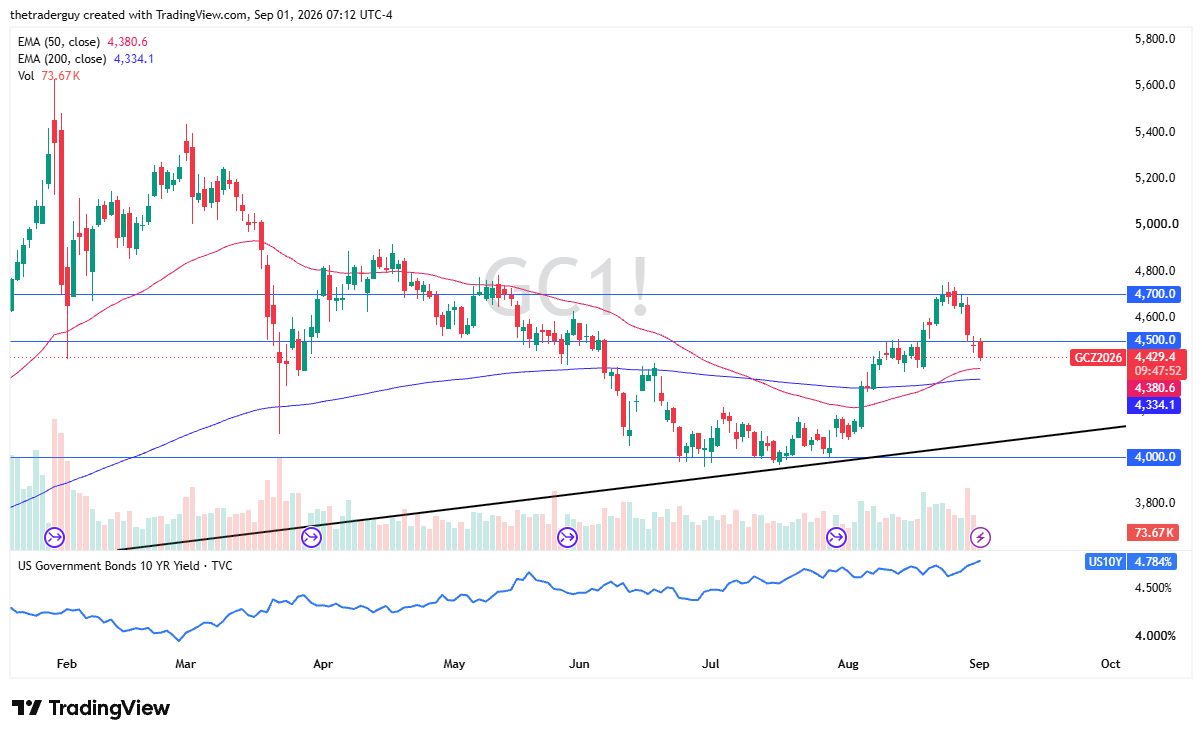 Gold Price Chart
The Push-Pull Dynamic
The push-pull dynamic masks a critical vulnerability: traders treat gold as a binary hedge against Fed easing, assuming rising rates are supposed to break that thesis decisively. Yet persistent Middle East tensions and European security concerns obscure the calculus. If Middle East escalation sharpens quickly - a risk that remains elevated despite recent headlines fading - safe-haven demand could overwhelm the Fed tightness narrative in a matter of hours. This mismatch leaves consensus positioned for a rate-driven selloff while remaining dangerously exposed to a geopolitical shock that reverses the tape entirely.
Real Yield Headwinds and Investor Sentiment
Real yields on the 10-year Treasury have climbed above 2.2%, a level that makes duration-hedging through gold mathematically unfavorable compared to rolling short-dated Treasuries. This calculus is what institutional asset allocators are following, and it has accelerated the rotation out of commodity hedges. The second-order effect is more insidious: as fixed-income becomes attractive on absolute value grounds, the urgency to maintain gold positions as inflation insurance diminishes. This dynamic suggests that unless inflation data surprises to the upside, or real yields compress, gold will struggle to recapture the narrative momentum that carried it to all-time highs earlier this year.
H2 Invalidation Parameters: Where the Thesis Breaks
The bearish technical thesis becomes invalid if price action makes a strongly bullish rejection of the 200-day EMA on elevated volume. Such a move would signal that institutional accumulation has resumed despite elevated real yields, suggesting geopolitical premium is dominating the rate narrative. Conversely, confirmation of weakness would come from a sustained break below $4,300 area, which would break all the major EMAs and reset tactical positioning toward a deeper pullback. Watch for this invalidation to potentially occur during Asian trade following any significant geopolitical headlines or ahead of Friday's non-farm payroll print, which could re-stoke Fed pivot speculation and reverse the current rate-driven consensus.
Gold's near-term trajectory hinges on whether real yield headwinds or geopolitical risk-off demand dominates trader positioning through Friday's non-farm payroll release. The technical breakdown risk at the 200-day EMA reflects this unresolved structural conflict, and the next catalyst will likely come from either an economic data surprise that restokes Fed pivot talk, or a headline-driven geopolitical shock that overrides rate-driven logic. Watch for invalidation signals during Asian and London trading sessions this week: a failure to hold the 200-day EMA would confirm bearish momentum, while a close above it would suggest institutional support is reemerging despite the real yield headwind.
Ready to trade our Gold analysis? Here is our list of the best Gold brokers worth reviewing.