


Top Regulated Brokers
This currency pair is caught in a familiar trap: two major central banks preparing hawkish moves on opposite shores, leaving the currency pair unable to commit to a direction. This structural friction ignites genuine uncertainty about which policy signal will dominate. Traders reassessing positions after the holiday break face a market where traditional rate-carry dynamics have been neutralized by simultaneous repricing expectations on both sides of the Atlantic.
Technical Setup
EUR/USD consolidation near key moving-average confluences reflects a rare institutional stalemate: the ECB is widely expected to raise rates Thursday in response to persistent eurozone inflation, while concurrent US payroll strength has reignited Fed hike bets for next week. This dual hawkish repricing has neutralized the traditional euro strength thesis, trapping the pair in a narrow range where neither fundamental nor technical conviction can take hold. The consolidation masks a deeper anomaly: the market cannot simultaneously price in tighter ECB policy and a hotter US rate outlook without one counterbalancing the other.
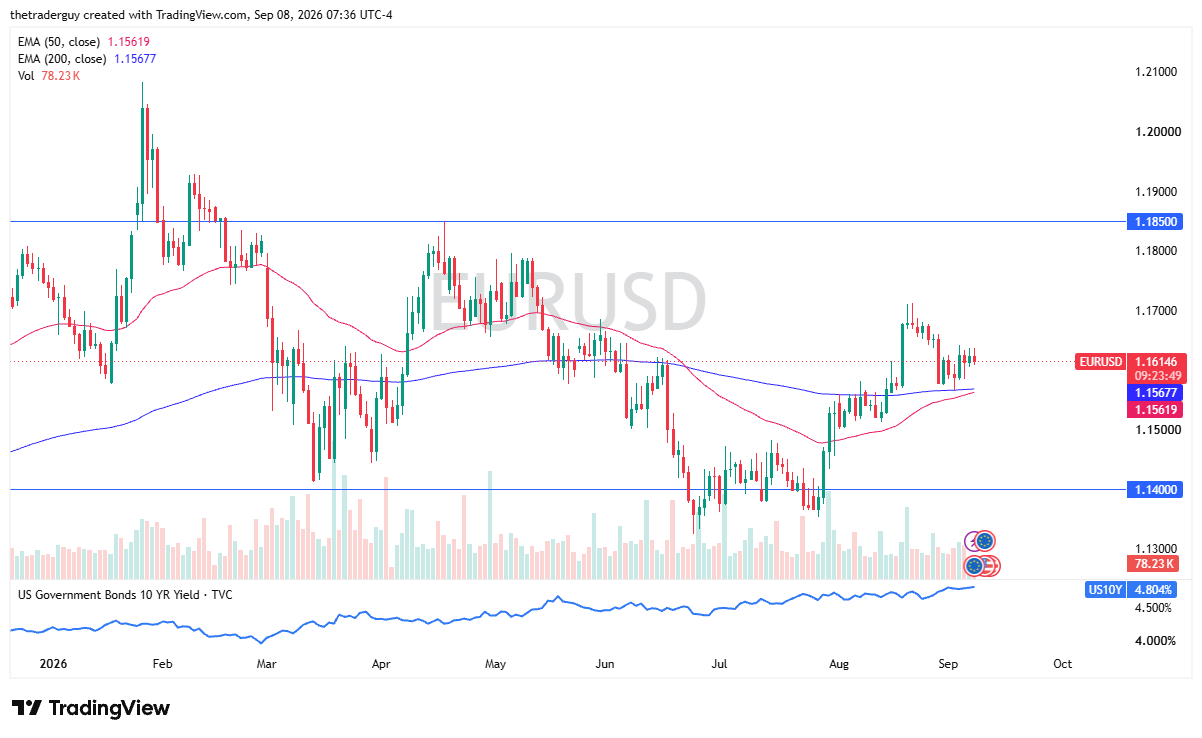 EUR/USD Price Chart
Why Dual Hawkish Repricing Creates Structural Friction
EUR/USD's consolidation points to a macro fault line that has become increasingly difficult for markets to navigate. Both the ECB and Fed face genuine inflation pressures that demand tighter policy, yet the synchronized timing of their hawkish repositioning creates a pricing paradox: traditional euro strength on rate differentials depends on the ECB moving faster or further than the Fed, but current expectations price in nearly parallel tightening cycles. This mismatch between the narrative (ECB hawkish, Fed hawkish) and the market structure (neither can definitively outpace the other) indicates a vulnerability in consensus positioning. Capital flows that typically follow rate differentials face conflicting signals, leaving institutional traders uncertain whether to rotate into euro assets or hold dollar exposure. The result is consolidation that masks genuine repricing confusion rather than reflecting true equilibrium.
Moving Averages and the Gridlock Zone
EUR/USD's positioning near both the 200-day and 50-day exponential moving averages is not coincidental—it signals institutional indecision about the intermediate trend. When a major currency pair trades within the arms of two primary moving averages, it typically indicates that neither bulls nor bears command sufficient conviction to push through. Volume dynamics in recent sessions have been muted, suggesting limited institutional commitment to either direction. The pair has consistently failed to sustain moves above 1.1050 or below 1.0950, creating a 100-pip gridlock zone that has persisted across multiple trading sessions. This narrow range, combined with low volatility, suggests that market participants are positioning defensively ahead of Thursday's ECB event—a classic behavior pattern when a headline catalyst is known but its outcome remains uncertain.
The Trap: Consensus Hawkishness vs. Forward Guidance Risk
Retail and institutional consensus has already priced in both the ECB hike and the Fed hike—this collective hawkishness masks a critical vulnerability. What remains unpriced is the forward guidance divergence: if either central bank signals a pause or shift in subsequent tightening, the entire consolidated positioning will unwind violently. The ECB press conference Thursday carries outsized risk because Lagarde's tone on future rate moves could contradict the market's assumption of a mechanical tightening cycle. Similarly, Fed speakers this week could hint at a terminal rate lower than currently expected, triggering a dollar reversal that would catch long-USD positioning off guard. The consolidation itself suggests anomalous complacency—traders are comfortable holding narrow positions precisely because hawkish outcomes are 'expected,' creating a blind spot to the dovish deviation risk that would trigger the sharpest moves.
When the Consolidation Thesis Breaks
The tight consolidation narrative depends on price action remaining bound within technical and fundamental guardrails. Should EUR/USD decisively clear 1.1050 on a daily close—a move that would signal institutional buying confidence ahead of the ECB—the bullish consolidation thesis would be invalidated and upside acceleration likely. Conversely, a breakdown below 1.0950 with a confirmed daily close would indicate that dovish forward guidance fears or unexpected hawkish Fed signals have overwhelmed the expected ECB hike. Either breach would require a fundamental catalyst: a surprise ECB dovish signal, unexpected US CPI weakness, or Fed commentary suggesting a slower tightening pace. Until one of these conditions materializes or price action delivers a decisive directional close outside the 1.0950–1.1050 range, the consolidation thesis remains intact. Watch for volume confirmation on any attempted breakout—thin volume would suggest a false breakout likely to reverse.
EUR/USD consolidation reflects genuine policy gridlock - simultaneous hawkish repricing on both sides of the Atlantic has neutralized traditional rate-carry dynamics and trapped the pair near key moving-average confluences. Thursday's ECB press conference and subsequent price reaction will test whether institutional conviction exists to break above 1.1050 or below 1.0950; forward guidance divergence on either side of the Atlantic could trigger violent unwinding of the current gridlock. The next 48 hours will reveal whether the consolidation holds or begins to crack under the weight of conflicting central bank signals.
Ready to trade our EUR/USD analysis? Here is our list of the best brokers worth reviewing.