


Top Regulated Brokers
This currency pair’s recent weakness has not arrived with the usual sense of panic. Instead, EUR/USD has moved lower as markets adjust to a more demanding backdrop: a Federal Reserve that sounded firmer on inflation, a dollar supported by higher US yields, and fresh uncertainty around the outlook for Europe. The pair is now testing whether an area traders had expected to hold can still provide a meaningful floor.
That makes the present pause more interesting than it first appears. A modest rebound is developing after a sharp move, but the wider message from the market remains cautious. The question is not simply whether EUR/USD can bounce; it is whether a short-term recovery can alter the assumptions that pushed the pair lower in the first place.
For now, the market appears caught between two competing forces: a dollar that has regained support from monetary-policy expectations and a euro that may be stretched after a quick decline. That tension is likely to define the next phase of trading.
Why the Setup Matters Now
The immediate change came from the Federal Reserve’s latest communication. Although the interest-rate increase itself had been widely anticipated, the accompanying tone was more hawkish than many participants expected. That shift strengthened the US dollar and reinforced the view that policy may need to remain restrictive for longer if inflation proves difficult to contain.
US Treasury yields remain an important part of that adjustment. The 10-year yield has continued to trade just below the closely watched 5% area, leaving the yield differential supportive of the dollar. When US yields remain elevated relative to alternatives, investors have a clearer incentive to hold dollar-denominated assets, and that can weigh on EUR/USD even without a new euro-specific catalyst.
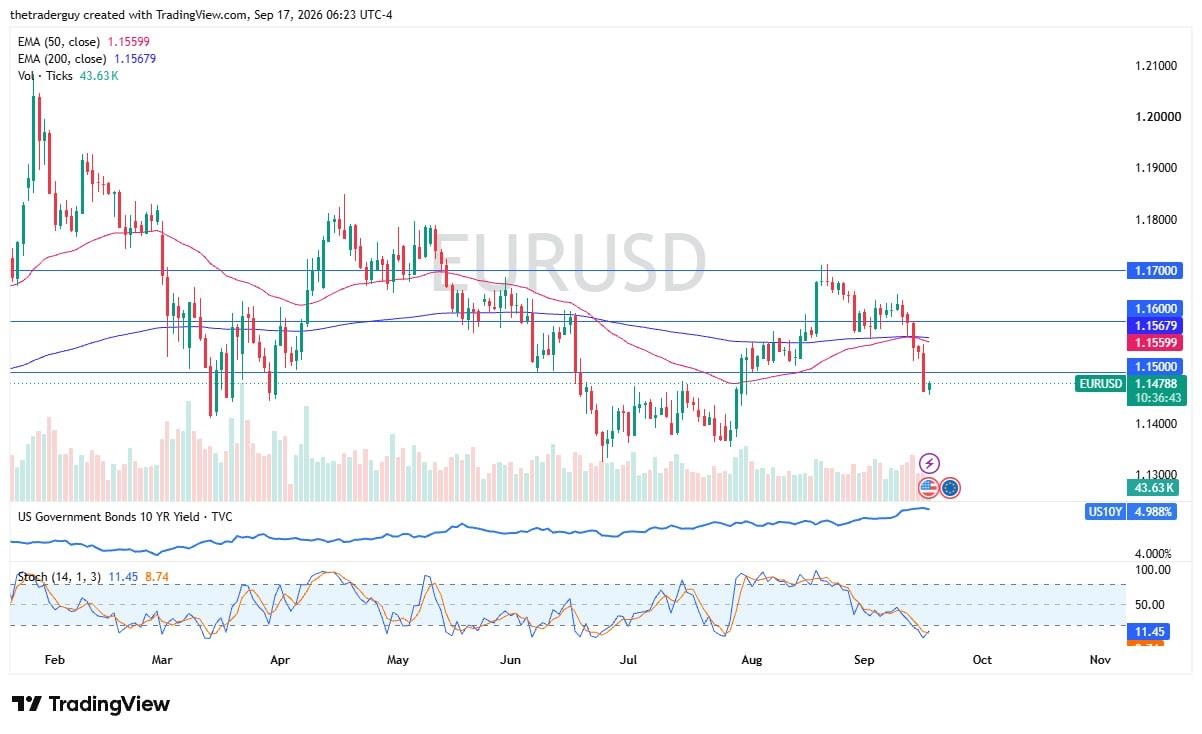
The move also matters because EUR/USD slipped below the 1.1500 area following the press conference. That level had been viewed as a meaningful support zone by many market participants. A break beneath a widely watched level does not settle the outlook on its own, but it changes the market’s reference point: buyers now need to show that the decline was temporary, while sellers can point to a loss of near-term technical support.
Price Action Shows a Market Seeking Balance
EUR/USD has begun to bounce slightly after the post-Fed decline, which is understandable following a fast move lower. The short-term price action suggests that the market may be somewhat oversold, and periods of consolidation or a partial recovery can develop when sellers have already acted aggressively. That does not necessarily signal a durable trend reversal.
The more important observation is the contrast between the short-term bounce and the broader direction. The dollar’s advance was driven by a reassessment of policy expectations rather than by a single isolated chart pattern. As long as traders continue to believe that US rates can remain high, the dollar retains a fundamental advantage. A recovery in EUR/USD would therefore need to be judged by its quality: whether it attracts sustained participation and reclaims important territory, rather than merely retracing part of the earlier fall.
There is also a substantial support area below current prices. That may make sellers less willing to pursue the move lower without confirmation, while it gives buyers a reason to test whether the market has already discounted enough negative news. This combination can produce uneven, sometimes hesitant trading rather than a clean continuation in either direction.
EUR/USD Price Chart
The Risk May Be Overconfidence in the Dollar
The most overlooked risk may be the assumption that a hawkish Fed automatically leaves no room for the euro to recover. Markets often move most decisively when a new narrative first takes hold, then become more selective once that narrative is widely accepted. With the dollar already strengthened by higher-rate expectations, incoming information has to continue validating that view if the move is to extend smoothly.
There are questions on the US side as well. The Fed’s ability to maintain a restrictive path depends not only on inflation but also on how the US economy responds to higher borrowing costs. If growth were to cool more noticeably, traders might reassess how far further tightening can realistically go. That would not remove inflation concerns, but it could alter the balance that currently favours the dollar.
At the same time, energy inflation and geopolitical headlines complicate the picture rather than producing a simple one-way result. Higher energy costs are a particular concern for Europe because they can pressure growth and confidence. Yet a meaningful easing of Middle East tensions, or an improvement in the energy outlook, could reduce part of that burden and prompt markets to revisit some of their pessimism toward the euro.
What Could Change the EUR/USD View
A more sustained recovery would require more than a brief oversold bounce. EUR/USD would need to regain lost ground with enough consistency to show that the break below 1.1500 did not create lasting seller control. Evidence of softer US yield pressure, less-hawkish signals from Federal Reserve officials, or a broader improvement in risk appetite could all make that outcome more plausible.
Conversely, renewed strength in US yields, firmer inflation concerns, or signs that Europe’s energy and growth challenges are deepening would keep the pressure on the pair. The European Central Bank has also sounded relatively hawkish, but the market is weighing that stance against the region’s more fragile growth outlook. The difference between policy intent and economic capacity remains central to the euro’s outlook.
What Traders Are Watching Next
The next sessions are likely to keep attention on US interest rates, comments from Federal Reserve officials, and developments affecting energy markets and the Middle East. Each has the potential to influence the confidence behind the dollar’s recent advance.
For EUR/USD, the key issue is whether the current stabilization develops into a more convincing recovery or simply gives the market time to reassess before pressure returns. The answer may emerge gradually, through the interaction of yields, risk sentiment, and the market’s response to the support area now under scrutiny.
Ready to trade our EUR/USD analysis? Here is our list of the best brokers worth reviewing.