


Top Regulated Brokers
This currency pair finds itself caught between two competing forces, unable to sustain momentum in either direction. This structural equilibrium reflects genuine uncertainty around whether the European Central Bank will reinforce or undermine euro strength relative to anticipated Federal Reserve easing, creating a bottleneck that masks where real vulnerability lies beneath current price consolidation.
The ECB's policy stance Thursday stands as the primary structural catalyst driving directional friction in EUR/USD. Institutional capital faces genuine uncertainty: a dovish pivot toward rate cuts would weaken the euro relative to the Fed's anticipated easing next week, while a hawkish hold reinforces euro strength and widens the rate differential in favor of European assets. This binary outcome hinges on messaging clarity that will determine whether near-term positioning unwinds or extends. The decision represents a critical inflection point for institutional capital allocation across major currency pairs and signals how much of the current consolidation reflects price discovery versus consensus consensus hedging.
Technical Structures and Current Price Dynamics
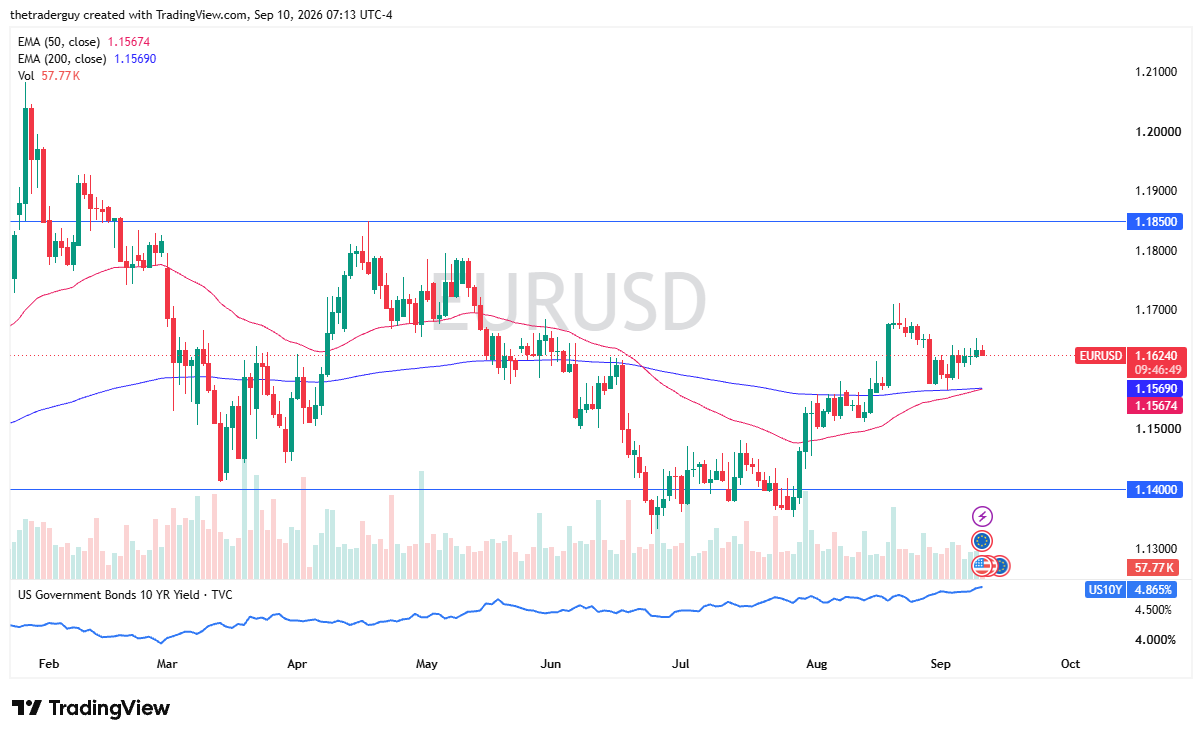
EUR/USD consolidates within a defined technical band, reflecting the market's hesitation before structural clarity arrives. The 50-day EMA establishes intermediate support, while the 200-day EMA forms a deeper anchor below current price action. Recent oscillations within these bands suggest institutional traders have already positioned for multiple scenarios, masking which outcome the market is actually pricing into current consolidation. Volume remains subdued across sessions, indicating capital is standing aside rather than committing fresh positions. This low-conviction structure creates vulnerability: if ECB messaging proves more decisive than consensus expects, real momentum could follow the initial directional trigger.
EUR/USD Price Chart
Monetary Policy Divergence as Structural Anchor
The ECB and Federal Reserve face divergent economic pressures that create friction across capital markets and currency flows. While the Fed has already begun easing expectations, the ECB has historically lagged in pivot timing, creating a policy lag that institutional investors use to position euro exposure. This divergence matters structurally because rate differentials drive carry trade positioning and reserve currency allocation decisions. When the ECB signals dovish intent, European yields compress relative to US yields, triggering a rotation out of euro-denominated assets. Conversely, a hawkish hold maintains the current rate premium and sustains euro demand. The current consolidation in EUR/USD indicates that capital is genuinely uncertain which direction the divergence will favor, masking the true direction of institutional flows beneath current price equilibrium.
Consensus Expectation Trap
Market positioning ahead of the ECB suggests a dangerous consensus: most traders expect a dovish signal that weakens the euro, but recent volatility and subdued volume indicate institutional players may have already hedged or unwound this positioning. This creates an anomaly—if consensus is fully priced into current price structure, then the real risk lies in a hawkish surprise or a dovish announcement that fails to trigger the expected weakness. The vulnerability masks beneath the surface: EUR/USD could gap higher on an ECB hold because short positioning may be crowded at current levels, or it could collapse on dovish clarity if the market has already discounted the move. Current consolidation suggests the market is uncertain which outcome has been priced in, exposing traders to gap risk in either direction on Thursday's announcement.
When the Setup Breaks
Should price action deliver a decisive daily close below the 200-day EMA at 1.1550, the current upside bias would be invalidated and expose the pair to deeper structural weakness. A close below this level would signal that institutional positioning ahead of the ECB has rotated decisively toward downside protection, contradicting consensus expectations for a hawkish hold. This represents the only scenario that would negate the current technical setup and trigger meaningful directional momentum lower.
EUR/USD consolidates within a technical band that masks genuine uncertainty around Thursday's ECB decision. The pair reflects the market's struggle to price whether divergence between European and US monetary policy will strengthen or weaken the euro, with key invalidation levels at 1.1550 (downside) and 1.1700 (upside). Traders should monitor the ECB announcement and intraday price action through the New York session close, as directional conviction that emerges Thursday will likely signal whether capital is rotating into or out of euro positioning.
Ready to trade our EUR/USD analysis? Here is our list of the best brokers worth checking out.