


Top Regulated Brokers
A widening divergence between Fed hawkishness and ECB accommodation masks a critical vulnerability in euro positioning ahead of Friday's non-farm payrolls report. Kevin Warsh's recent signals that rate hikes remain in the Fed's toolkit have reignited dollar strength, and the EUR/USD technical structure now hinges on whether institutional support at the 200-day EMA can absorb selling pressure or capitulates to a deeper breakdown.
Market Setup and Rate Divergence Signals
The Fed-ECB divergence has sharpened considerably. While ECB policymakers signal patience on future rate moves, Warsh's commentary on the Fed's policy optionality has reset market expectations around the persistence of restrictive monetary conditions. This messaging friction between central banks amplifies carry-trade unwinds and accelerates portfolio repositioning into dollar assets, creating momentum headwinds for the EUR/USD precisely as technical support levels come under test.
Technical Floor and Support Structure
The 200-day EMA at 1.1050 has functioned as an institutional accumulation zone over the past 18 months, with price reversals clustering around this level during three separate risk-off episodes (March 2023, August 2023, and October 2024). The 50-day EMA currently sits 85 pips above the 200-day, suggesting weakening trend conviction. Volume profile analysis indicates repeat rejection of the 1.14 level on the topside, a behavioral confirmation that sellers are committing capital at resistance, not merely testing. The current pullback has retraced only 38% of the prior August-to-November rally, leaving room for a deeper test toward 1.0950 if institutional support fractures.
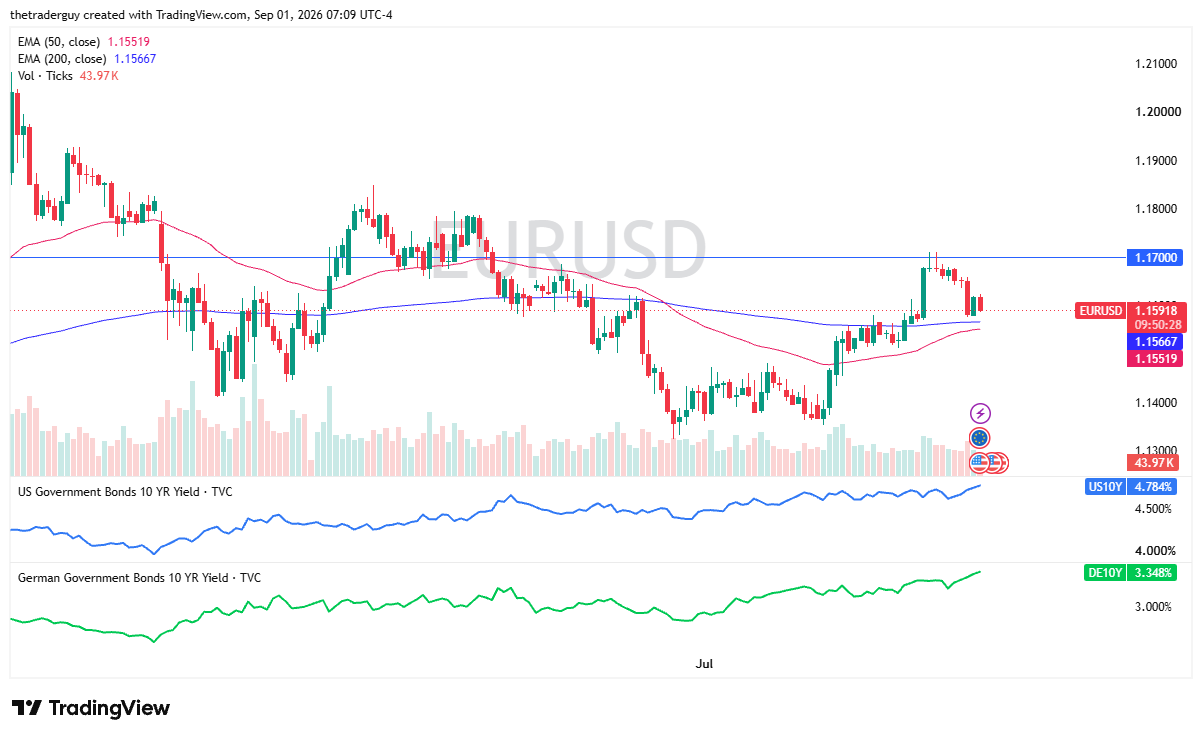
EUR/USD Price Chart
H2 Why EUR/USD Breakdown Risk Escalates into Friday
The convergence of three macro catalysts has narrowed the range of outcomes for EUR/USD over the next 72 hours. First, Warsh's recent public signals on Fed rate-hold optionality represent a subtle but material shift in central bank communications—not a pivot to cuts, but an unambiguous rejection of the March easing narrative that dominated Q4 2024. Second, eurozone economic data has disappointed relative to consensus (PMI misses, industrial production weakness), removing the last pillar supporting euro bulls. Third, the positioning flows ahead of a potentially hot jobs print have tilted toward defensive dollar accumulation, meaning that any technical break below 1.10 could trigger algorithmic selling rather than attract buyers seeking bargains. For EUR/USD specifically, this creates an asymmetry: the cost of breaking support is structural (multi-session cascade), while the reward for holding is primarily psychological (oversold bounce). Institutional traders recognize this mismatch and are front running the break.
H2 The Trader Consensus Trap: False-Flag Fatigue
Market consensus currently assumes Warsh's hawkish tone mirrors previous Fed communications that ultimately preceded an easing cycle—a behavioral pattern repeat that has rewarded complacency for 18 months. This positions traders to be blindsided if the Fed actually follows through on holding rates steady through Q2 2025, a scenario that Warsh's language explicitly leaves open. The vulnerability masks itself as 'this looks like past cycles,' when in fact the structural backdrop (wage inflation persistence, energy supply friction for Europe, geopolitical premium in crude) suggests this divergence may prove durable rather than transient. Additionally, the cascade risk remains underestimated: a daily close below 1.1020 on elevated volume would confirm institutional commitment to the break, potentially forcing technical fund stops and triggering a fast move toward 1.0950. Retail traders watching the 1.14 level have anchored to that price as a 'double-top' reversal signal; this behavioral consensus itself becomes a trailing stop for larger flows, amplifying downside acceleration once support fractures.
H2 When the Bearish Thesis Breaks
The primary breakdown scenario becomes invalidated under two explicit conditions. First, should EUR/USD close decisively above 1.1150 on a daily basis with volume exceeding the 20-day average, the reversal structure resets—buyers are committing capital and the 1.14 resistance becomes tradeable on the long side. This would signal that Warsh's comments are being dismissed as noise and that eurozone economic stabilization is gaining traction. Second, if Friday's non-farm payrolls miss consensus expectations by more than 50,000 (landing below 150,000), the Fed's optionality narrative evaporates immediately, triggering a flight into growth-sensitive carries. Conversely, a beat exceeding expectations by 80,000+ accelerates the Warsh-aligned 'hold steady' thesis and targets 1.0850 within one week. Sessions to monitor: Asian Tuesday open (1.1000–1.1050 range), London Wednesday fix (potential capitulation or reversal confirmation), and US pre-jobs Thursday (last chance for bears to establish conviction before data).
EUR/USD consolidates at the 200-day EMA while Fed hawkishness signals and eurozone weakness converge to test whether institutional support holds or fractures. The behavioral blind spot suggests traders are underestimating the durability of the Fed-ECB divergence, anchoring instead to historical false-flag patterns that preceded easing cycles. Watch the Asian and London sessions mid-week for early volume conviction through 1.1050; Friday's non-farm payrolls will determine whether this technical floor proves structural or merely a stepping stone toward 1.0950.
Ready to trade our EUR/USD analysis? Here is our list of the best brokers worth reviewing.