


The euro faces conflicting signals as transatlantic monetary policy divergence collides with technical resistance, leaving traders caught between structural rate pressure and near-term consolidation. An unexpectedly strong US employment report has reignited Federal Reserve rate-hike expectations, sharpening the divergence with ECB, a gap that typically pressures EUR/USD into its technical ceiling. The market now signals genuine uncertainty about whether this repricing friction will hold or reverse, positioning the pair at a critical inflection point.
Top Regulated Brokers
Why This Matters Now
The labor report revealed 162,000 nonfarm payrolls with upward revision, directly challenging Fed hold expectations that markets had priced at 65% probability for September. This recalibration forced traders to resync their rate models, triggering dollar strength and structural downward pressure on EUR/USD. The widening transatlantic rate differential, driven by Fed repricing against ECB easing, now manifests as tangible currency headwinds, tightening the band where the pair can consolidate.
Technical Structures and Institutional Commitment
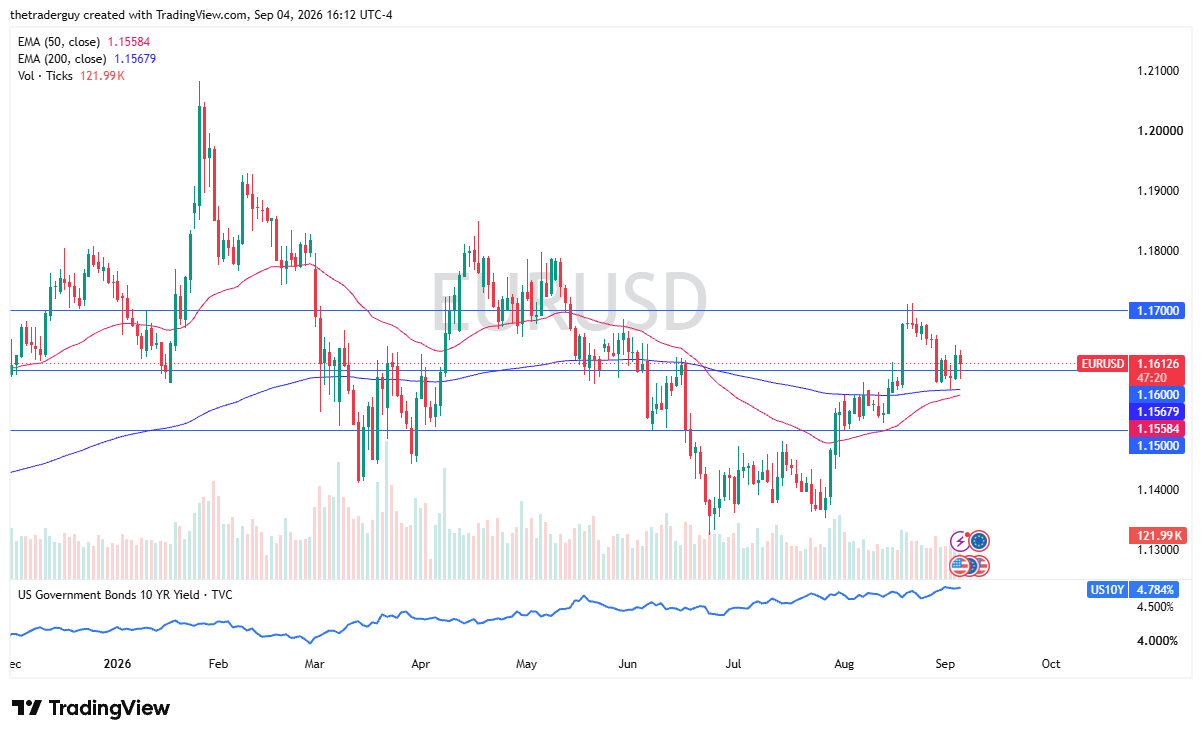
EUR/USD consolidates above its 50-day EMA while testing resistance at 1.17, a level where the 200-day SMA and late-August failed breakout converge. Bears defend this zone with institutional conviction, refusing to yield without a new catalyst (ECB dovishness reversal, Fed pivot signal, or geopolitical de-escalation). The rejection pattern indicates that while bulls possess sufficient stamina to test 1.17 repeatedly, volume has not confirmed upside breakout intent. Below 1.17, structural support clusters at 1.15 and psychological support at 1.14 act as secondary guardrails, creating a trading range that may persist until conviction clarity emerges.
Where Retail Consensus May Be Wrong
The retail consensus that EUR/USD will chop sideways until the Fed decision mid-month masks a critical vulnerability: a single catalyst (official Fed commentary, Middle East escalation, or ECB guidance shift) could trigger rapid repricing that leaves consensus traders flat-footed. Retail positioning typically assumes continued 1.15/1.17 range persistence, but that assumption diverges from institutional rate-model sensitivity. Should conviction clarity emerge, whether from Fed communications or geopolitical headlines, the speed of repricing could exceed retail risk management capacity, exposing the complacency embedded in the chop narrative.
EUR/USD consolidates below 1.17 as market participants weigh Fed mid-month guidance against structurally widening rate differentials that favor dollar strength. The technical range at 1.15/1.17 reflects genuine institutional-retail positioning mismatch, where retail consensus assumes consolidation persists, but rate-model sensitivity suggests vulnerability to rapid repricing. Watch for Fed speaker signals and any ECB guidance revision - either could trigger the conviction clarity that breaks the current equilibrium and signals which direction the pair will ultimately resolve.
The Vulnerability in Consensus Chop
The current consensus that sideways consolidation will dominate until mid-month rate clarity suggests an anomaly worth examining. Retail traders and many institutional accounts are positioned for range-bound oscillation, but this view masks an underestimated tail risk: a single official Fed comment or unexpected geopolitical escalation could reprrice the entire EUR/USD setup in hours, not days. The market has priced 65% probability into a September Fed hold, but that number remains sensitive to incoming labor data or Fed speaker signals. If the Fed suddenly signals more hawkishness than the current repricing assumes, or if the ECB surprises with dovish tone beyond expectations, the structural pressure on EUR/USD would intensify beyond the current 1.15–1.17 band. Conversely, if Middle East headlines suddenly de-escalate or Fed pivot hopes resurface, bulls could test 1.17 with conviction that breaks the institutional bear defense. The vulnerability is not in the range itself—it is in the complacency that assumes the range will hold without external trigger.
Levels That Invalidate the Consolidation Thesis
The current thesis, that EUR/USD will consolidate between 1.15 and 1.17 until rate clarity emerges, remains valid only under specific price and data conditions. A decisive daily close above 1.17 with volume confirmation (above 20-day average volume) would invalidate the bear defense narrative and signal institutional conviction shift toward euro strength, likely requiring a sudden dovish surprise from the Fed or renewed ECB tightening talk. Conversely, a break below 1.15 on daily close with follow-through volume would negate any remaining structural support and suggest that rate differential pressure has overwhelmed technical guardrails—a scenario that would require an unexpected Fed hawkishness acceleration or a sudden risk-off event that reverses current capital flow assumptions. Any of these scenarios would suggest that the repricing friction has resolved into a new directional bias rather than continued range persistence.
EUR/USD consolidates below 1.17 as market participants weigh Fed mid-month guidance against structurally widening rate differentials that favor dollar strength. The technical range at 1.15–1.17 reflects genuine institutional-retail positioning mismatch, where retail consensus assumes consolidation persists but rate-model sensitivity suggests vulnerability to rapid repricing. Watch for Fed speaker signals and any ECB guidance revision, either could trigger the conviction clarity that breaks the current equilibrium and signals which direction the pair will ultimately resolve.
Ready to trade our EUR/USD analysis? Here is our list of the best brokers worth reviewing.