


Treasury intervention in U.S. bond markets triggered a sharp USD/BRL reversal that exposed a critical fault line: institutional buyers who dominated higher levels suddenly vanished when the bounce tested. The collision between policy response and positioning uncertainty has fractured the narrative that held the pair aloft for weeks, leaving traders to determine whether this marks a structural shift or merely a tactical pause before conviction returns.
Top Regulated Brokers
Important Factor Suddenly Emerges
U.S. Treasury bond-market intervention collided with USD/BRL positioning at precisely the wrong moment: when overbought conditions were already signalling vulnerability in institutional conviction. The policy response exposed that the pair's strength rested on momentum rather than fundamental rerating, a distinction that matters as central bank calendars crowd with competing signals from both the U.S. Federal Reserve and Brazilian authorities navigating election-cycle uncertainty.
Why USD/BRL Hinges on Central Bank Divergence
The USD/BRL sits at the intersection of two competing central bank cycles: U.S. Treasury intervention aimed at slowing capital outflows from emerging markets, and Brazilian monetary policy navigating election-year political constraints. This divergence creates a structural bottleneck. Brazilian real weakness would normally attract USD buying, but U.S. policy is explicitly designed to suppress the yield advantage that drives that trade. The intervention signals that institutions face a narrowing window to express USD conviction before policy friction becomes acute.
Technical Setup and Key Levels
The retreat from overbought extremes has brought two support anchors into focus as institutional participants reposition. The zone where conviction was first tested marks a natural retest target; failure to hold there would signal deeper selling into Brazilian election-cycle hedging. Conversely, a reversal and retest of the previous highs would suggest institutions rapidly renewed USD conviction, contradicting the signal sent by absent buyers during yesterday's bounce.
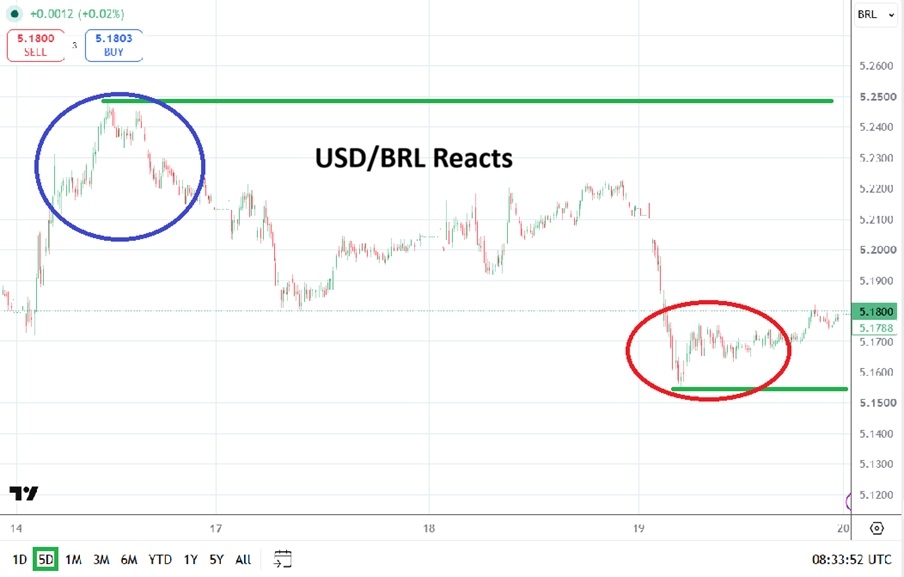
USD/BRL Price Chart
The Vulnerability Treasury Intervention Exposed
The overbought extreme masked a deeper institutional fissure: retail traders who followed momentum into late-week highs did not witness the same conviction from larger players when the pair retested those levels Tuesday and Wednesday. The sharp selloff after the Treasury announcement suggests institutions had already begun positioning for reversal before policy was explicitly announced, leaving retail participants as the marginal buyers at the worst possible price. This mismatch - retail chasing conviction that had already departed - reveals how Treasury action accelerated a transition that was already underway in positioning flow.
Invalidation Parameters
A decisive daily close above the previous high would invalidate the institutional-positioning thesis and suggest that Treasury intervention merely compressed a temporary buyer exodus before conviction rapidly renewed. Conversely, a daily close below the recent support anchor would confirm that selling momentum is accelerating into Brazilian election-cycle hedging and that institutional supply is genuinely exhausted at higher levels, not merely paused.
The USD/BRL tests a critical inflection point where Treasury intervention has exposed institutional positioning fragility that predated the policy announcement. Support anchors will determine whether the selloff reflects a structural shift or a tactical compression before conviction renews, with the coming sessions revealing whether institutions maintain USD commitment or capitulate into Brazilian election-cycle hedging. The unresolved question is whether this reversal marks the beginning of a longer retracement or merely a speed bump in the longer-term appreciation narrative.
Ready to trade our analysis of the USD/BRL? Here is our list of the best Forex brokers in Brazil worth checking out.