


Top Regulated Brokers
Precious metal markets have extended their rally into structural territory, testing levels unseen in months as bond yields roll over and the US dollar weakens from recent strength. The breakout exposes a fundamental tension: whether this move reflects genuine repricing of interest rate expectations or merely positioning asymmetry that masks vulnerability to mean-reversion shocks. Traders face mounting uncertainty as geopolitical risk and potential bond market reversals create friction in the narrative.
The Technical Setup: Gold Breaks $4,500
Gold has extended its rally as bond yields roll over and the US dollar retreats from strength. The move comes after weeks of consolidation, suggesting that buyers have overcome earlier selling pressure. Momentum indicators are now extended, yet price structure suggests that conviction remains intact despite the recent run.
Why This Matters: The Bond Yield Rollover Dependency
The rally hinges on a confluence of macro factors now being repriced: softer inflation data has prompted a rethinking of rate expectations, and bond yields have compressed as a result. When real yields fall gold becomes more attractive because it forgoes no yield. The lower the real return on bonds, the lower the opportunity cost of holding bullion.
Simultaneously, the US dollar has rolled over from recent strength, a move that often accompanies safe-haven rallies in gold. The inverse relationship between the dollar and gold is one of the most reliable correlations in markets: when the dollar weakens, foreign holders find gold cheaper in their local currencies, and domestic investors view it as a hedge against currency depreciation. Both dynamics are now aligned, creating a structural tailwind for the precious metal.
The Risk: Real Yields Remain Elevated, Dollar Is Oversold
Real yields remain elevated by historical standard, and that has historically capped gold rallies. This means the fundamental backdrop for gold, while improving, has not undergone dramatic repricing. The move higher appears driven by tactical repositioning and short covering rather than a wholesale shift in investor behavior.
The US dollar, meanwhile, sits at oversold extremes on many technical measures. When the dollar reaches these levels, even modest shifts in rate expectations or risk sentiment can trigger sharp mean-reversion rallies that redirect safe-haven flows away from gold and back into the currency. The risk profile is asymmetrical: gold has room to extend higher, but downside reversals could be sharp and sudden if dollar sentiment flips.
The Geopolitical Wildcard
Geopolitical uncertainty in the Middle East and Eastern Europe creates a two-way trigger for safe -haven flows in gold. A spike in headline risk could accelerate the rally and push toward key resistance zones, a move that would open the door to further appreciation. Conversely, if tensions cool and investors rotate back into risk assets, gold could face substantial headwinds. The combination of dollar strength and higher real yields would quickly erode current tailwinds. Traders must monitor both macro calendar events and headline risk to anticipate reversals.
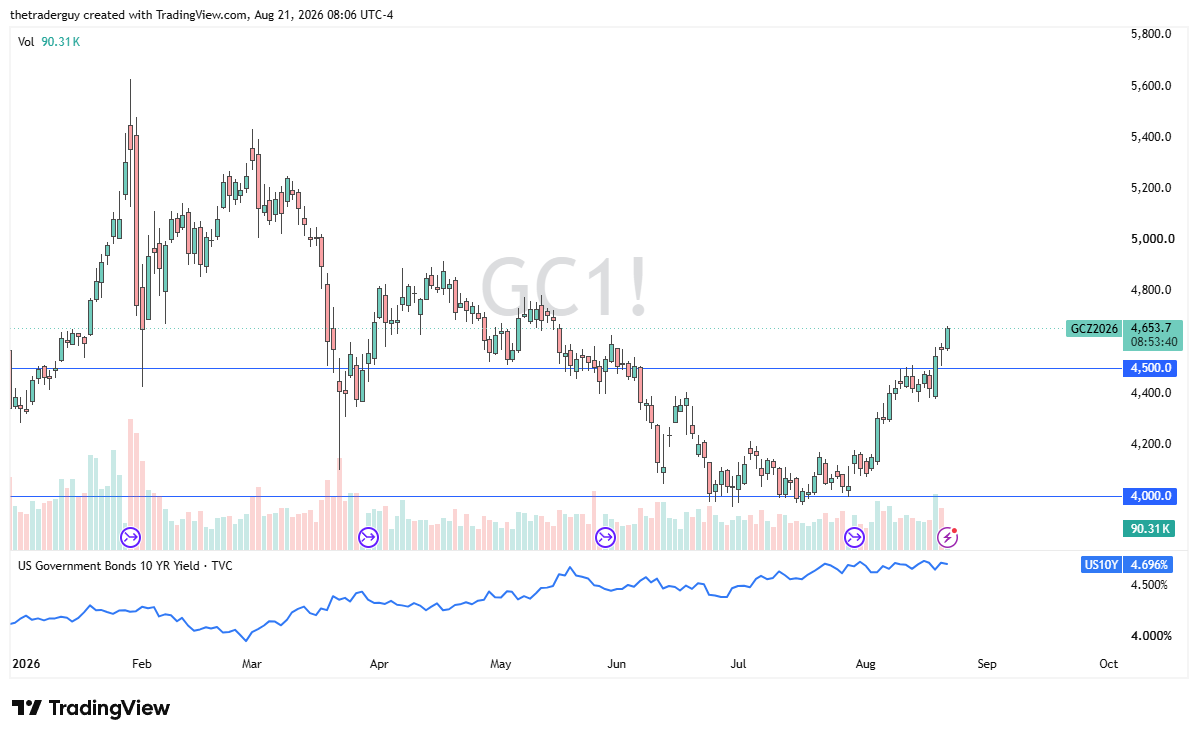
Gold Price Chart
Invalidation: What Would Break the Bullish Case
The bullish thesis for gold invalidates decisively if price closes below the $4,400 support zone on a daily basis. Should that level be breached, a retest of the $4,300 major support would come into play, and the narrative would shift from breakout to failed breakout. A closing print below $4,300 would negate the structural case entirely and open downside toward $4,150. On the macro side, a spike in real yields above historical thresholds—sustained moves in the 10-year real yield into positive real-rate territory—would similarly trigger reversal signals and reduce gold's appeal relative to fixed-income assets. Additionally, if the US dollar breaks decisively above recent highs and reclaims strength amid Fed tightening signals, the dollar-gold correlation would flip and accelerate downside momentum. Traders should use these price and yield levels as hard invalidation triggers, not soft support zones.
Positioning and Sentiment: The Asymmetry Problem
Positioning has become lopsided, with managed money and retail traders adding substantial long exposure in recent weeks. Many market participants view this as an unsustainably large net-long position that leaves the market vulnerable to a positioning squeeze - a sudden exit of longs that can overwhelm bids and trigger sharp pullbacks.
This market relies on sentiment-driven flows and technical support as primary defenses against exogenous shocks. Should either pillar crack, whether from a hawkish Fed shift, real yield spikes, or geopolitical deescalation, the rally could reverse with little warning. Traders should recognize that positioning extremes and the tactical (rather than fundamental) nature of the current move leave gold vulnerable to sharp reversals.
Gold has cleared $4,500 on converging tailwinds from softer bond yields, dollar weakness, and safe-haven demand, yet the breakout exposes a tension between tactical repricing and shallow macro improvement. Real yields remain elevated by historical standards, the dollar sits at oversold extremes, and positioning has become lopsided: all ingredients for sharp mean-reversion should sentiment shift or exogenous risk spike. The rally reflects positioning asymmetry and technical break rather than fundamental repricing, leaving traders vulnerable to sudden reversals if macro calendar events or geopolitical headlines redirect flows.
Ready to trade our Gold analysis? Here is our list of the best Gold brokers worth checking out.