


EUR/USD is caught between violent intraday reversals and structural consolidation, a pattern that masks deeper uncertainty about the true intent behind recent policy signals. The euro's inability to sustain Wednesday's sharp rally suggests traders are reassessing whether the move reflects genuine dovish pivot or merely technical rebalancing of cross-asset positions. Geopolitical friction in the Strait of Hormuz continues to weigh on European energy costs, creating a structural drag that may constrain upside regardless of near-term rate repricing.
Top Regulated Brokers
Context: Treasury Buyback Pivot and Energy Supply Risk
The US Treasury's announcement to double 30-year bond buybacks next month triggered a sharp repricing of quantitative easing expectations, yet Thursday's consolidation reveals trader uncertainty about whether the move reflects genuine dovish concern or technical rebalancing of cross-asset positions. This divergence between Treasury behavior - signaling potential deflation anxiety - and market pricing anchored to rate hikes exposes a fundamental mismatch in policy regime expectations. Compounding this friction, geopolitical supply constraints in the Strait of Hormuz have tightened European energy access, pushing industrial input costs higher and adding structural headwind to euro sentiment. German manufacturing, already fragile from post-pandemic normalization, now faces margin compression if energy scarcity persists, creating a feedback loop where European industrial stress could depress the euro even as Fed dovishness weakens the dollar.
Technical Positioning: The 200-Day Battleground
EUR/USD bounced sharply from its 200-day EMA (around 1.1380) on Wednesday, reaching 1.1550 intraday before consolidating lower, a pattern that reveals institutional resistance rather than sustained conviction. The pair remains trapped within an 18-month consolidation band between 1.1200 and 1.1550, where support at 1.1400 marks both a psychological floor and a zone of institutional accumulation on recent dips. Thursday's small-bodied candle closing near midrange signals fading retail conviction, suggesting neither bulls nor bears possess sufficient force to sustain directional moves beyond established boundaries. This technical paralysis reflects the underlying structural uncertainty: buyback-driven volatility cannot overcome the gravitational pull of energy supply headwinds, leaving the pair locked in consolidation until a macro catalyst breaks the impasse.
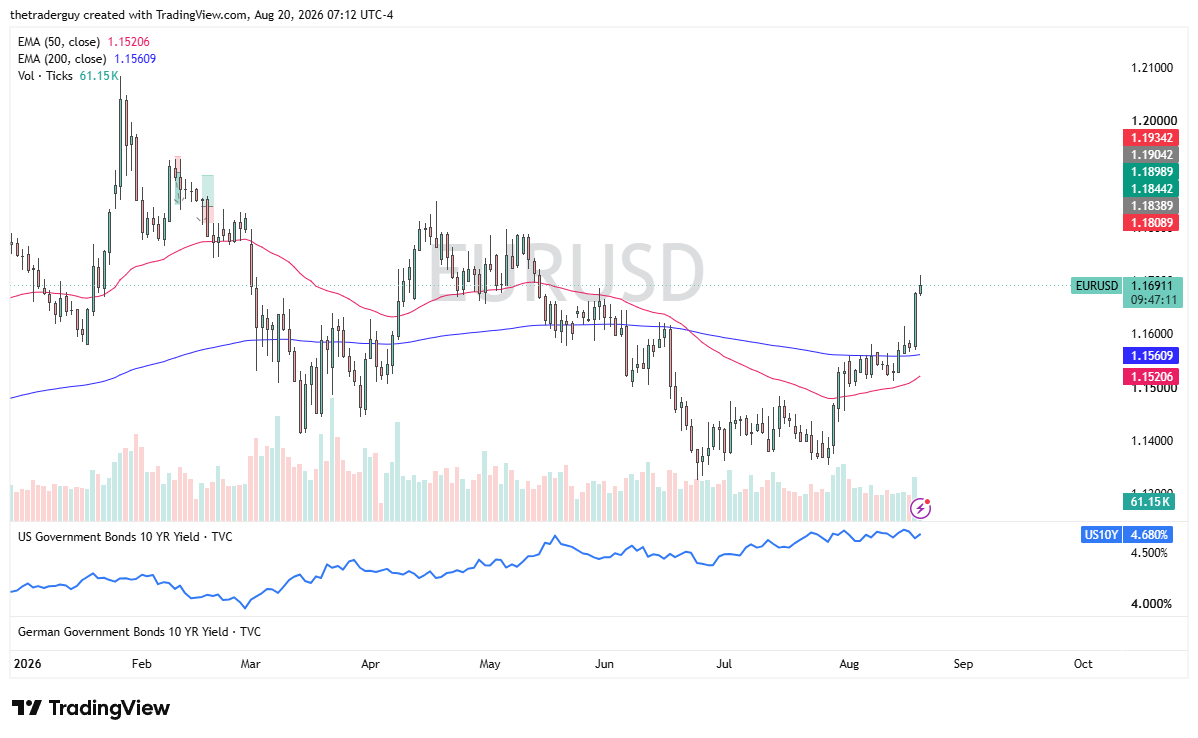
EUR/USD Price Chart
The Energy Supply Vulnerability
Geopolitical friction in the Strait of Hormuz carries elevated risk premium despite minimal official transit disruption; approximately 21% of global crude transits this passage, and rising security tensions have forced European refineries to absorb higher hedging costs for supply certainty. This cost translates directly into elevated energy prices across the eurozone, compressing industrial margins and dampening consumer purchasing power, a structural drag that creates asymmetric downside to the euro relative to the dollar. The market consensus is anchored to Fed dovishness from Treasury buybacks, yet consensus is overlooking the energy supply vulnerability: should Strait tensions escalate further, hedging cost spikes could force European energy prices higher precisely when the ECB faces political pressure to avoid tightening. This mismatch - dovish Fed signals colliding with potential European energy scarcity - masks a tail risk that euro traders are under pricing.
Hope Burns Eternal: The Bullish Alternative Scenario
The bearish energy scarcity narrative is not predetermined; peace negotiations in the Middle East could ease Strait of Hormuz tensions, normalizing energy prices and removing structural euro headwinds. If geopolitical risk recedes and the Fed's dovish pivot gains traction via Treasury buyback signals, EUR/USD could break above 1.1550 and test 1.1700, especially if the ECB aligns with softer Fed guidance. However, this bullish alternative masks a critical vulnerability in consensus positioning: traders are anchored to energy scarcity and rate-hike expectations, yet both assumptions could shift abruptly on geopolitical news. The mismatch between current price action (consolidation bias) and the binary risk (peace vs. escalation) suggests the market is under pricing the probability of sudden regime shift. This vulnerability to geopolitical surprise creates an unresolved tension that keeps the pair trapped. Neither direction has overwhelming institutional conviction until one scenario crystallizes.
EUR/USD remains trapped in its 18-month consolidation band, where Treasury buyback volatility masks the unresolved structural question of whether energy supply scarcity or dovish Fed pivot breaks the range first. The convergence of Thursday's European session close and ongoing geopolitical risk monitoring will determine whether price breaks above 1.1550 (signaling buyback-driven upside) or respects 1.1400 support (confirming energy drag dominance), with each outcome carrying vastly different implications for next week's Fed policy signal interpretation.
Ready to trade our EUR/USD analysis? Here is our list of the best brokers worth checking out.