


The Forex market has become more interesting over the past few weeks as focus turns away from a consolidating stock market to other asset classes, assisted by the new focus on Kevin Warsh and a seemingly more hawkish approach at the Fed. This extra focus on the Fed has boosted the US Dollar and put other currencies on watch. Adding to the sense of anticipation is the imminent end of the “summer market” as September arrives tomorrow.
The Australian Dollar is in a long-term bullish trend and has been the best-performing currency over recent months. It received a boost some days ago when Australian CPI (inflation) data came in higher than expected, which will likely keep the Aussie interest rate relatively elevated. This will continue to be a tailwind for a while.
The US Dollar is in a changing position – it has become stronger, with the USD Index reaching a 2-week high price earlier today, following new Fed Chair Kevin Warsh’s speech at Jackson Hole, which was seen to be hawkish, and a 0.25% rate hike by the Fed in September is now seen as likely to happen.
Top Regulated Brokers
Fundamentally, we might now see something of a break on the continuing rise – it might still happen, but it will probably be more muted than it has been.
The price chart below shows that the AUD/USD currency pair is in a bullish trend, most recently evidenced over almost the entire calendar month of August by the ascending price channel which has almost completely contained the price action. This was created by a linear regression analysis and so it is likely to be a relatively reliable technical feature.
We can see, however, that bulls are faltering. The price has just broken below the former support level at $0.7167 with a very clear and patient bearish top testing it from below, as it seems to have flipped cleanly to become new resistance, which is a bearish sign.
A further bearish sign is that the current price action is right at the lower end of the range of the ascending price channel, so a breakdown below $0.7150 will be technically significant and a more decisive bearish sign. The support level is just below that at $0.7142 and is likely to be today’s pivotal point.
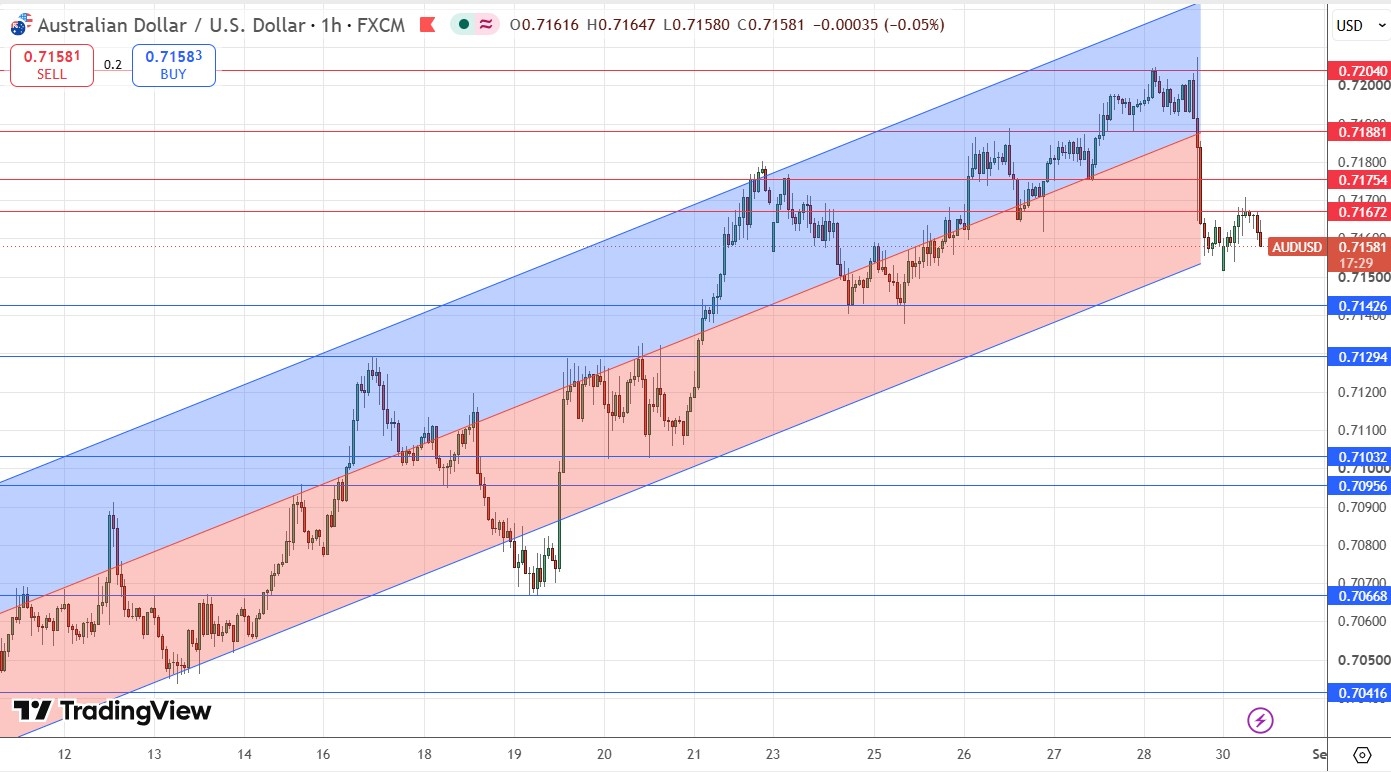
AUD/USD H1 Price Chart
Support & Resistance Levels
Risk 0.25%.
Trades may only be entered prior to 5pm Tokyo time Tuesday.
Short Trade Idea
Short entry following a bearish price action reversal on the H1 time frame immediately upon the next touch of 0.7167, $0.7175, or $0.7188.
Put the stop loss 1 pip above the local swing high.
Move the stop loss to break even once the trade is 20 pips in profit.
Remove 50% of the position as profit when the price reaches 20 pips in profit and leave the remainder of the position to ride.
Long Trade Ideas
Long entry following a bullish price action reversal on the 1H1 time frame H1H1H1 time frame immediately upon the next touch of $0.7143, $0.7129, or $0.7103.
Put the stop loss 1 pip below the local swing low.
Move the stop loss to break even once the trade is 20 pips in profit.
Remove 50% of the position as profit when the price reaches 20 pips in profit and leave the remainder of the position to ride.
The best method to identify a classic “price action reversal” is for an hourly candle to close, such as a pin bar, a doji, an outside or even just an engulfing candle with a higher close. You can exploit these levels or zones by watching the price action that occurs at the given levels.
There is nothing further of high importance scheduled today concerning the Australian Dollar. Regarding the US Dollar, there will be a release of Core PCE Price Index and Preliminary GDP data at 1:30pm London time.
Ready to trade our free Forex signals? Here is our list of the best Forex brokers worth reviewing.