


Top Regulated Brokers
Gold continues to attract attention, but not because the market looks especially confident. The more interesting feature is that support around $4,000 keeps holding even as traders are being pulled in different directions by the same macro forces that have unsettled so many other markets.
That tension matters because gold is usually easier to read when fear is simple. Right now it is not. The market has to balance gold’s safe-haven appeal against a U.S. dollar that is also drawing support from relatively high yields, and that leaves the metal looking supported without looking especially free to run.
Why Gold Still Looks Unsettled Near a Major Support Zone
The uncertainty in gold makes sense in the current backdrop. Volatility tied to the Middle East has kept traders cautious, while the bond market continues to shape the broader macro mood, especially in the United States.
The larger concern across markets is still the possibility of an inflationary shock. If energy supplies are disrupted more severely, central banks could be forced to deal with another powerful cost surge, and that makes gold more complicated than a simple fear trade. In a more typical environment, gold might benefit more cleanly from geopolitical stress, but this time the U.S. dollar is competing for the same defensive demand because higher rates continue to make it attractive.
How the $4,000 to $4,200 Range Reflects Market Uncertainty
For the past couple of weeks, gold has been boxed into a roughly $200 range between $4,000 on the bottom and $4,200 on the top. That kind of behavior does not suggest conviction so much as hesitation, which is understandable going into a weekend when traders know the next major headline could arrive while markets are shut.
This is one of the biggest risks in the current environment. Nobody wants to carry a position into a gap driven by news that cannot be managed in real time, and that has helped keep gold trapped in a market where traders seem more willing to react than to anticipate.
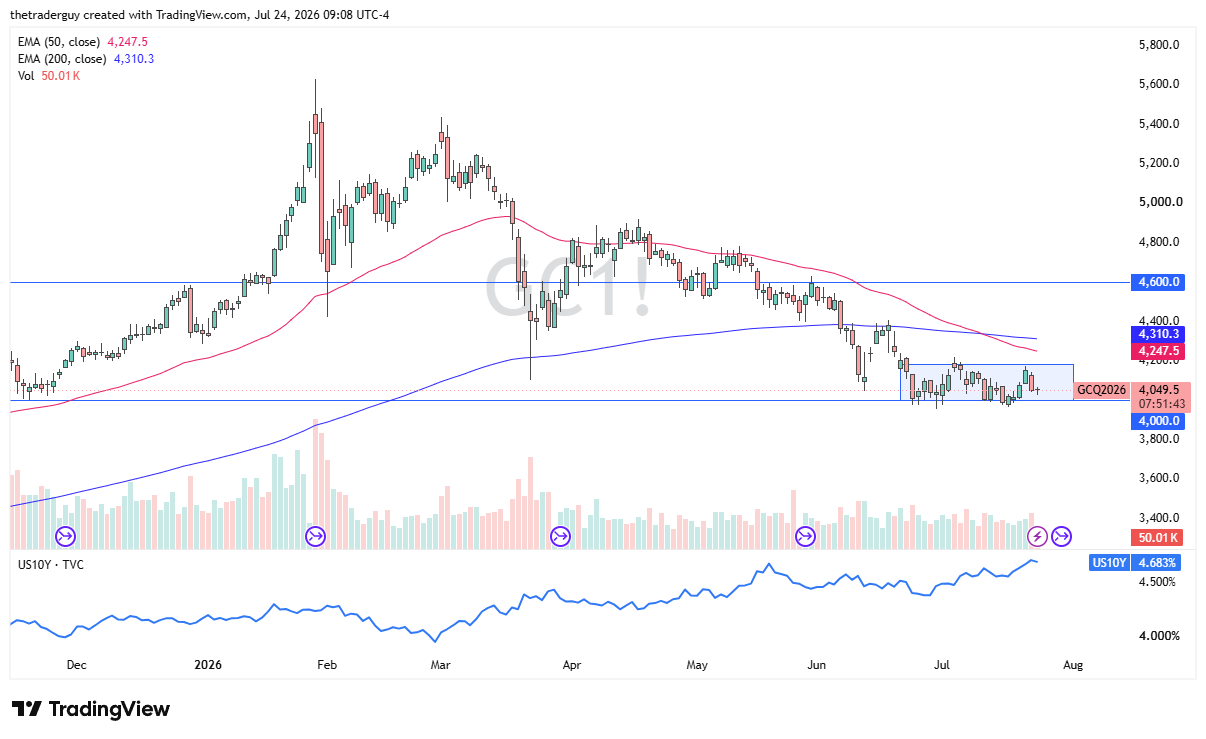
Gold Price Chart
Why the Death Cross Is Not the Whole Story
There are still longer-term traders who will look at this area and see a possible buying opportunity, and from a technical standpoint that argument is not unreasonable. Gold is sitting at a major support zone, and markets often become interesting when they refuse to break lower despite sustained pressure.
At the same time, the recent death cross, where the 50-day EMA moves below the 200-day EMA, is a longer-term bearish signal that will keep some traders cautious. Even so, that indicator is often late, so it may be more useful as a sign of existing stress than as a clean forecast of what comes next.
What Could Change Gold’s Direction More Quickly
The clearest alternative scenario is some form of genuine de-escalation in the Middle East. That would not automatically send gold sharply higher, but it could calm interest-rate expectations enough to ease some of the pressure currently supporting the U.S. dollar.
If yields were to settle and broader uncertainty begin to fade, gold could find a cleaner path higher. The problem is that markets have already been teased more than once by the idea of peace, only to find that the situation remained unstable, so traders have reason to stay skeptical for now.
What Traders Should Watch Next in Gold
For now, gold still looks caught between support that continues to matter and a broader macro backdrop that refuses to settle down. The most useful signals are still likely to come from headlines and from U.S. bond yields, especially given the inverse relationship that often develops between yields and the metal.
The next stretch should say more about whether this is simply another pause inside the same grinding range or the beginning of a more decisive move. Until then, gold may continue to frustrate traders by looking stable enough to hold support, but not stable enough to resolve the bigger question.
Explore the trading levels in our gold price prediction and assess whether the setup fits your own trading plan. Try FP Markets for Gold Trading.