


Top Regulated Brokers
The Aussie Dollar (AUD/USD) has broken out from a descending broadening formation as traders weigh worries that the Middle East conflict could spread further across the region against the potential stabilizing impact of a proposed 10-day ceasefire.
The AUD/USD currency pair pushed higher from this respected technical pattern on Monday, extending last week’s solid gains, but has since spent most of its time in consolidation as market participants pause to reassess the geopolitical backdrop and consider where the currency pair may be headed next.
Traders Refocus on Middle East Developments
Following last week's softer-than-expected inflation-driven rally, the Aussie dollar's near-term direction today looks increasingly tied to how the latest Middle East headlines unfold, rather than purely domestic data. With tensions between the United States and Iran fueling worries that hostilities could spill across the wider region, traders are weighing the risk of disrupted energy supplies and renewed risk-off sentiment against the possibility that ongoing negotiations might deliver a more durable ceasefire framework, a balance that could define the Aussie’s next leg.
In early trade on Tuesday, AUD/USD edged slightly higher, with risk appetite getting a cautious lift after reports that Iranian negotiators had received a proposal for a 10‑day ceasefire designed to pave the way for a longer-lasting agreement and, in turn, a clearer backdrop for the pair’s next move.
What the AUD/USD 1-Hour Chart is Signaling
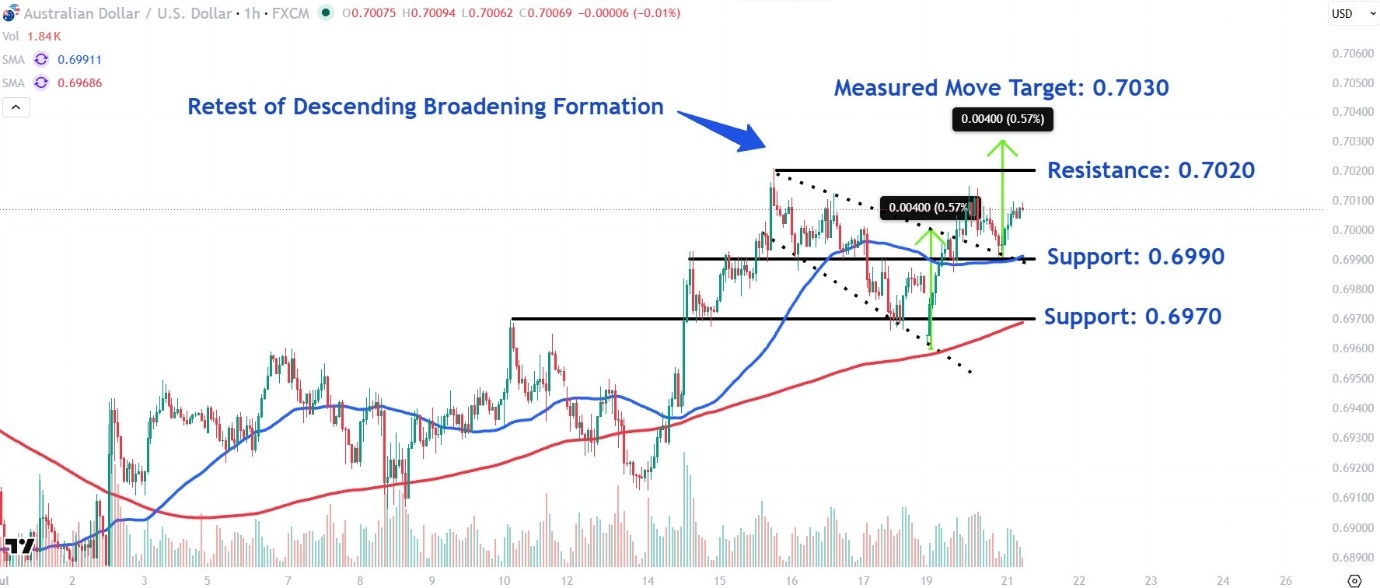
Following the AUD/USD’s bullish move last week, the pair consolidated in a descending broadening formation over the weekend, a chart pattern that traders often interpret as a continuation of recent price action. Indeed, the Aussie broke out above the formation’s upper trendline early on Monday before pulling back to retest the initial breakout area, potentially paving the way for the uptrend to continue this week.
The first lower level on the AUD/USD’s chart worth watching sits around 0.6990. Traders may view this region as a high probability accumulation area because it finds a confluence of support near the descending broadening formation’s upper trendline and several minor peaks and troughs stretching back to the July 14 high.
However, if bulls fail to defend this level, the pair could retreat toward 0.6970 as traders who expected a strong continuation move this week trim their long position exposure. Still, the location could attract buying interest near a horizontal trendline that connects the July 10 high and the first retracement low following last week’s impulsive rally.
AUD/USD H1 Price Chart
Key AUD/USD Levels if the Bullish Move Resumes
Further buying today around the descending broadening formation’s top trendline could give traders confidence that a continuation move to around 0.7020 may unfold. If that plays out, those who opened long positions over the weekend near the pattern’s lower trendline could look for exit points around this month’s high.
If the Aussie stages a decisive break above the July peak, traders can use a measured move to project a potential bullish price target, a technique that uses well-known chart patterns to forecast future directional moves. In this case, we calculate the distance between the descending broadening formation’s two trendlines and add that amount to the pattern’s top trendline. For example, we add 40 pips to 0.6990, which projects a target of 0.7030.
Light Week of Economic Data for AUD/USD
On the economic data front, traders will this week turn their attention to employment and housing releases. On Thursday, the Australian Bureau of Statistics will publish the country’s unemployment rate and employment change for June, while later the same day, the Department of Labor will release weekly jobless claims data. To close out the week, the U.S. Census Bureau on Friday will release June New Home Sales numbers.
While the Fed has indicated that each piece of economic data will help determine its future policy settings, this week’s reports will likely carry less weight among traders compared to last week’s inflation numbers that significantly shifted the near-term outlook for U.S. interest rates.
Geopolitics and Technicals Set to Drive AUD/USD
With last week’s tamer-than-expected inflation data priced into the AUD/USD, I think the pair’s next movement will likely be driven by ongoing developments in the Middle East and modestly bullish technicals.
A further flareup in hostilities between the United States and Iran could cap further upside in the Aussie this week given its reputation as a risk-on currency that acts as a proxy for global economic health and commodity demand. However, a breakthrough in negotiations between Washington and Tehran could see the pair build on last week’s bullish momentum.
Sources:
https://www.bloomberg.com/news/articles/2026-07-20/latest-oil-market-news-and-analysis-for-july-20
Ready to trade our analysis of the AUD/USD? Here is our list of the best Forex brokers worth checking out.