


Top Regulated Brokers
AUD/USD had been trying to hold onto its recent recovery, but the tone has shifted. What looked like a relatively stable stretch has started to feel more fragile, and the change is not really about one sharp move so much as the way several pressures are beginning to align at the same time.
That is what makes the pair more interesting here. The Australian dollar is not weakening in isolation; it is doing so while oil prices, geopolitical tension, and the U.S. rates story are all feeding back into the same market narrative. When that happens, a chart pattern matters more because it starts to fit the wider mood instead of fighting it.
Why AUD/USD Is Under More Pressure Now
The immediate backdrop is a return to stronger demand for the U.S. dollar as traders move back toward safe-haven positioning amid escalating strikes between the United States and Iran. At the same time, West Texas Intermediate crude has moved above the psychological $100 per barrel area, reinforcing concern that higher energy costs could keep inflation elevated and make it harder for the Federal Reserve to soften its stance.
The attached draft also notes that the market is pricing in better-than-even odds of a 25-basis-point Fed rate increase in September, according to CME FedWatch data. That matters for AUD/USD because a firmer U.S. rate outlook tends to widen the interest-rate gap against the Australian dollar and make rallies in the pair harder to sustain.
What the Chart Is Suggesting
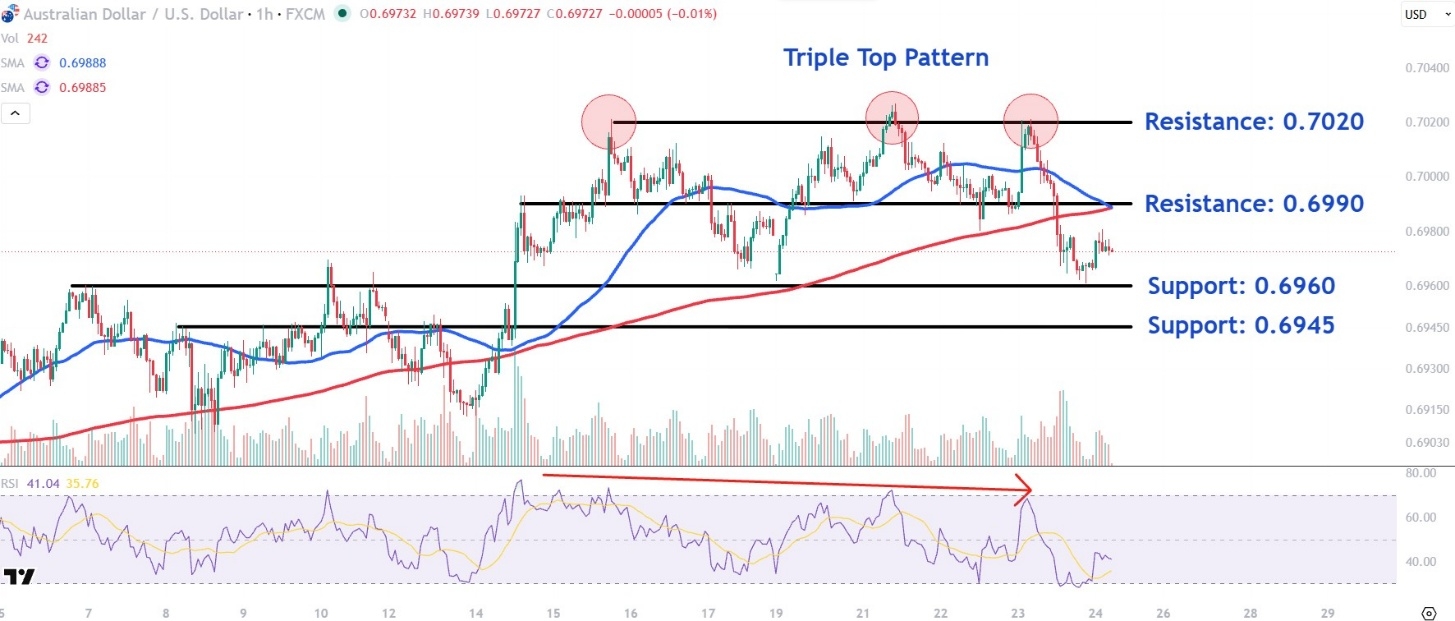
On the one-hour chart, the most important feature is the triple top that has formed after last week’s peak. That pattern does not guarantee a deeper move lower, but it does suggest that upside momentum has become less convincing each time price has tried to revisit the same general area.
AUD/USD Price Chart
As the three peaks developed, the relative strength index carved out lower highs, highlighting fading upside momentum, while price also slipped below the closely watched 200-period moving average, reinforcing the bearish technical tone. Taken together, those details make the bearish case more coherent because the pattern is not appearing in isolation; it is being supported by weakening participation and a loss of technical footing.
Where the Market May React Next
If the pair continues to soften, the first area to watch is $0.6960. Even with the technical picture leaning bearish, that zone may still attract tactical buyers because it lines up with several earlier peaks on the chart and could briefly shift from former resistance into support.
A more decisive break below that area would bring $0.6945 into clearer view. The draft treats that level as another place where traders may look for a response because it sits near a horizontal trendline linked to a series of peaks and troughs formed during consolidation between July 8 and July 14.
The Blind Spot in the Bearish View
The risk in becoming too comfortable with the downside setup is that the Australian dollar is not without support of its own. Better-than-expected employment data this week gave the pair a temporary lift, precisely because a healthier labor market leaves the Reserve Bank of Australia with more room to keep policy firm as it confronts inflation.
That rebound faded as traders rotated back toward risk-off positioning, but the signal still matters. It suggests that domestic data has not stopped influencing the currency; it has simply been overshadowed for now by a louder external story tied to oil, geopolitics, and U.S. rates.
What Would Challenge the Current Structure
The bearish setup would look less persuasive if AUD/USD can recover back through $0.6990 and begin holding above it. The draft points to that area as a confluence zone near the 200 moving average and prior price action, which means a recovery there would suggest that sellers are losing some control.
Beyond that, a move back toward $0.7020 would matter even more because it would bring the pair back toward the region defined by the three peaks that created the triple top in the first place. In that scenario, what currently looks like a pattern of exhaustion could start to look more like a pause that briefly shook out weaker positioning.
What May Matter Next for AUD/USD
For now, the balance of pressure still appears to lean lower, especially with weekend risk approaching and the market still sensitive to the Middle East story. However, the next move may depend just as much on whether traders keep focusing on geopolitical risk and the Fed as it does on the chart itself.
Next week’s Australian second-quarter CPI release could become the next important test for the pair. It may show whether AUD/USD remains trapped inside a broader risk-off narrative, or whether local inflation data is strong enough to pull attention back toward the RBA and give the Aussie a steadier footing.
Ready to trade our analysis of the AUD/USD? Here is our list of the best Forex brokers worth reviewing.