


Fundamental Analysis & Market Sentiment
I wrote on 7th June that the best trades for the week would be:
Long of the USD/JPY currency pair following a daily close above ¥160.44. This set up on Wednesday but ended the week slightly lower by 0.20%.
A summary of last week’s most important data in the market:
US CPI (inflation) – one of the metrics was just a tick lower than expectations, which briefly produced a rise in US stocks and a small drop in the US Dollar.
European Central Bank Policy Meeting (including Main Refinancing Rate) – the ECB hiked by 0.25% as expected but hinted at a further rate hike as possible soon so this was seen as a minor hawkish tilt which helped keep the Euro firm.
Bank of Canada Policy Meeting (including Overnight Rate) – this was seen as mildly dovish as it implied a lower likelihood of rate hikes later in 2026, which helped the Canadian Dollar weaken marginally over the week.
US PPI – this was generally stronger than expected, although Core PPI was a tick lower than expected, which was a minor counterweight to the lower-than-expected inflation data.
UK GDP – as expected, GDP is confirmed to be contracting by a tiny amount.
Markets were generally very quiet last week, with no dramatic or even significant responses to any of the data items listed above, or to the growing near-certainty that a Memorandum of Understanding (not a deal) will be signed by the USA and Iran for a framework of talks to formally end their war.
Top Regulated Brokers
After publicly promising over 35 times since early April that a deal would shortly be agreed between Iran and the USA, President Trump finally seems to be extremely close to delivering an agreed performance-based Memorandum of Understanding which will likely be signed by the parties over the coming days. The MoU is expected to lock in a 60‑day ceasefire extension, start structured nuclear talks, and open the door to incremental oil‑export and sanctions relief, but with meaningful risk of delay by Iran. It is also an open question whether Iran will be expected to cease funding and arming terrorist groups such as Hezbollah in Lebanon, although American sources seem to expect that some kind of full ceasefire will be demanded in Lebanon. Israel and Lebanon are not parties to the deal.
Markets are not reacting with much excitement to the deal, although most stock markets gained some ground last week. Markets understand that there is a long road ahead and a signed Memorandum of Understanding guarantees nothing. In my view, as long as the Iranians agree not to rebuild blatant nuclear weaponization projects and blend down their buried stock of enriched uranium in Isfahan, Trump will declare that as a win and climb down. Many countries in the Middle East will take a different view.
Another item last week was the IPO of SpaceX, which made owner Elon Musk the world’s first dollar trillionaire. The stock closed about 7% above its opening price on its first day of trading. It is not yet a member of the NASDAQ 100 Index, but it is expected to join the Index soon.
The Week Ahead: 15th – 19th June
The coming week’s most important data points, in order of likely importance, are:
US Federal Reserve Policy Meeting
Bank of Japan Policy Meeting – the bank is expected to hike its interest rate by 0.25% to 1.00%.
Bank of England Policy Meeting
Reserve Bank of Australia Policy Meeting
Swiss National Bank Policy Meeting
UK CPI (inflation)
New Zealand GDP
UK Unemployment Claims
Friday is a public holiday in the USA and China.
Monthly Forecast June 2026
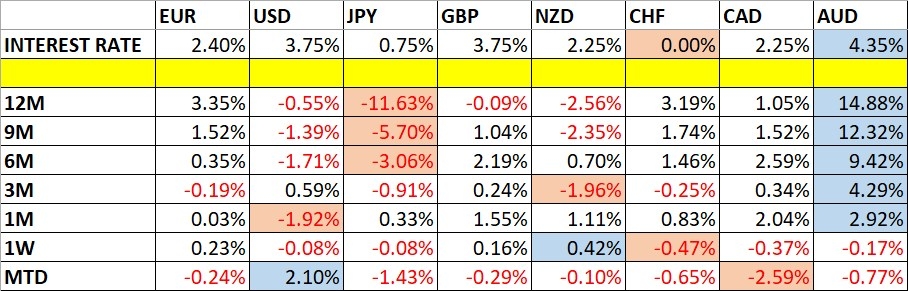
Currency Price Changes and Interest Rates
For the month of June, as there was still no clear trend in the US Dollar, I made no monthly forecast.
Weekly Forecast 14th June 2026
Last week, I forecasted that the NZD/JPY currency cross was likely to rise in value, and that the EUR/NZD and GBP/NZD currency crosses would fall in value. This was a good call, as all these trades were winners:
This week, I make no forecast, as there were no exceptional price movements last week.
Volatility decreased dramatically last week, with only a single notably currency pair or cross moving by more than 1% in value. Next week’s volatility is likely to increase, however, as there are no fewer than five major central bank meetings due, including the Federal Reserve.
You can trade these forecasts in a real or demo Forex brokerage account.
Technical Analysis
Key Support/Resistance Levels for Popular Pairs
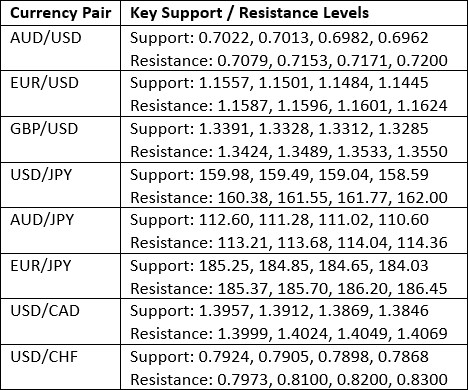
Key Support and Resistance Levels
US Dollar Index
The US Dollar printed a relatively small bearish candlestick last week, rejecting an area near the high of the consolidation pattern which has persisted for over one year. This suggests weak bearishness, but as the price has been ranging for over one year now while locked in consolidation, and there is clearly no valid long-term trend, I do not want to make any predictions about the US Dollar.
Even though we see a strong chance that the USA and Iran will soon begin talking to try to find a deal to end their war, which is sending the price of crude oil lower, it is not having any strong effect upon the greenback.
I think it makes sense to base trades over the coming week on other factors and to just ignore the US Dollar as an issue, even if you are trading something priced in Dollars.
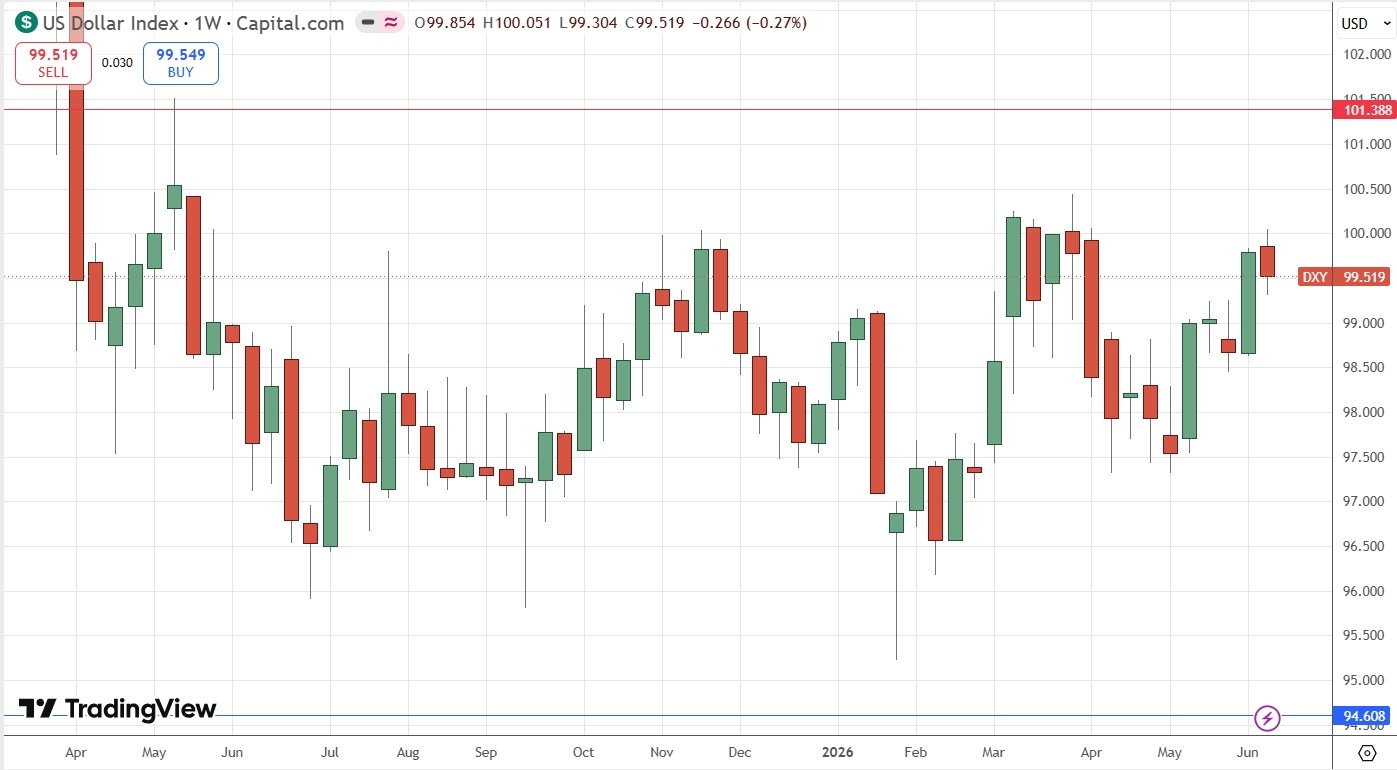
US Dollar Index Weekly Price Chart
USD/JPY
The USD/JPY currency pair printed a small dragonfly doji last week, which included a long-term high daily closing price in New York, which will have triggered entry by many institutional trend followers on the long side. However, an absolute new high has not yet been reached, and there seems to be little momentum here. Volatility is also falling to a relatively low level, which can be a sign of an impending reversal,
The price is now just short of recent long-term highs. The price failed here at the last attempt to make a long-term bullish breakout. We may see another test very soon.
Dollar strength is being pushed by fundamentals (a hawkish environment for the Fed with a hot US economy putting pressure on for more rate hikes), with the Japanese Yen showing long-term weakness for a similar reason (the extent of Japanese debt making further Bank of Japan rate hikes very difficult). However, the Bank of Japan is expected next week to hike its interest rate by 0.25%. If it passes on the hike, we can expect the price of this currency pair to shoot higher.
One question that must be asked is whether the Bank of Japan will intervene in the Forex market as it did the last time the USD/JPY reached this price area. I think they will feel they have to, especially if they see the breakout start to falter and run out of buy orders. The Bank of Japan does not want to see this currency pair weaken much beyond ¥160.00.
This might be a trade you want to pass on, but there are many trend traders who know they can usually find an excuse not to take good trades. I am long.
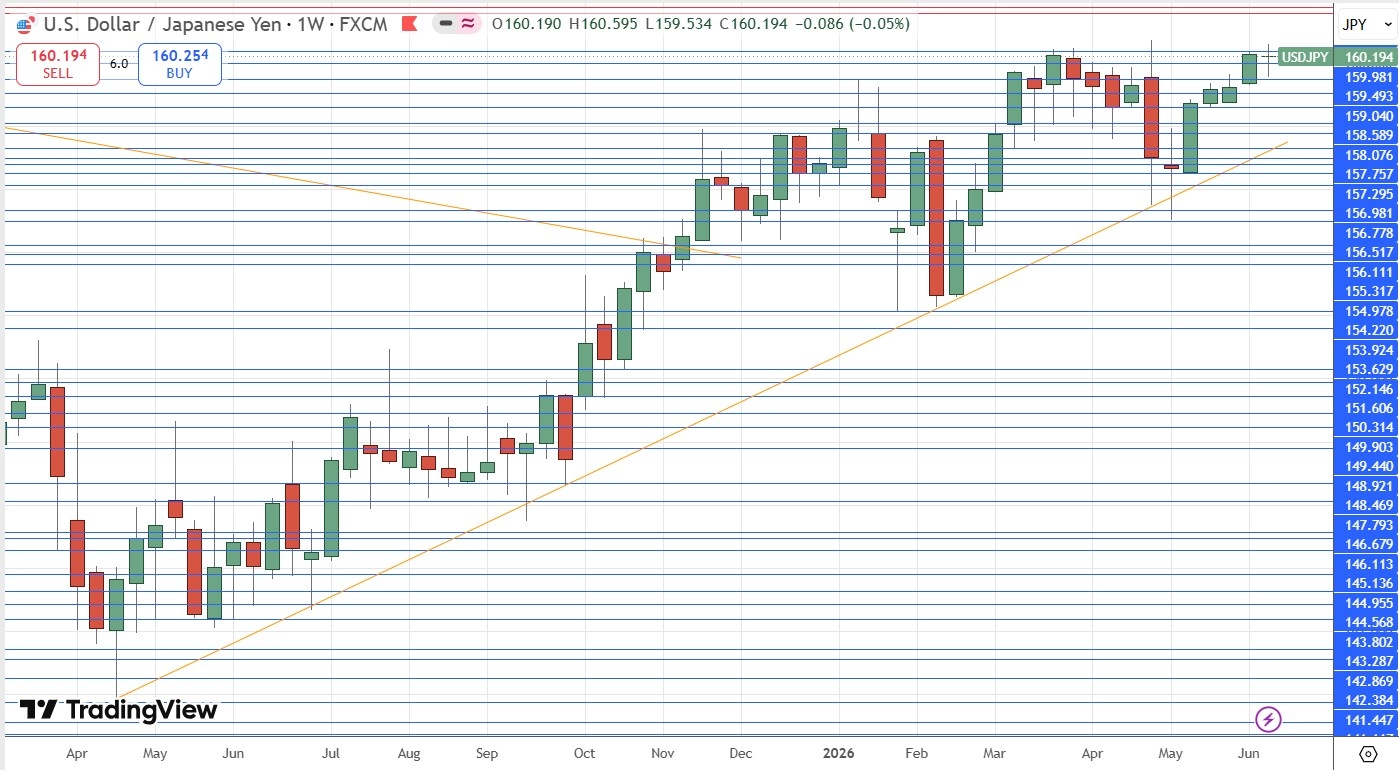
USD/JPY Weekly Price Chart
NASDAQ 100 Index
The NASDAQ 100 Index recovered after dropping sharply at the end of last week. The weekly close is about halfway up the previous week’s bearish candlestick, so it is not very bullish, but you have to say it’s a reasonably bullish recovery.
The rise was caused by general bullishness on the AI sector, and a hope the market has that the US/Iran war is close to a peaceful resolution. However, most trend following institutions will be out of their long positions now and waiting for a new high to get back in, which has not happened yet.
There are many analysts fearing a crash in the tech sector will happen soon due to over-valuations and AI hype.
I would not buy this Index just yet, as it is possible that it has further to fall. Best to wait a few more days to see how it behaves.
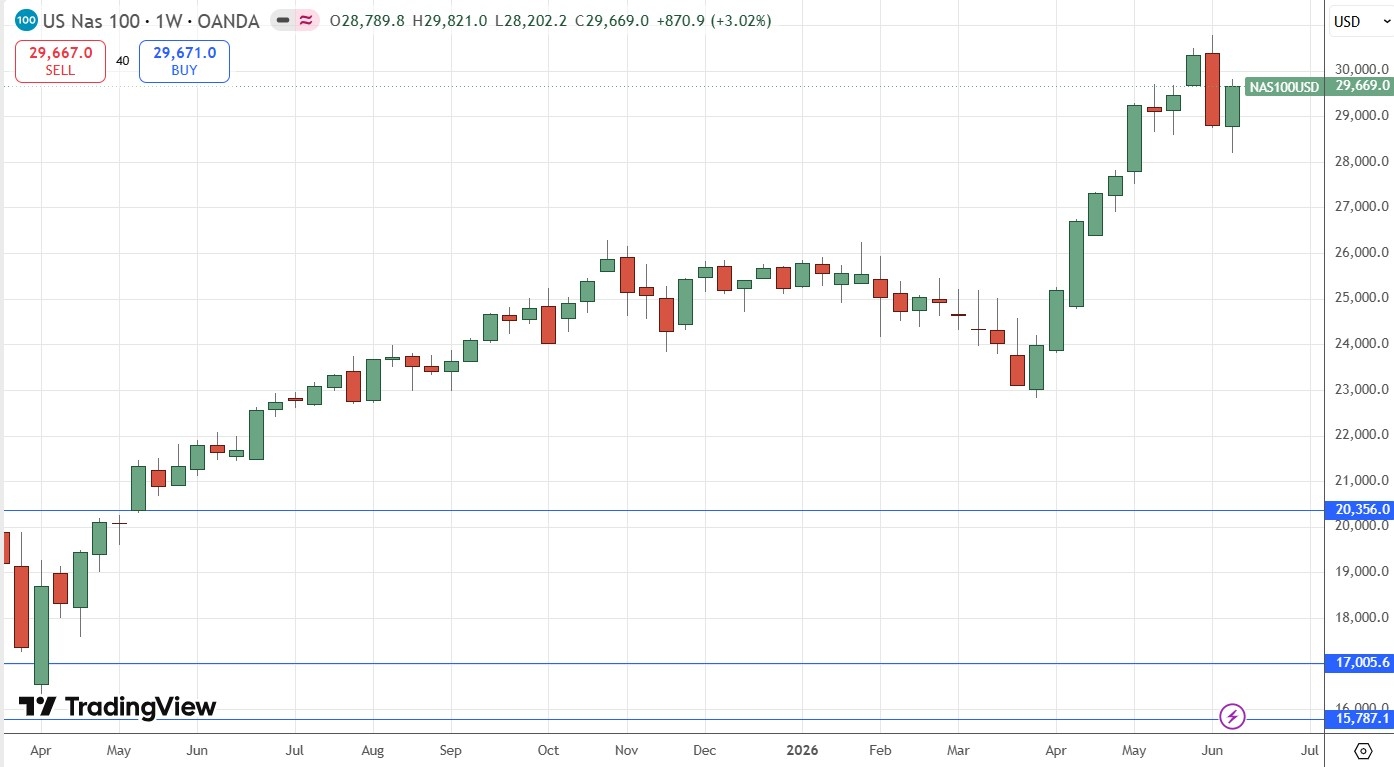
NASDAQ 100 Index Weekly Price Chart
S&P 500 Index
The S&P 500 Index had the same story last week as the NASDAQ 100 Index which I spelt out above. The only notable difference is that the S&P 500, being a broader Index without an exclusive technology focus, produced less of a recovery last week.
I think the price has a good chance to bounce back, but it would be wise to wait a few days to see what happens, in case the market is spooked and stocks are due a further fall.
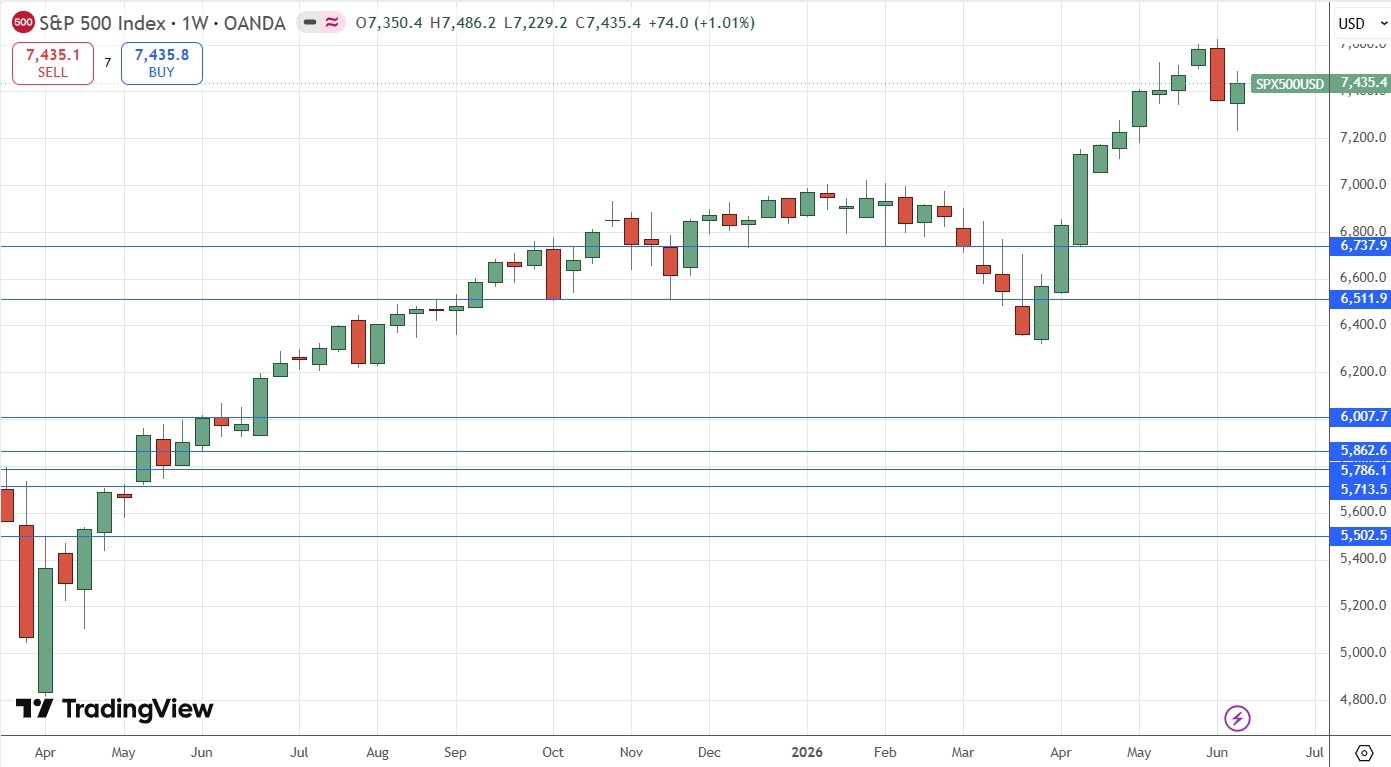
S&P 500 Index Weekly Price Chart
Gold
Gold continued its medium-term bearish trend last week, breaking down to a fresh 1-year high just above the big round number at $4,000 before making a partial recovery.
Note how in April, we saw a bullish retracement to the 50% level of the crash move down, and then a bearish rejection of that price.
There is a descending trend line suppressing the price.
The failed breakdown and the fact that $4,000 was not even touched may encourage long-term buyers to think there is some value in buying now. However, there are still plenty of bearish indications. If you are thinking of buying, it will likely be wiser once the trend line I mentioned is decisively broken. Next week, this trend line will be sitting at about $4,450.
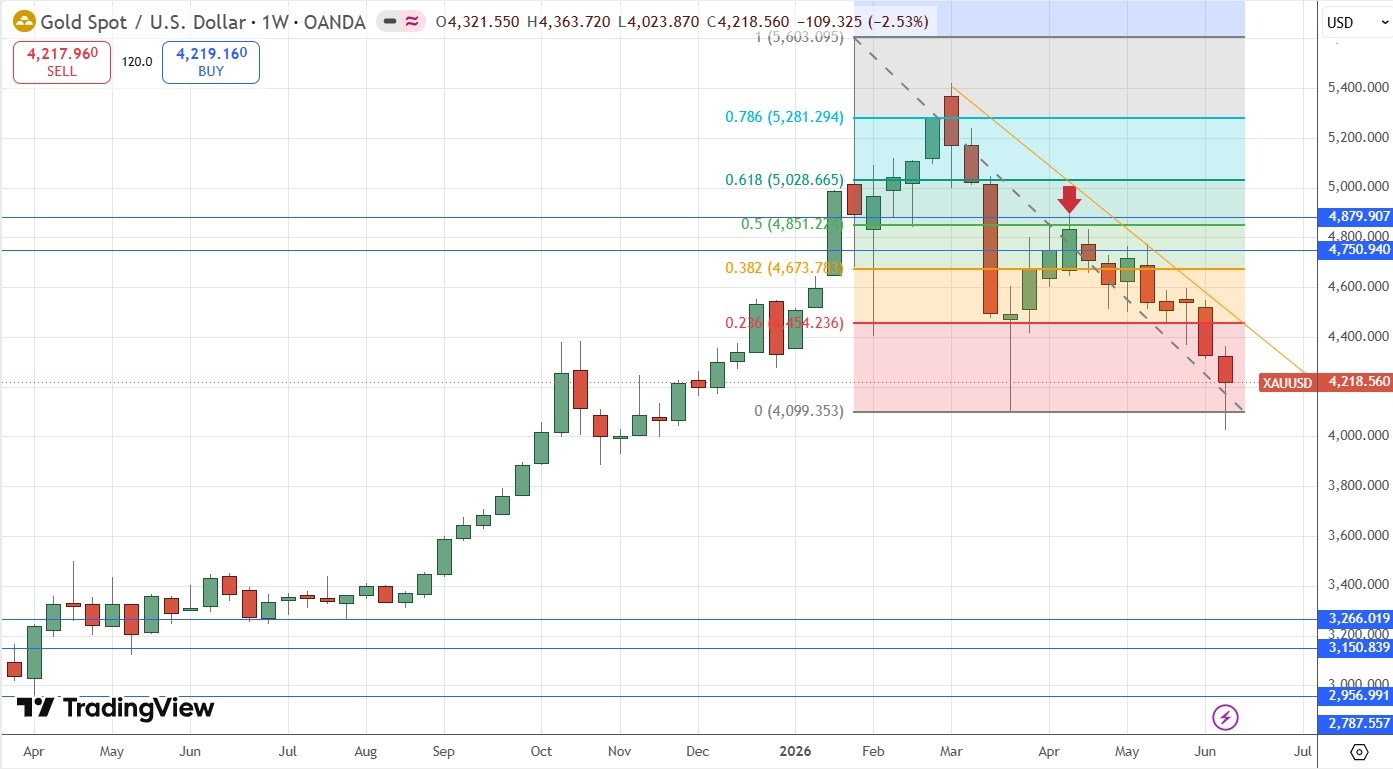
Gold Weekly Price Chart
Bitcoin
Bitcoin reached a new 18-month low price the week before last, and looked like it might test $60,000, much as Gold looked likely to test $4,000. However, last week saw a weak, modest advance in the price, but with a higher low. This may give hope to long-term buyers that Bitcoin has found a floor and is safe to buy. Yet technically, that is still some way from looking probable – so I judge it, and I think most technical analysts would agree with me.
I have no interest in buying Bitcoin yet, but a breakdown below $60,000 might make an interesting short trade, depending upon the shorter-term price action.
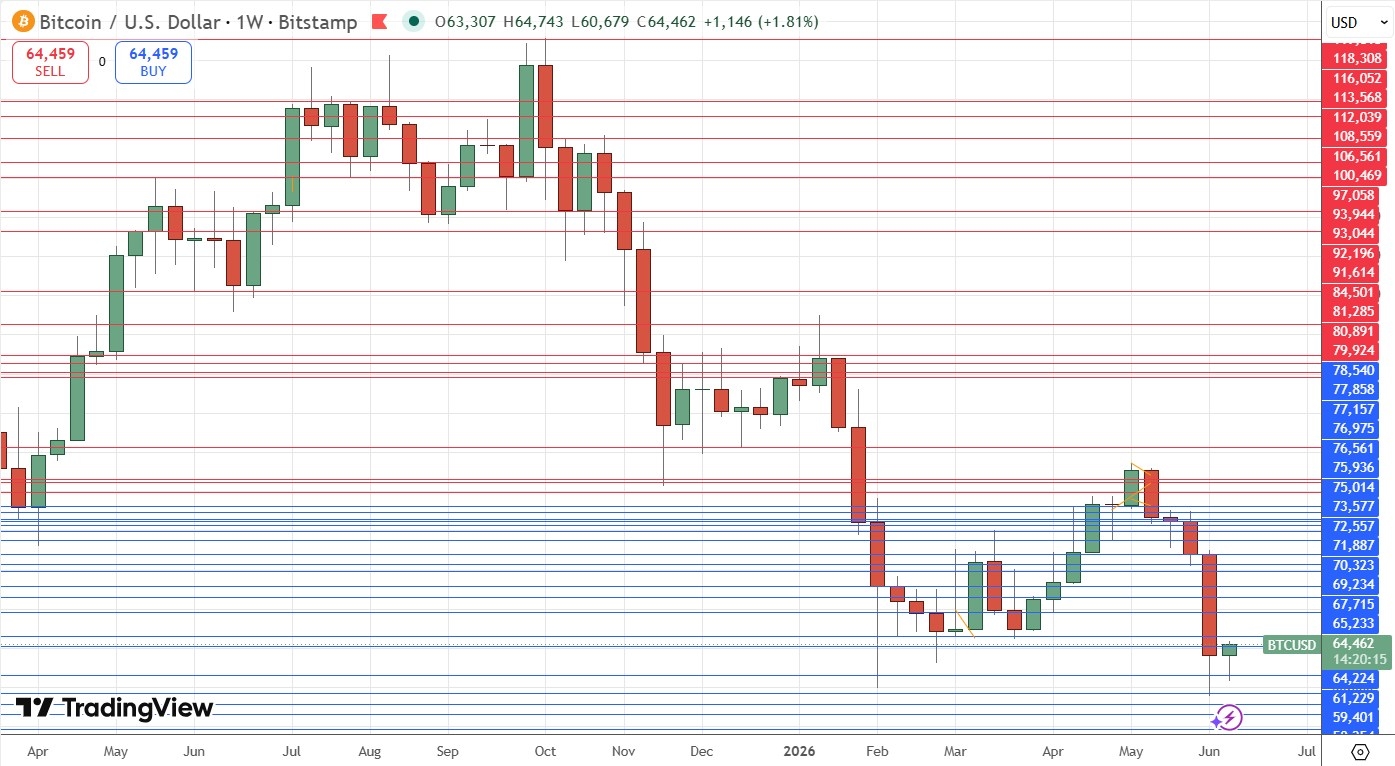
Bitcoin Weekly Price Chart
Bottom Line
I see the best trades this week as:
Long of the USD/JPY currency pair following a daily close above ¥160.44.
Ready to trade our weekly Forex forecast? Check out our list of the best Forex brokers.