


The USD/ILS exchange rate has moved sideways in the past two months as the US-Iran conflict continued. It was trading at 3.1288 on Thursday, down slightly from last month's high of 3.1750. It remains nearly 20% below its highest point last year.
The Israeli shekel has done well despite the ongoing war between the United States, Israel, and Iran. This war has largely placed Israel’s economy at a standstill, with the daily barrages from Iran, Yemen, and Lebanon.
As a result, economists expect the economy will grow 4.7% this year, with the IMF and OECD expect it to grow by 4.8% and 4.9%. This means that the Israeli Central Bank may decide to keep cutting interest rates this year to boost the economy. It has slashed rates from last year's high of 4.75% to the current 4.0%.
The challenge, however, is that Israel’s inflation has started rising, a trend that may continue as it continues. The most recent data showed that the headline Consumer Price Index (CPI) rose 2% in February from 1.8% in January.
Meanwhile, Donald Trump has hinted that he wants to end the war. In a speech, he announced that Iran was seeking for a ceasefire, an allegation that Iran has rejected. He also continued to push other countries to go and secure the Strait of Hormuz.
The next important catalyst for the USD/ILS pair will be the upcoming US macro data. Economists expect the data to show that the economy created 50k jobs in March as the jobless rate rose to 4.5%.
USD/ILS Technical Analysis
The daily timeframe chart shows that the USD/ILS pair has held steady in the past few weeks, moving from a low of 3.05558 in February to 3.1260m
It has moved slightly above the 50-day moving average, while the Supertrend indicator has flipped from red to green. It has formed a small cup-and-handle pattern and is now in the handle section.
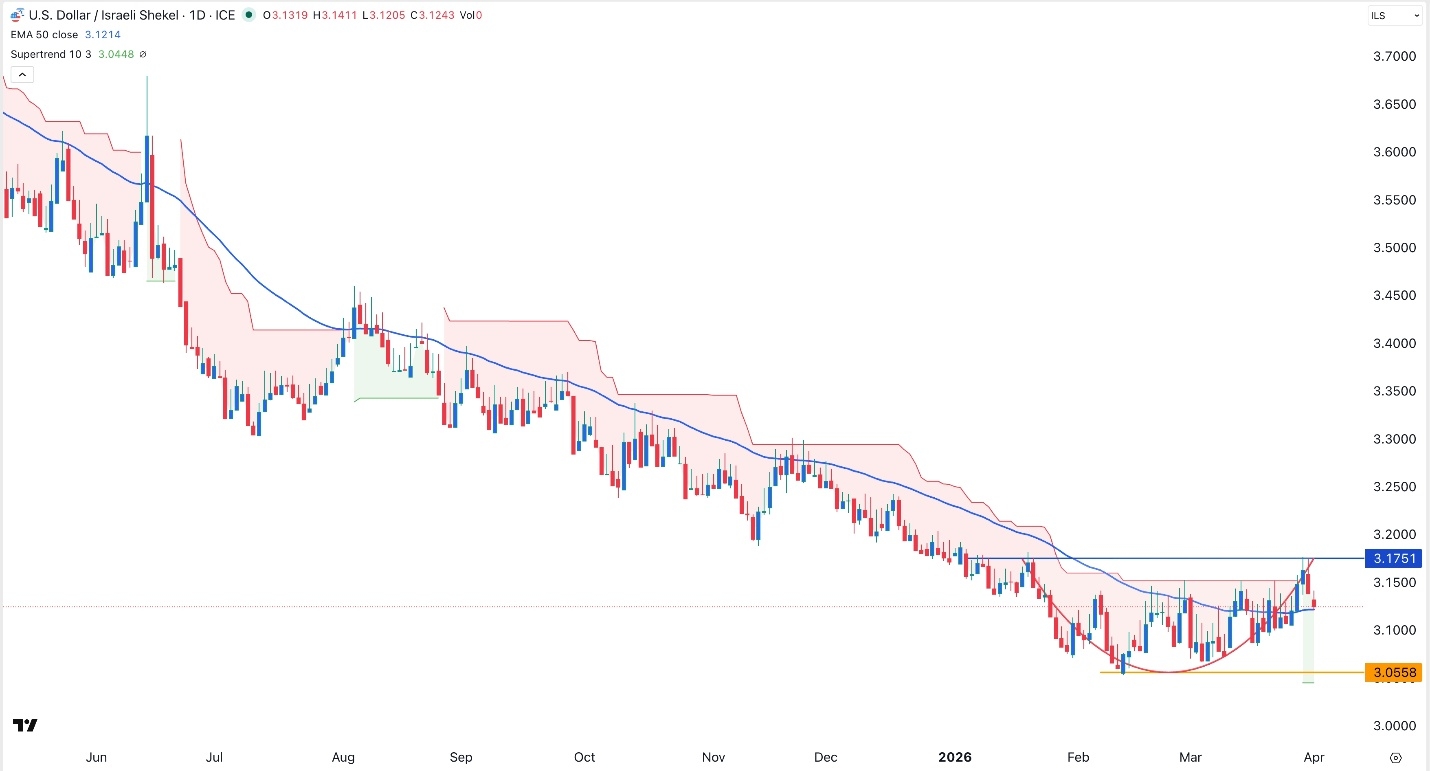
Therefore, the pair will likely continue rising in the coming weeks as bulls target the next key target being at 3.1750. A move above that level will point to more gains, potentially to the key resistance level at 3.2500.