


Crypto has long been known for its volatility, and Bitcoin’s (BTC) price action in late March 2026 has lived up to that understanding. Its movement has been defined by sharp reactions to geopolitical headlines, particularly those involving U.S.-Iran tensions.
The latest market rumblings were directly tied to positive developments on that front. Reports emerging on March 30-31 suggested that Trump was actively considering an end to the war, leading to a rally in stocks and crypto, with BTC rising 5.56% from a low of $64,943 on Sunday to a high of $68,556 on Tuesday.
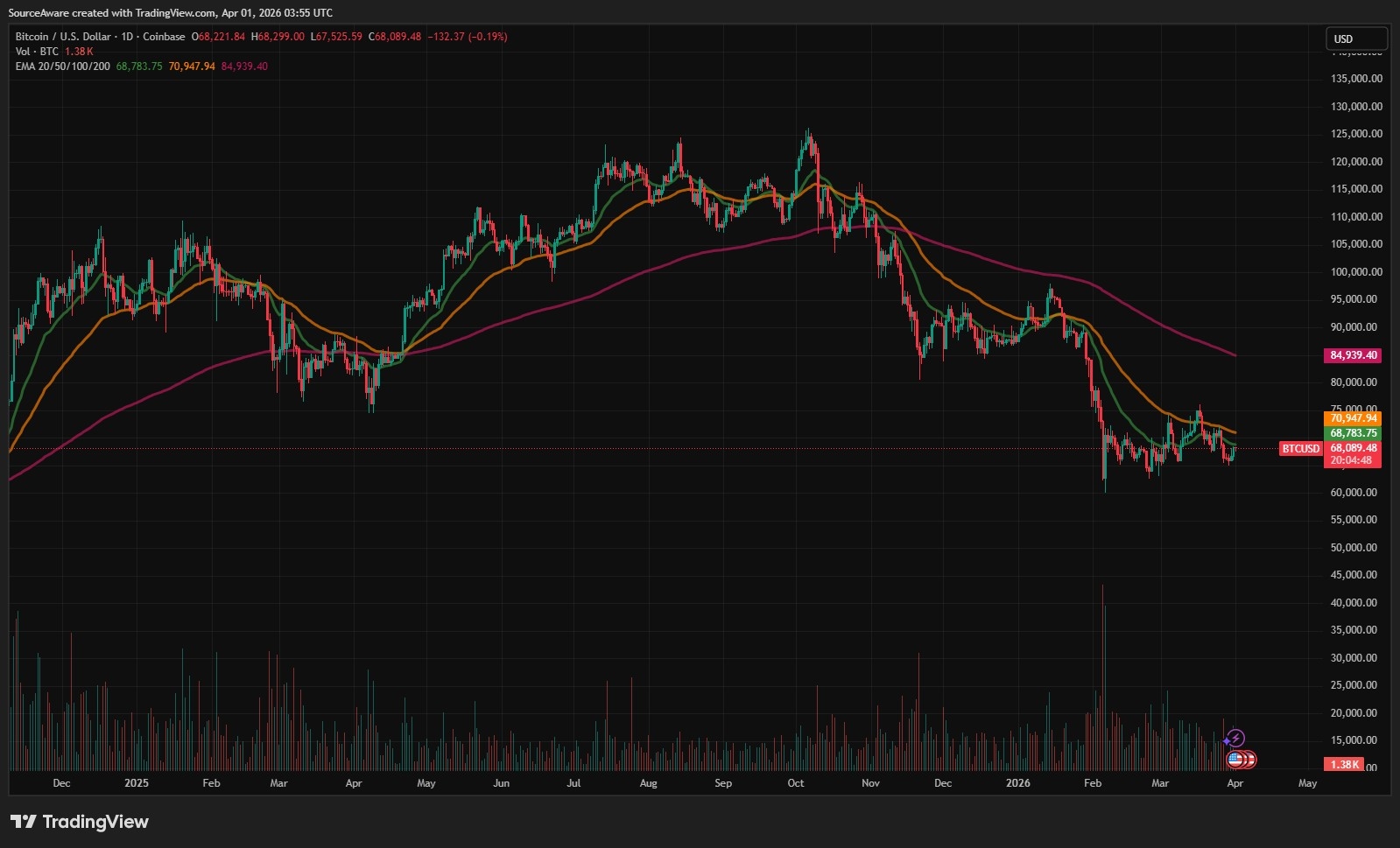
BTC/USD 1-day chart. Source: TradingView
And it wasn’t just Bitcoin that enjoyed a brief crypto winter respite, as Ether, Solana, and XRP all posted comparable moves. The in-tandem movement underscored crypto's correlation with broader risk assets during periods of easing uncertainty.
Analysts note that this is a pattern worth paying attention to. Bitcoin increasingly acts as a barometer for global risk appetite, moving in lockstep with headlines in a way that would have seemed strange even a few years ago.
BTC ultimately closed March around $68,330, up nearly 13.56% from the February lows, buoyed not just by the geopolitical reprieve but by continued ETF inflows and solid technical support levels holding firm throughout the volatility.
But that doesn’t mean it's time to celebrate the end of crypto winter. An honest assessment shows the moves higher remain fleeting, with Bitcoin's weekly performance staying modestly negative in some sessions. This reality reflects lingering caution over inflation, Fed policy, and unresolved global debt concerns.
Altogether, the volatility of late March highlights Bitcoin's maturing role as a barometer for investor sentiment – rising on clarity, even if that clarity is diplomatic rather than fundamentally bullish. But as the saying goes, be careful what you wish for; yes, Bitcoin is maturing as an asset class, but that maturity comes with a new kind of sensitivity to the same forces that move equities, crude oil, and currencies.
At the time of writing, BTC trades at $68,089, a decrease of 4% on the 7-day chart.
TradFi→ DeFi Merge Accelerates
While Bitcoin and the broader crypto market navigate short-term headlines, a deeper structural shift is underway: the accelerating integration of traditional finance (TradFi) with decentralized finance (DeFi) through real-world asset (RWA) tokenization.
A prime example came on March 31 when S&P Dow Jones Indices tokenized its iBoxx US Treasuries Index on the Canton Network in partnership with data provider Kaiko. While the move does not create a new investable product, it embeds benchmark pricing, index levels, and performance data directly onto the blockchain as permissioned tokens, creating a programmable, on-chain benchmark for U.S. Treasury securities performance.
Think automated pricing, real-time valuation, and dramatically reduced operational friction. Best of all, it comes without sacrificing the compliance and privacy standards that institutions require. Canton's permissioned infrastructure, backed by heavyweights including Goldman Sachs and DTCC, is precisely the kind of environment where this type of integration makes sense.
With this development, institutions building digital fixed-income products can now access Treasury benchmark information natively onchain, bypassing legacy data feeds and licensing hurdles. S&P retains control over access and usage rights embedded in the token, while Kaiko handles issuance and delivery.
The development is significant because U.S. Treasury products already dominate the tokenization market. Of the roughly $27.8 billion in total tokenized RWAs (excluding stablecoins), more than $12.7 billion consists of tokenized Treasuries. By placing benchmark data onchain, S&P's initiative further cements Treasuries as the "base layer" for emerging digital financial systems.
As for the Canton Network's native token (CC), it has been trading in the $0.14–$0.15 range through late March and into April.
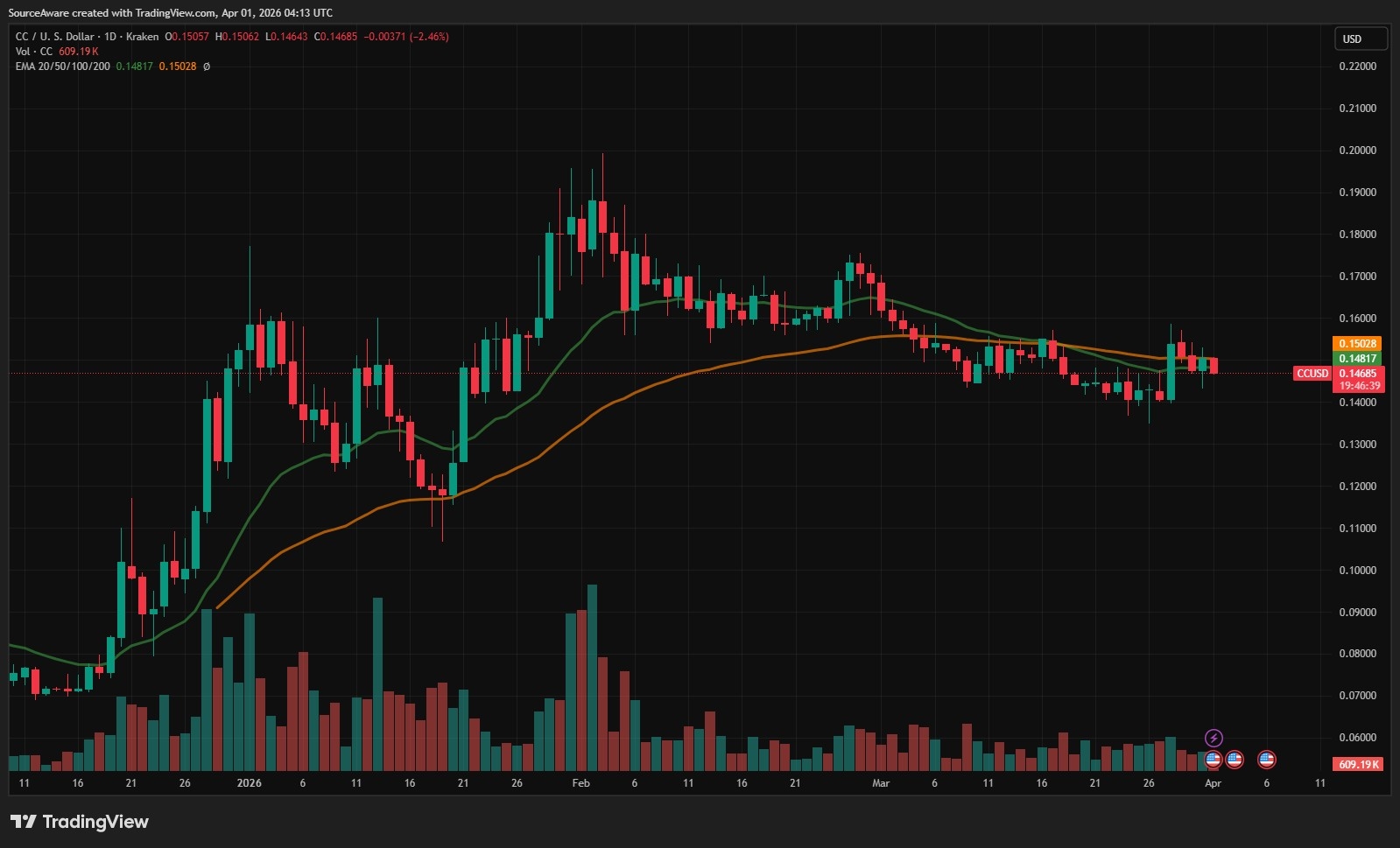
CC/USD 1-day chart. Source: TradingView
While not experiencing explosive daily spikes, CC has benefited from broader RWA sentiment, rising roughly 4% over the past week as adoption metrics, including $6 trillion in assets processed and 500,000 daily transactions, underscore its production-grade status.
Beyond its price action, the token's relatively subdued movement shouldn't overshadow the network's growing institutional footprint. The real story with Canton is its growing role as the underlying infrastructure for institutional involvement in RWA tokenization.
At the time of writing, CC trades at $0.14685, an increase of 3.8% over the past 7 days.
My Take
Taken together, these developments paint a picture of a market in genuine transition - where macro politics can still swing Bitcoin by 5% in an afternoon, but where the deeper structural story is one of steady, serious institutional integration that's only just getting started.
For investors, the message is clear: volatility from geopolitics may drive near-term price action, but the real transformation lies in the plumbing being rebuilt for a hybrid financial future.
We hope you enjoyed reading our analysis of developments in Bitcoin and in RWA tokenization infrastructure. If you’d like to trade with one of the best crypto CFD brokers, check out our list.