





Fundamental Analysis & Market Sentiment
I wrote on 15th March that the best trades for the week would be:
Long of the USD/JPY currency pair. This gave a loss of 0.31%.
Long of Wheat. This gave a loss of 1.27%.
Last week’s overall loss of 1.58% is 0.79% per asset.
A summary of last week’s most important data in the market:
US Federal Reserve Policy Meeting – a slightly hawkish tilt as the Fed emphasized inflation risk from the secondary effects of the war in the Middle East, which briefly sent the US Dollar higher.
US PPI – this was much stronger than expected, showing a month-on-month increase of 0.7% while only 0.3% was widely forecast. This suggests higher inflationary pressure in the USA and contributed to the more hawkish sentiment around the US Dollar.
Reserve Bank of Australia Policy Meeting – the Cash Rate was hiked by 0.25% as expected, and the renewed strong focus on inflation was seen as mildly hawkish.
Bank of Japan Policy Meeting – a slightly hawkish hold, with one board member pushing for a rate hike of 0.25% now.
European Central Bank Policy Meeting – a hawkish hold, as the bank revised its 2026 inflation forecast upward.
Bank of England Policy Meeting – a solidly hawkish hold, with analysts now seeing a chance of a rate hike later in 2026.
Bank of Canada Policy Meeting – a marginally dovish hold, with the Bank downplaying inflationary risk.
Canadian CPI (inflation) – slightly lower than expected, showing an increase of only 0.5% month-on-month while 0.7% was widely expected.
Swiss National Bank Policy Meeting – arguably a slightly dovish hold, as the Bank are acting in a way that suggests further cuts to a negative rate are possible.
US Unemployment Claims – very slightly better than expected.
New Zealand GDP = worse than expected, with growth increasing by only 0.2% when 0.5% was expected.
Australia Unemployment Rate – this rose unexpectedly from 4.1% to 4.3%.
UK Unemployment Claims – as expected.
Last week’s data had little effect on the market, excepting the boost in the US Dollar and the strengthening of the Euro after the ECB’s hawkish rate hold. Generally, we are seeing hawkish central banks against the backdrop of a potentially inflationary energy price shock generated by the ongoing war in the Middle East. There are open and frightening questions over how this war might end, with the parties on the bring of seriously escalating by targeting critical energy and infrastructure.
Top Regulated Brokers
The latest developments in the war are:
A few hours ago, President Trump issued an ultimatum that if the Strait of Hormuz is not opened by Iran within 48 hours, the USA will start destroying Iranian power plans. This follows several days of attacks on other countries’ infrastructure by Iran, which has been aiming at Israel’s (alleged) nuclear reactor in its South and at the oil refinery in Haifa. It is hard to see an outcome where Iran backs down over this so we can expect US attacks here probably on Tuesday or Wednesday. This threat, let alone its execution, is likely to rattle energy and stock markets.
Seven NATO and non-NATO allies have pledged to assist the USA in reopening the Strait of Hormuz. However, experts believe such a military operation will take a few weeks to be executed.
Prediction markets see this war continuing for at least another five weeks, into May, after US troops enter Iran at some point in April. This war is very unlikely to stop quickly, which increases the potential for it to disrupt or influence markets.
Clearly, the USA and Israel are successfully striking all the targets they want to inside Iran, while suffering very few casualties themselves. There is damage to US bases and facilities near the Gulf, and relatively minor damage in Israel, although yesterday’s missile strikes produced an unusually large number of casualties which Israel will see as an escalation to be met.
There is massive damage to Iran’s regime and military. What is far from clear is the fate of the Iranian regime and the large supply of enriched uranium which is somewhere in Iran.
We are on the brink of a very serious escalation.
The Week Ahead: 23rd – 27th March
The middle east war is likely to remain more influential that any economic data releases which are scheduled over the coming week, especially if it escalates towards increased targeting of infrastructure. The top three items have realistic potential to move the market a bit, especially in the British Pound and in the Australian Dollar.
The coming week’s most important data points, in order of likely importance, are:
UK CPI (inflation)
Australian CPI (inflation)
USA, Germany, UK Flash Services & Manufacturing PMI
US Unemployment Claims
UK Retail Sales
Monthly Forecast March 2026
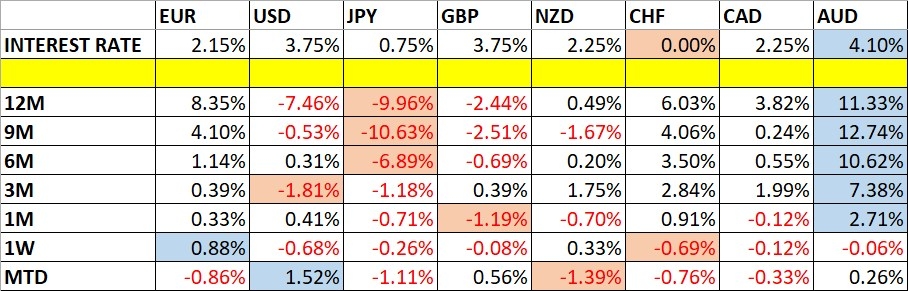
Currency Price Changes and Interest Rates
For the month of March, I made no monthly Forex forecast as the US Dollar was not in a clear trend at the start of the month.
Weekly Forecast 22nd March 2026
Last week saw no currency crosses with excessive volatility, so I am making no forecast for the coming week.
The Euro was the strongest major currency last week, while the Swiss Franc was the weakest. Directional volatility decreased strongly last week, with only 11% of all major pairs and crosses changing in value by more than 1%.
Next week’s volatility is likely to increase and might be exceptionally high due to the escalation of the war in the Middle East, which is now threatening power facilities, oil facilities, and desalination plants. This could generate volatility in the US Dollar, the Japanese Yen, and the Canadian Dollar, not to mention stock markets. There could also be unforeseen side effects which might affect other currencies.
You can trade these forecasts in a real or demo Forex brokerage account.
Technical Analysis
Key Support/Resistance Levels for Popular Pairs
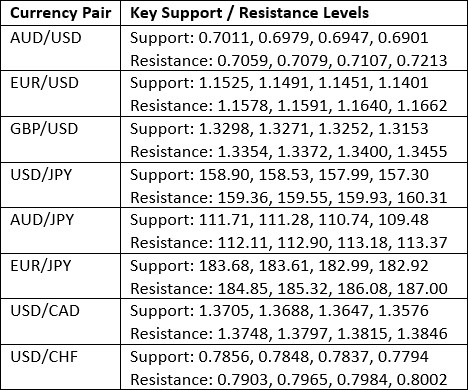
Key Support and Resistance Levels
US Dollar Index
The US Dollar printed a bearish inside bar, although the price remains within a valid long-term trend. There is a lower wick on the candlestick, which is a minor bullish sign. The price has more room to rise before reaching the key resistance level at 101.39.
I think expecting the greenback to rise is still the healthy and correct approach despite this minor retracement, because fundamentals and sentiment still point towards a rising US Dollar, with US Treasury Yields reaching significant highs last week. The Fed itself expects to make one rate cut in 2026, though, although the market does not agree that this is likely to happen.
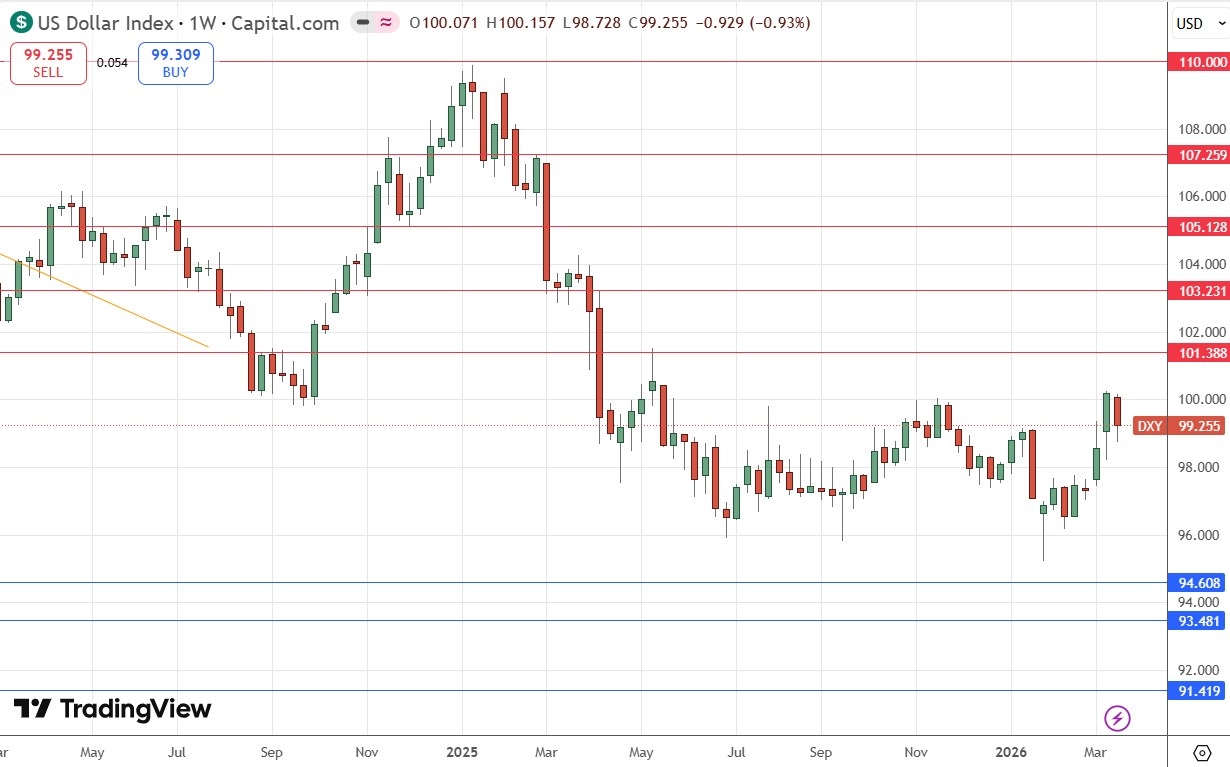
US Dollar Index Weekly Price Chart
USD/JPY
The USD/JPY currency pair gained strongly at the end of last week but could still not regain the high price made earlier in the week, which represented a long-term high. I am long of this currency pair. The only doubts I have is that we have not yet cleared the big round number at ¥160 which has acted as resistance for a long time, and that the technically significant breakout is taking a long time to happen.
The US Dollar lost some ground last week but did better against the Japanese Yen than it did against many other currencies. The Bank of Japan did not look like it is about to start hiking rates very soon at its meeting last week, and that has caused a little underlying weakness in the Yen.
There are excellent fundamental, sentimental, and technical reasons to be long here, but more cautious traders might want to wait for a New York close above ¥160 before going long.
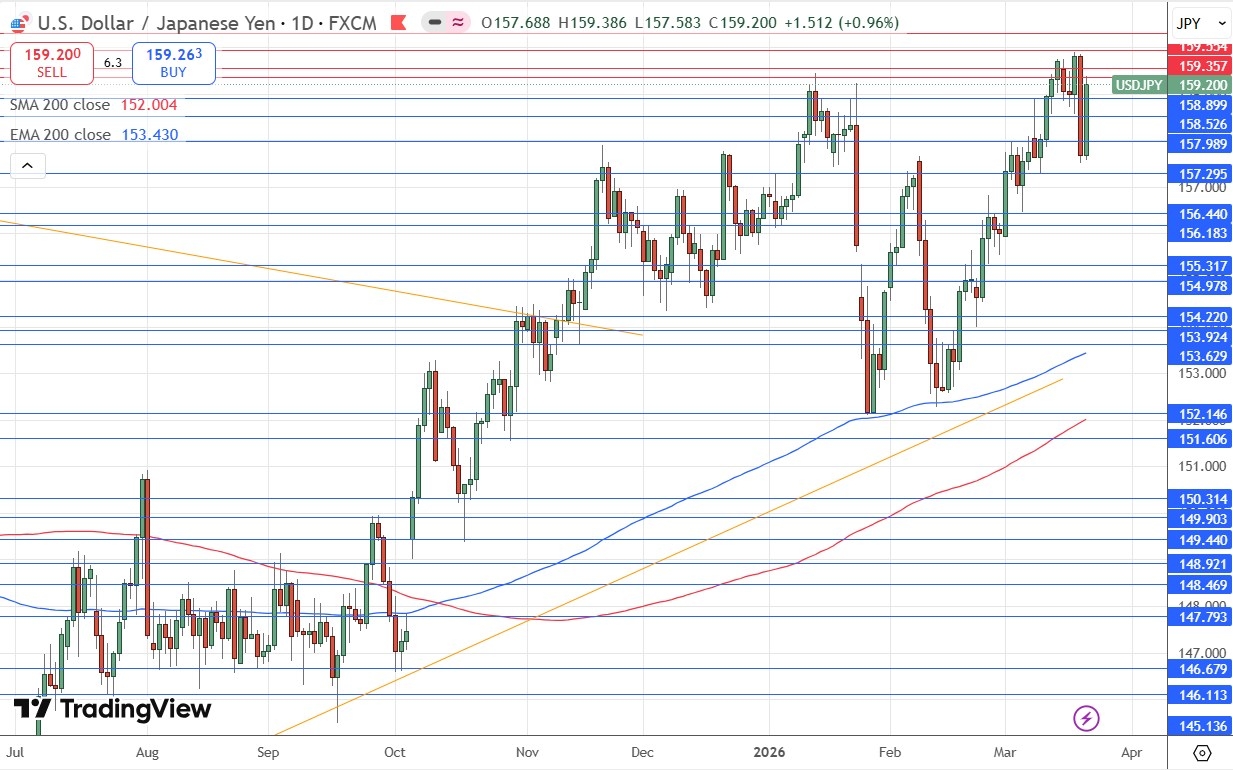
USD/JPY Daily Price Chart
Brent Crude Oil Futures
Brent Crude Oil is outperforming WTI Crude Oil, mainly because the USA is functionally energy independent (WTI), while Brent Crude is seaborne international trade which is currently more prone to well-founded fears of supply disruption due to the war in the Middle East and Iranian blockade of the Strait of Hormuz.
The war in the middle east is showing signs of escalating as President Trump threatens Iranian power stations if Iran does not open the Strait of Hormuz by about dawn local time Tuesday. Iran in turn threatened power and desalination plants throughout much of the Middle East, which it has already shown it is prepared to target and in some cases able to target.
These threats, as well as ongoing speculation that the USA might seize Kharg Island as one of its next military steps, are spooking markets – we can be sure that markets will open with energy prices higher and stock markets lower as the new week gets underway, unless there is a credible rumour of ceasefire talks.
Polymarket is showing US ground troops in Iran at some point during April and the USA (plus presumably Israel) ceasing operations in May, meaning the war will probably go on for at least another five weeks.
It is likely to be dangerous to enter now as we could easily see a fast and huge move in the price either up or down. However, the price action does look bullish, so longs will still be dominating orders. I don’t see the Iranians backing down, and I think that means a week of rising crude oil prices.
Despite the mature and very over-extended trend here, and its total reliance on geopolitical developments, I think it will still be a good idea to enter long on bullish price action using a trailing stop (I prefer 3 X ATR (100)). It will probably be wise to use a very small position size maybe one-quarter of the usual, or maybe even one-eighth.
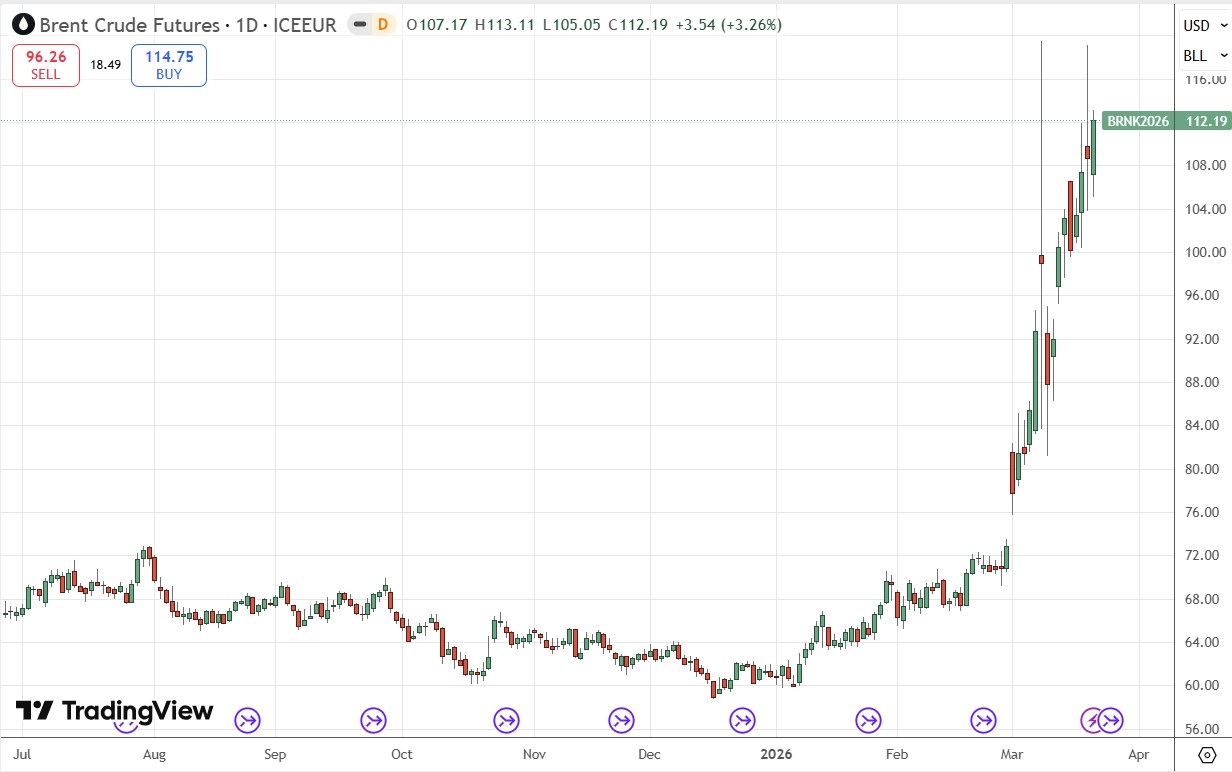
Brent Crude Oil Daily Price Chart
Gasoline Futures
RBOB Gasoline futures rose firmly to close at a new 3-year high last week ending very near the high price, which was made on Friday. Gasoline is trading in blue sky and can keep rising easily.
This is all about what I wrote above concerning Brent Crude Oil. As the price of crude oil rises, so the price of Gasoline is almost certain to rise with high positive correlation between the two assets, as gasoline is derived by refining crude oil.
As I wrote above, it might be too late for a long trade, but it may be wise to try to get in on the ongoing action using a very small position size (respect the very high volatility) and a trailing stop to avoid a catastrophic loss. Remember that what goes up very hard and very fast can come down just the same way.
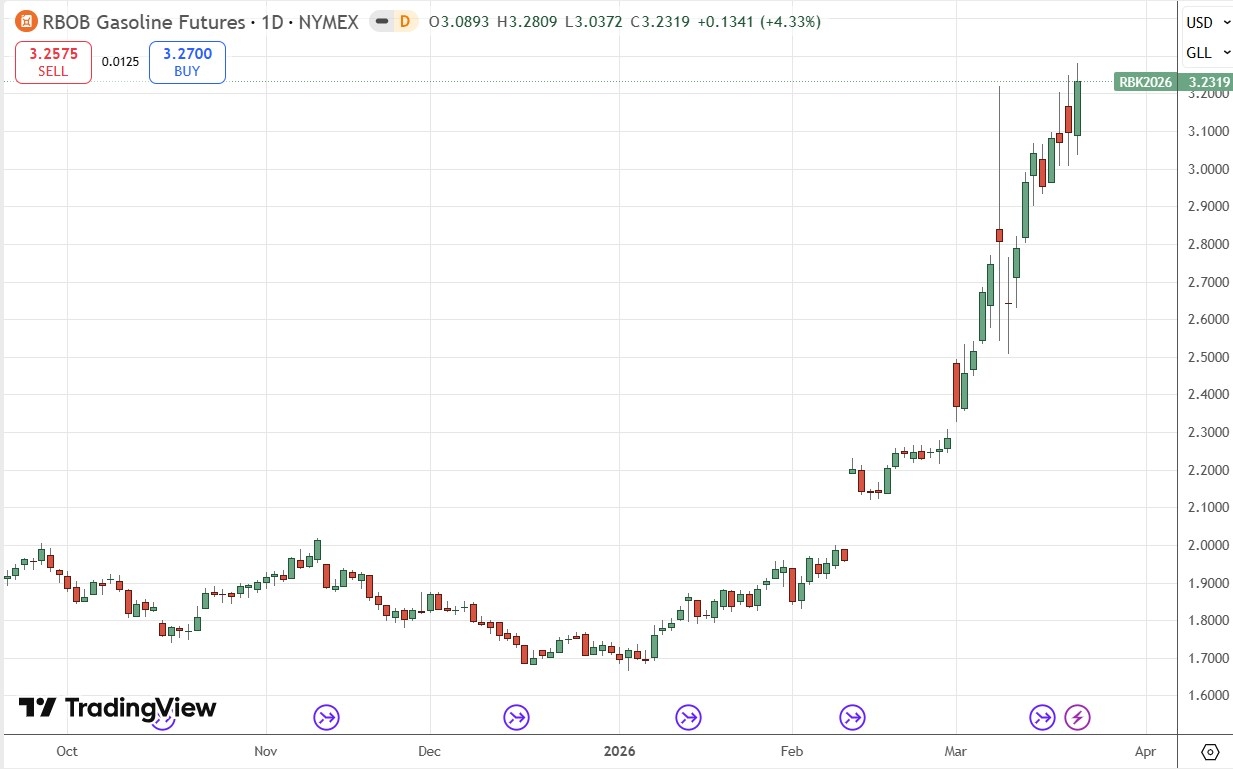
RBOB Gasoline Futures Daily Price Chart
S&P 500 Index
Last week was poor for the US stock market, with the S&P 500 Index falling quite heavily to reach a new 6-month low, with the daily chart closing below both the SMA 200 and the EMA 200. These are bearish signs, although it is worth pointing out that the market is not down by even 10% from its recent all-time high which it reached just a few weeks ago.
I was correct last week in saying that the price would quickly reach the significant round number at 6,500. What will be closely watched now is whether the price continues to descend below that. If it spends most of the coming week below 6,500 that will be a very bearish sign and point to further losses.
President Trump and Iran’s latest infrastructure threats are likely to further spook the market. Unless there is contrary news, I am sure this Index will open below 6,500 and probably lose some more ground on Monday.
The escalating war in the Middle East is not the only thing weighing on the stock market. It is also very over-extended and overbought and due a significant retracement, and the worrying war was easily enough to give that a tailwind.
Despite the bearish outlook, shorting the US stock market, especially an Index, is not easy, and should only be attempted by experienced traders. A bullish bounce over the coming week, or at least a consolidation and minor gain, is a possible outcome, as we are in a price area where you could expect long-term buyers to step in.
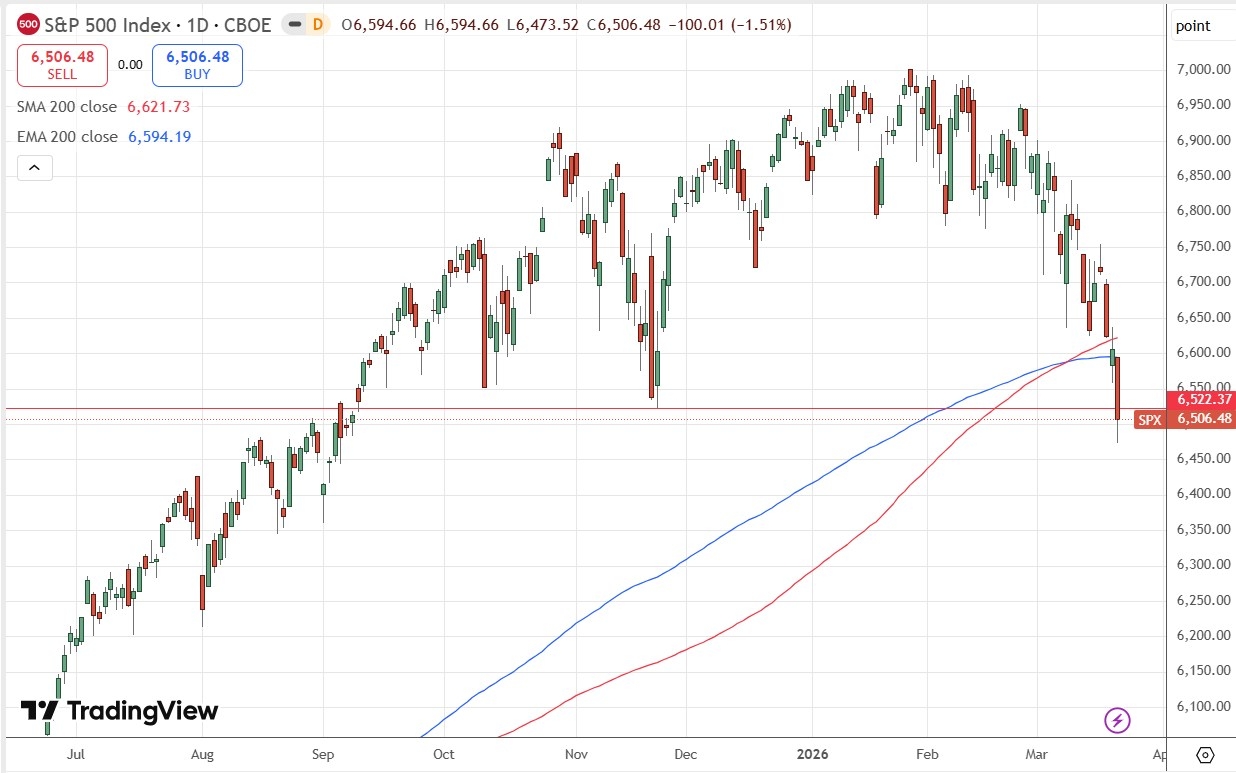
S&P 500 Index Daily Price Chart
Bottom Line
I see the best trades this week as:
Long of the USD/JPY currency pair.
Long of Brent Crude Oil but with ¼ of the normal position size.
Long of Gasoline but with ¼ of the normal position size.
Ready to trade our Forex weekly forecast? Check out our list of the best Forex broker.