





Fundamental Analysis & Market Sentiment
I wrote on 8th March that the best trades for the week would be:
A summary of last week’s most important data in the market:
USA CPI (inflation) – as expected at an annualized rate of 2.4%.
US Core PCE Price Index – as expected at 0.4% month-on-month.
US Preliminary GDP – lower than expected at 0.7% over the quarter when a reading as high as 1.4% was expected, which may contribute to bearish sentiment in the US stock market.
US JOLTS Job Openings – slightly higher than expected.
US Unemployment Claims – as expected.
UK GDP – lower than expected, with no change month-on-month while an increase of 0.2% was expected.
Canada Unemployment Rate – unexpectedly ticked higher to 6.7% while 6.6% was expected.
Last week’s data had very little effect on the market. What did affect the market was the ongoing and escalating war in the Middle East, which has pushed the price of crude oil higher, damaged the economies of the Gulf states which are suffering from attacks from Iran, and raised tension between the USA and China. There are open and frightening questions over how this war might end, with the parties on the bring of seriously escalating by targeting critical energy and infrastructure.
Clearly, the USA and Israel are successfully striking all the targets they want to inside Iran, while suffering very few casualties themselves. There is damage to US bases and facilities near the Gulf, and relatively minor damage in Israel. There is massive damage to Iran’s regime and military. What is far from clear is the fate of the Iranian regime and the large supply of enriched uranium which is somewhere in Iran.
Prediction markets see this war continuing for at least another two weeks. It is very unlikely to stop quickly, which increases the potential for it to disrupt or influence markets.
A large-scale Israeli invasion of Lebanon is also on the table, after Hezbollah entered the war on Iran’s side and began attacking Israel, although this is unlikely to affect markets much.
Iran has begun striking economic targets in the Gulf states, as well as certain oil infrastructure.
We are on the brink of a serious escalation.
Top Regulated Brokers
The Week Ahead: 16th – 20th March
The middle east war is likely to remain more influential that any economic data releases which are scheduled over the coming week. Having said that, we will see an unprecedented seven major central bank policy meetings within the same week!
The coming week’s most important data points, in order of likely importance, are:
US Federal Reserve Policy Meeting
US PPI
Reserve Bank of Australia Policy Meeting (rate hike of 0.25% is expected)
Bank of Japan Policy Meeting
European Central Bank Policy Meeting
Bank of England Policy Meeting
Bank of Canada Policy Meeting
Canadian CPI (inflation)
Swiss National Bank Policy Meeting
US Unemployment Claims
New Zealand GDP
Australia Unemployment Rate
UK Unemployment Claims
It will be a public holiday in Japan on Friday.
Monthly Forecast March 2026
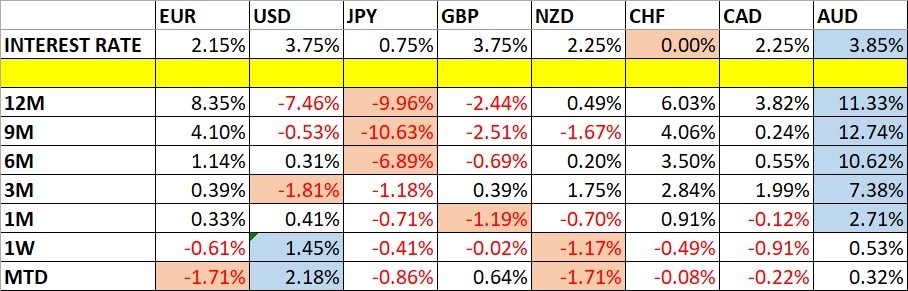
Currency Price Changes and Interest Rates
For the month of March, I made no monthly Forex forecast as the US Dollar was not in a clear trend at the start of the month.
Weekly Forecast 15th March 2026
Last week saw no currency crosses with excessive volatility, so I am making no forecast for the coming week.
The US Dollar was again the strongest major currency last week, while the New Zealand Dollar was the weakest. Directional volatility decreased slightly last week, with 37% of all major pairs and crosses changing in value by more than 1%.
Next week’s volatility is likely to increase and might be exceptionally high due to the escalation of the war in the Middle East, which is now threatening oil facilities, which might generate volatility in the US Dollar, the Japanese Yen, and the Canadian Dollar, not to mention stock markets. There could also be unforeseen side effects which might affect other currencies.
You can trade these forecasts in a real or demo Forex brokerage account.
Technical Analysis
Key Support/Resistance Levels for Popular Pairs
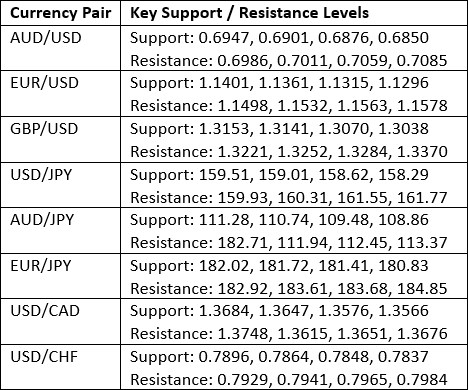
Key Support and Resistance Levels
US Dollar Index
The US Dollar had its strongest week since November, powering higher to close at a fresh 9-month high price with an unusually large candlestick which closed right on the high of its range. These are very bullish signs. The price is obviously in a valid long-term trend and has further room to rise before reaching the key resistance level at 101.39.
There are three reasons for the greenback’s strength:
The Fed is looking less likely to cut rates in 2026, with the CME FedWatch tool now showing the markets are barely expecting a single cut of 0.25%, at the Fed’s December meeting. The 2-Year Treasury Yield has risen to a level not seen since August 2025.
The escalating war in the Middle East which is now seriously threatening to meaningfully restrict global supplies of crude oil and potentially trigger a more hostile relationship between the USA and China, is generating a flight into the US Dollar. The war is also starting to impact Gulf states such as the U.A.E. which are increasingly being targeted by Iran.
Nervous markets are seeing liquidation of American stock positions, meaning American equity is being redeemed into Dollars, raising demand for Dollars.
It is very hard to see this situation changing over the coming week, unless there will be a highly surprising sudden end to the war in the Middle East. I will be very confident being long of the US Dollar over the coming week.
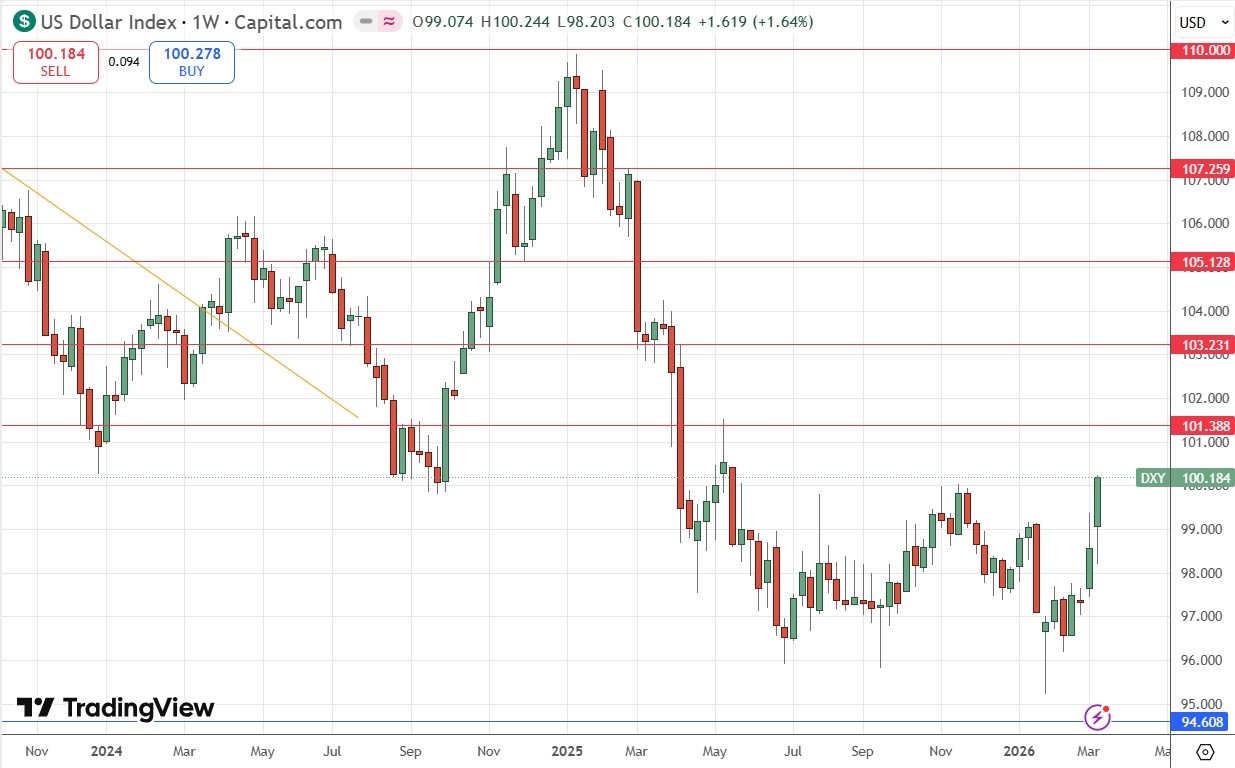
US Dollar Index Weekly Price Chart
USD/JPY
The USD/JPY currency pair gained strongly last week, closing right on the high of its range with a reasonably large bullish candlestick at an 18-month high. These are bullish signs and I am long of this currency pair. The only doubt I have is that we have not yet cleared the big round number at ¥160 which has acted as resistance for a long time.
Another technically encouraging sign is the bullish breakout we saw a few weeks ago from the narrowing triangle formation that can be seen within the price chart below, although this does not prove much for the future, just that we have had a nice technical breakout which now continues into blue sky.
I explained above why the US Dollar is the strongest of all the major currencies, and why this is likely to continue over the coming week. As for the Japanese Yen, although the Bank of Japan would like to raise its rates, it is having great difficulty in doing so due to the high level of debt in Japan. The Japanese Yen has been in a long-term bearish trend.
There are excellent fundamental, sentimental, and technical reasons to be long here, but more cautious traders might want to wait for a New York close above ¥160 before going long.
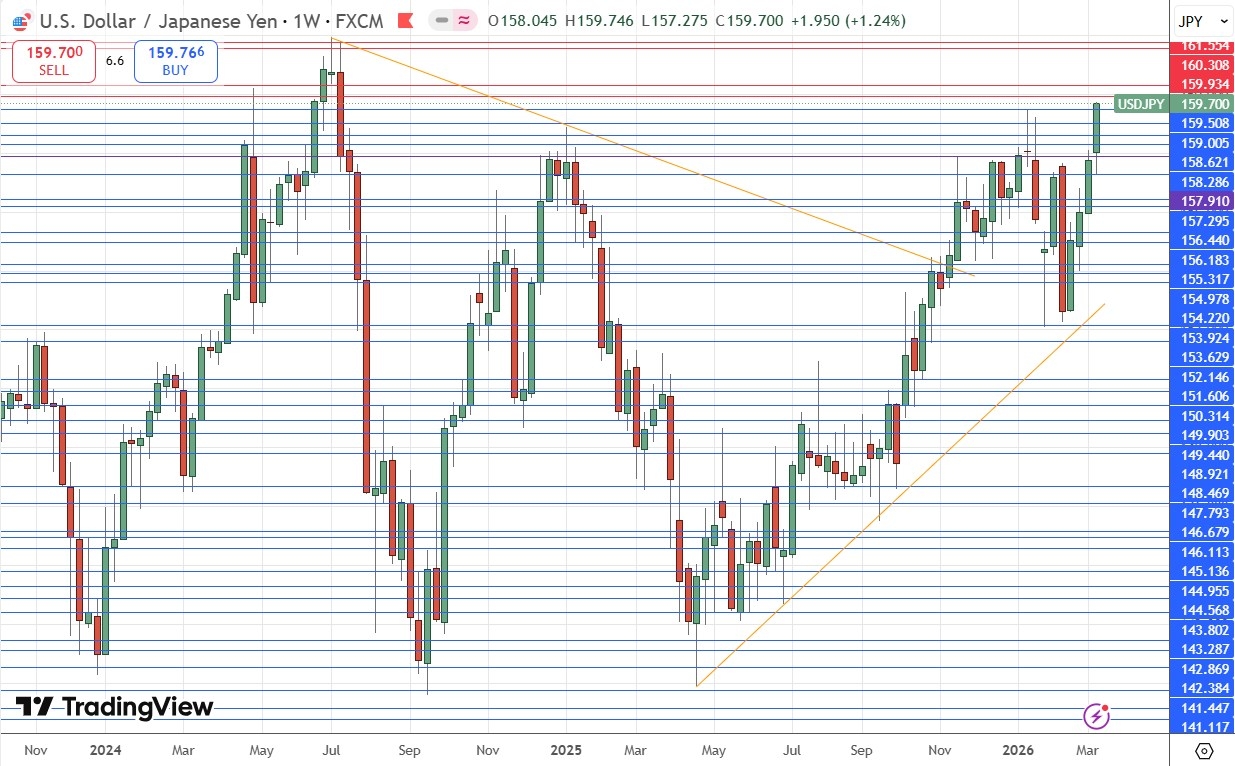
USD/JPY Weekly Price Chart
WTI Crude Oil Futures
WTI Crude Oil rose last week, but not by much, as President Trump had some success in talking the price down by hinting the war would end soon, even though there was really no such early end on the table at all.
Despite the small rise overall, the price briefly reached $120 on Monday before falling back, but as the daily chart below shows, it is rising again, and the price action looks bullish.
The war in the middle east was showing signs of escalating during the second half of last week, with the rumour that Iran had begun mining the Strait of Hormuz through which about 20% of the world’s crude oil transits keeping a bid in the price.
However, after markets closed on Friday for the weekend, news came that the US sent in heavy bombers to wipe out all the military defenses on Kargh Island, an island just off the coast of Iran near Iraq and Kuwait at the end of the Gulf, which processes 90% of Iran’s crude oil exports. President Trump has publicly threatened to devastate the oil facilities there, or at least to “reconsider” his decision to spare them, if Iran does not start to allow free passage through the Strait of Hormuz. However, President Trump has also made it clear that he expects other nations to step up and help in opening the Strait. Effectively, Trump knows that the USA is not affected directly by the closure of the Strait, so he is expecting other countries to take care of their own problem. Ironically, this might calm the price of crude oil as nobody really expects other countries to do much about Hormuz. However, the effective closure of Hormuz is going to eventually send the price well above $100 if it persists.
It is likely to be dangerous to enter now as we could easily see a fast and huge move in the price either up or down. However, the price action does look bullish, and the long trend trade from the breakout near $65 will have survived for most trend following systems, so longs will still be dominating orders.
If you do go long, do it with a very small position size that reflects the enormously high volatility which we see in the price now.
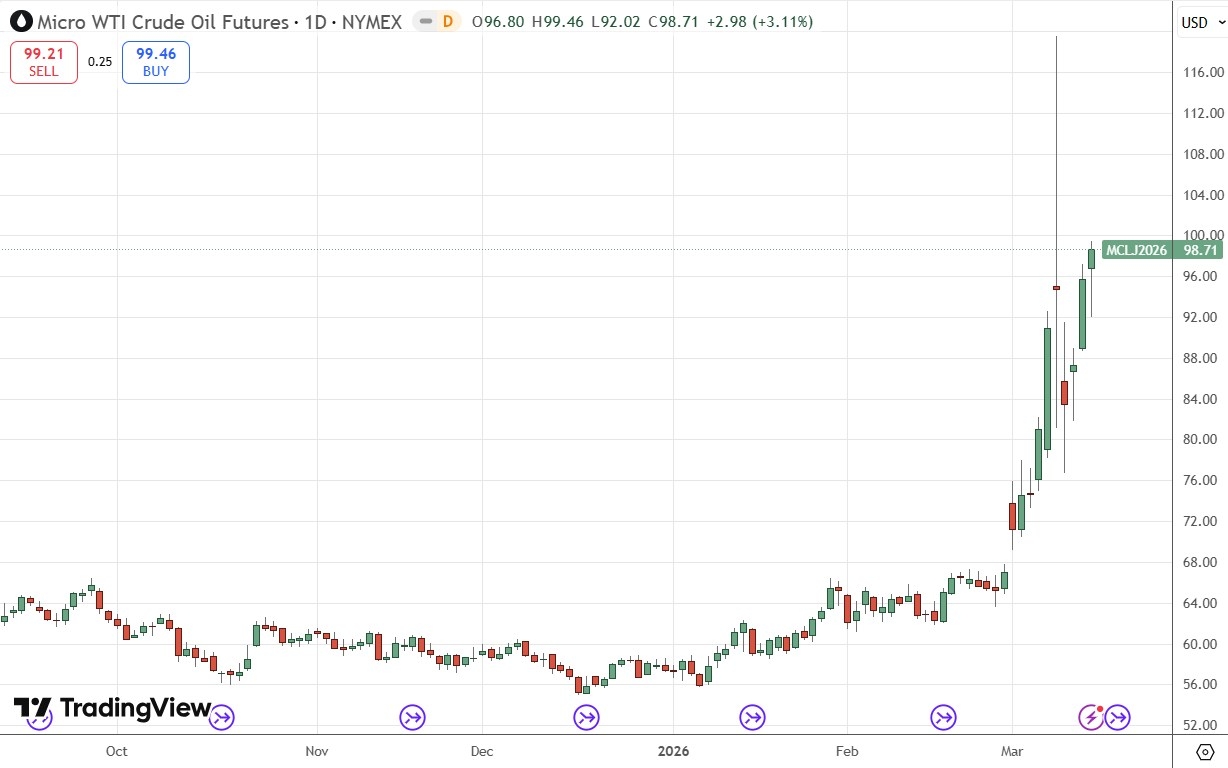
WTI Crude Oil Daily Price Chart
Gasoline Futures
RBOB Gasoline futures briefly traded at a new 3-year high last week before falling back, but like Crude Oil, the price action remains bullish.
This is all about what I wrote just above concerning WTI Crude Oil. As the price of crude oil rises, so the price of Gasoline is almost certain to rise with high positive correlation between the two assets, as gasoline is derived by refining crude oil.
As I wrote above, it might be too late for a long trade, and if you do feel you have to go long here, use a very small position size (respect the very high volatility) and a trailing stop to avoid a catastrophic loss. Remember that what goes up very hard and very fast can come down just the same way.
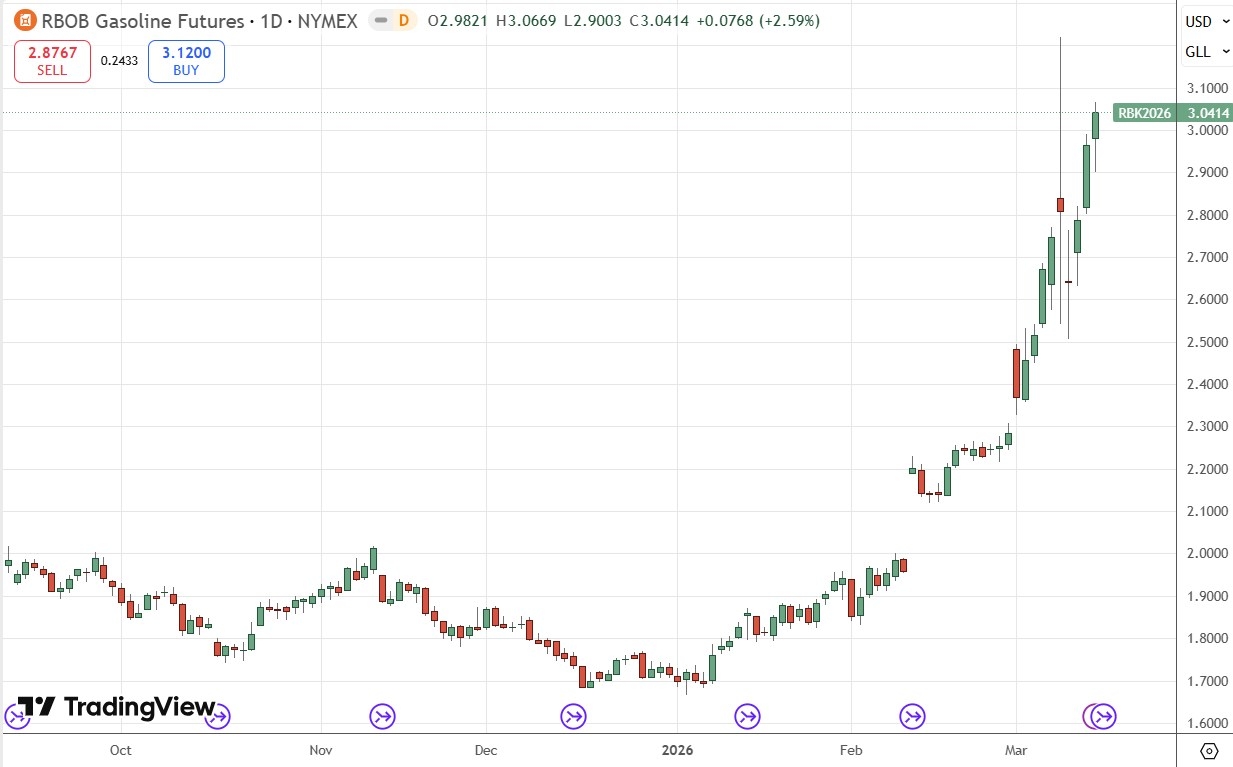
RBOB Gasoline Futures Daily Price Chart
Wheat Futures
ZW Wheat futures are slightly lower over the week, after reaching their highest price in a year during the previous week but ended the week on a strong note with bullish price action which suggests technically that new highs are going to be reached. Many analysts see the ongoing middle east war as pushing the price of grains up but there are deeper reasons relating to supply issues in the grain markets and changes to the wheat business in the USA.
If Wheat futures are too big for you (and they probably are), you can get exposure to US Wheat by buying the Teacrium Wheat Fund (WEAT) which is an ETF and very affordable.
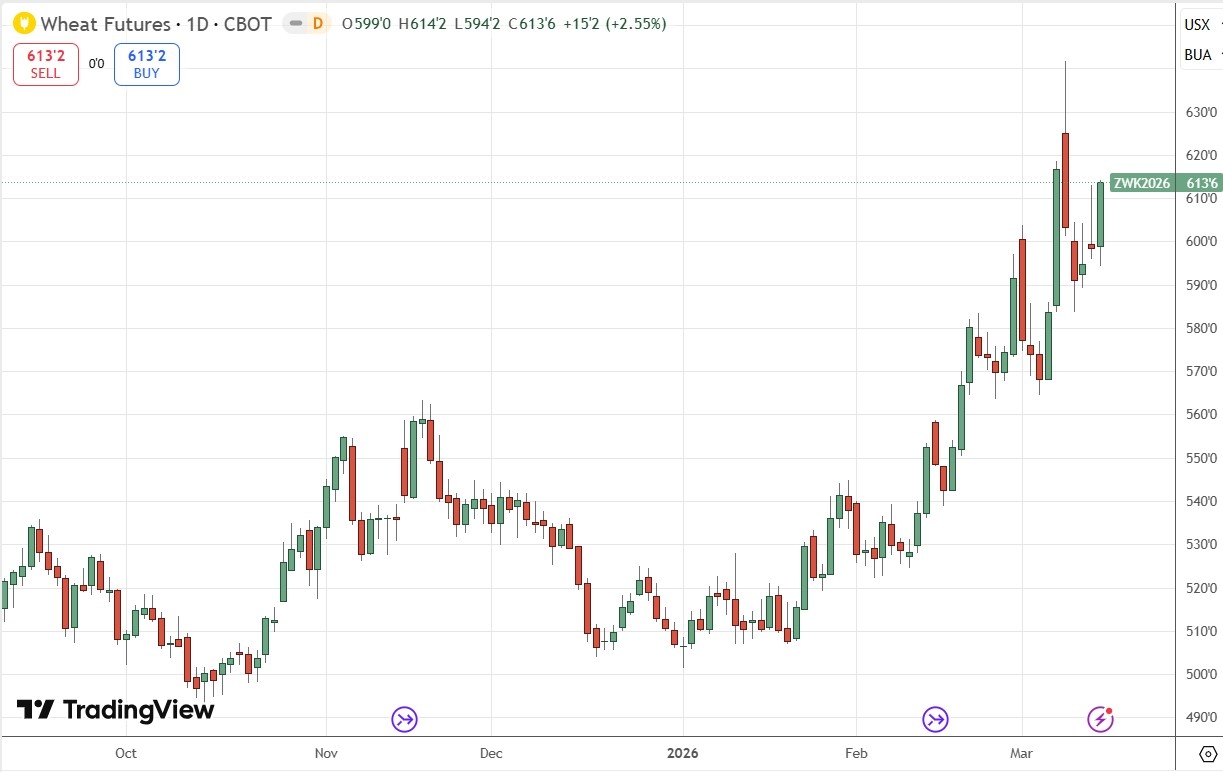
Wheat Futures Daily Price Chart
S&P 500 Index
Last week was poor for the US stock market, with the S&P 500 Index not only closing lower, but ending the week right on its low of the week after breaking below the long-term support level at 6,737.
Technically, things are looking firmly bearish. Look at the topping price action underneath and just touching the big round number at 7,000 which we have seen over recent weeks, and the way the price has started to move lower from there with growing momentum.
I see the price quite quickly reaching the other significant round number at 6,500 or possibly stopping at the horizontal support at 6,522. This area is likely to be strong support and the 200-day moving average is not far below which gives even more supportive confluence. If the price breaks below all that, the market really will be in big trouble.
The US stock market, and stock markets generally, are looking bearish for two reasons:
The over-extended and massive bull market which ran for a long time.
The escalating war in the Middle East which is threatening to cause serious damage to global oil supplies and the economies of the Gulf states.
Despite the bearish outlook, shorting the US stock market, especially an Index, is not easy, and should only be attempted by experienced traders.
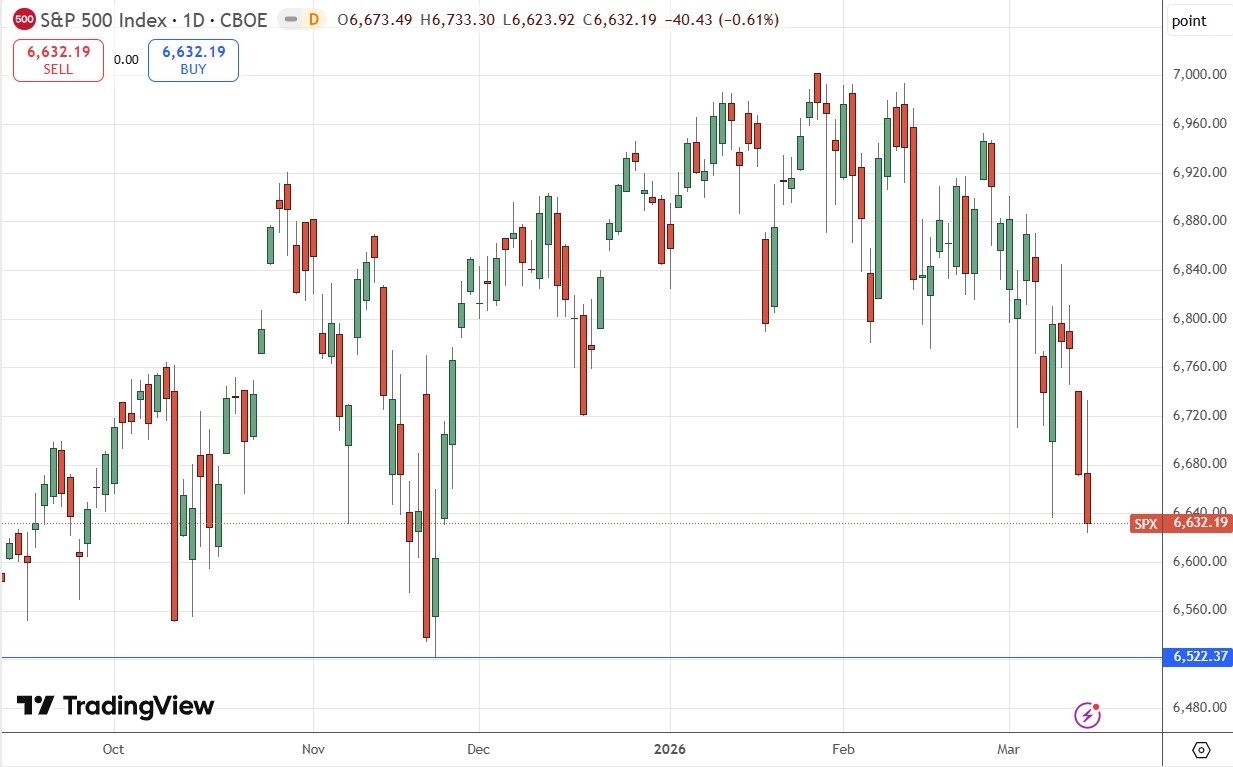
S&P 500 Index Daily Price Chart
Bottom Line
I see the best trades this week as:
Long of the USD/JPY currency pair.
Long of Wheat.
Ready to trade our weekly Forex forecast? Check out our list of the top 10 Forex brokers in the world.