


Bearish view
Sell the EUR/USD pair and set a take-profit at 1.1600.
Add a stop-loss at 1.1825.
Timeline: 1-2 days.
Bullish view
Buy the EUR/USD pair and set a take-profit at 1.1825.
Add a stop-loss at 1.1600.
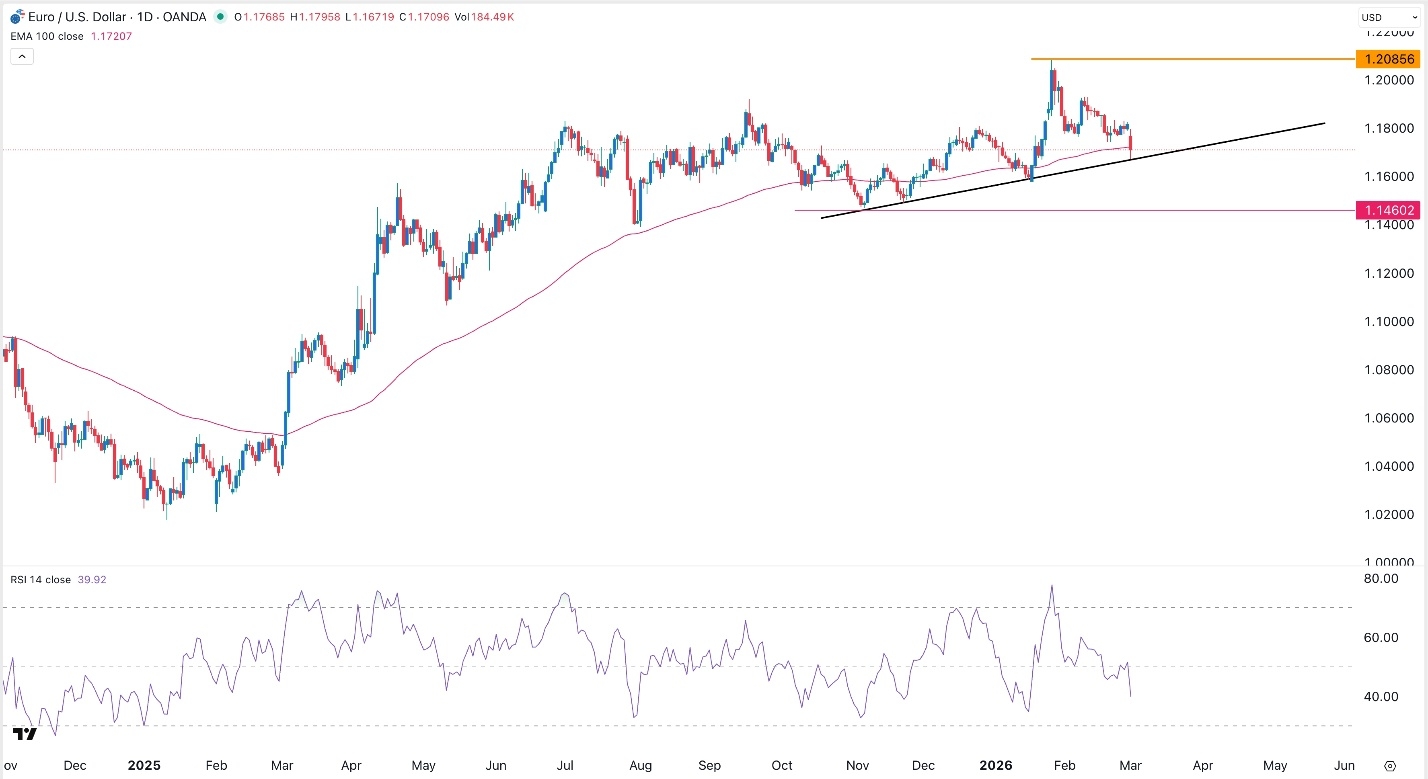
The EUR/USD exchange rate tumbled this week as the US dollar rose amid the ongoing crisis in the Middle East. It also retreated as concerns about the European economy rose. It dropped to a low of 1.1700, its lowest level since January 22nd and 3.17% below the year-to-date high of 1.2083.
US Dollar Jumps as War Continues
The EUR/USD exchange rate retreated sharply as investors moved to the safety of the US dollar amid the ongoing crisis in the Middle East that has left hundreds of people dead.
The US dollar index rose to $98.50, its highest level since January 22nd. It has soared substantially from the year-to-date low of $95.56.
This price action was also boosted by the recent macro data. A report released on Friday showed that the US Producer Price Index (PPI) rose in January, raising concerns that inflation remains strong.
Another report by the Institute of Supply Management (ISM) showed that the manufacturing PMI rose to 52.4 in February. A similar report by S&P Global revealed that the PMI rose to 51.6 in February. A PMI figure of over 50 is a sign that an industry is growing.
Therefore, the strong PMI numbers and the ongoing war means that inflation will remain stubbornly high. Crude oil prices jumped to close to $80, while natural gas prices soared after Qatar closed a key plant.
The next key EUR/USD news will be the flash European consumer inflation, which will come out on Tuesday. Economists expect the data to show that annual inflation remained at 1.7%, while core inflation rose 2.2%.
The pair will also react to statements by top Federal Reserve officials like John Williams of New York Fed and Neel Kashkari of Minneapolis Federal Reserve.
EUR/USD Technical Analysis
The daily timeframe chart shows that the EUR/USD pair has pulled back in the past few weeks, moving from a high of 1.2085 on January 27 to a low of 1.1662.
Its lowest level this week coincided with the ascending trendline, which connects the lowest swings on November 5 and 20th last year and its lowest point in January.
The pair was also trading at the 50-day Exponential Moving Average (EMA), while the Relative Strength Index (RSI) has slipped below the neutral point of 50.
Therefore, the pair will likely remain under pressure as the war goes on. More downside, potentially to the key support level at 1.1460 will be confirmed if it drops below the ascending trendline.
The alternative scenario is where it bounces back since it has settled at a key support level. If this happens, it may rebound to the key resistance level at 1.2000.