


Summary
The New Zealand dollar rebounded against the US dollar as risk sentiment improved, with the US dollar being a major factor in this pair.
New Zealand Dollar vs US Dollar
The New Zealand dollar initially fell on Monday but then turned around as risk sentiment caught a bit of a bid. This, of course, favors the Kiwi over the US dollar.
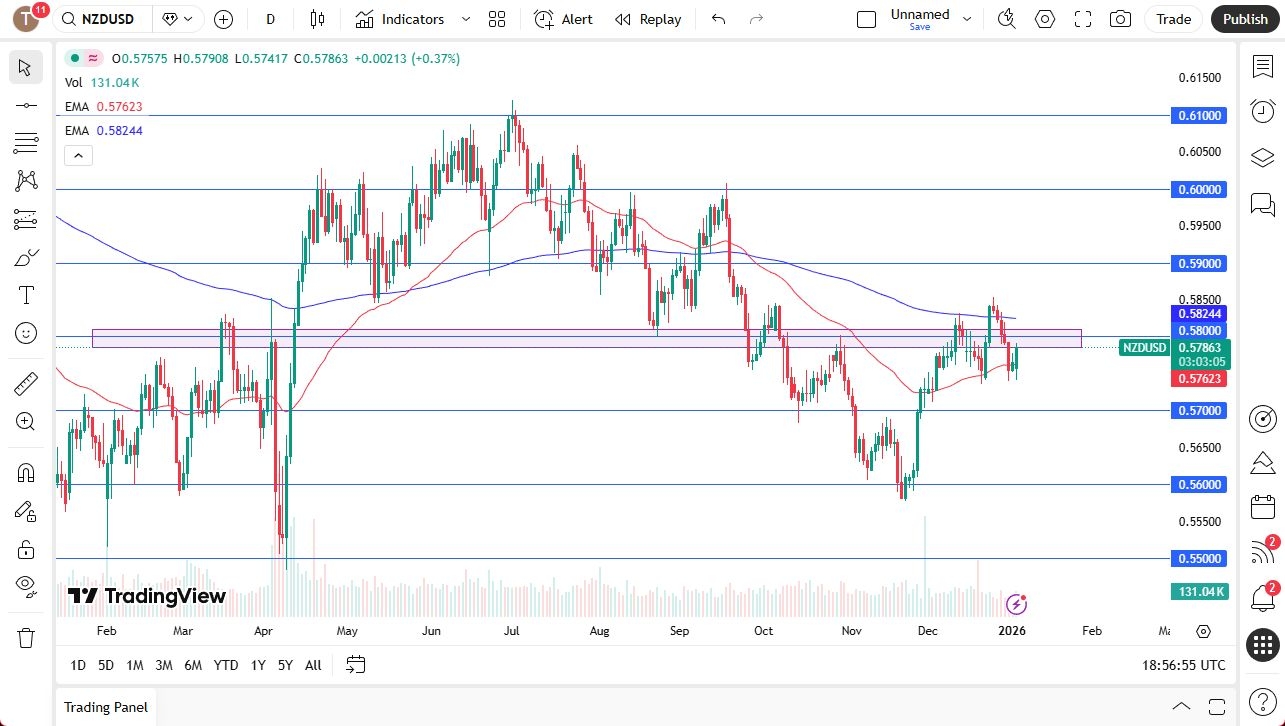
And as we are between two major moving averages, I think a lot of people are paying close attention. With that being said, there are some fundamentals to keep in the back of your mind when trading the New Zealand dollar. It is staging a relief rally, but this is driven mainly by the US dollar correcting. After the US dollar came out like gangbusters at the beginning of the year, we are seeing some profit-taking.
Interest Rate Divergence and Broader Trend Outlook
Global risk sentiment remains choppy, and steady energy prices, as well as hopes for a 2026 capital return to New Zealand dairy farmers, are providing a little bit of a floor for the domestic economy. The rate divergence still favors the US despite the fact that the Federal Reserve has cut. The New Zealand rate is at 2.25% right now, about 1.25% lower than in America.
Top Regulated Brokers
That being said, if the Federal Reserve is going to continue to cut, that should stabilize the interest rate differential and perhaps work out for the New Zealand dollar over the next several months, slightly. The bounce, of course, has recently found a bit of a double bottom, and now we're reacting to it. I do see significant resistance just above the 0.58 level.
This could be an area that you'll have to watch very closely. The broader trend remains bearish as long as we stay below the 0.59 level. And at this point, despite the fact that we've had a nice bounce, I don't see that happening. Ultimately, though, this is a market that I think is just trying to hold a consolidation range with the 0.58 level as your magnet for price.
Ready to trade our Forex daily analysis and predictions? Check out the best forex brokers in New Zealand worth using.