


Short Trade Idea
Enter your short position between $44.20 (yesterday's intra-day low) and $45.53 (the upper band of its horizontal resistance zone).
Market Index Analysis
The broader US equity market remains near all-time highs, but underlying technical deterioration signals potential weakness ahead, particularly for cyclical consumer discretionary stocks like CarMax. While the S&P 500 Index, where CarMax i a member, maintains elevation and fresh all-time highs, decreasing bullish trading volumes despite rising prices indicate exhaustion—a classic warning pattern. The Bull Bear Power Indicator shows bullish momentum paired with a significant negative divergence, hinting at potential short-term reversals. For auto retailers specifically, this macro backdrop is particularly concerning: consumer discretionary rotation is underway as institutional investors recognize valuation risks and economic headwinds. Rising interest rates, tighter consumer credit conditions, and slowing vehicle sales are creating structural headwinds for used car retailers. CarMax's recent 50%+ rally appears disconnected from deteriorating fundamentals, suggesting the move represents a short-term relief bounce rather than fundamental recovery.
Market Sentiment Analysis
Market sentiment toward CarMax has undergone a dramatic reversal, with investor enthusiasm building on the recent 50%+ rally despite fundamental deterioration. This sentiment shift reflects capitulation buying and short covering rather than genuine business improvement. Retail investors have grown optimistic on hopes of 2026 recovery narratives, but institutional money managers remain skeptical about the company's ability to return to historical profitability levels. The recent leadership change and strategic repricing initiatives have temporarily buoyed sentiment, but analyst downgrades continue to accumulate. Major Wall Street firms have slashed price targets (Bank of America cut to $31, Morgan Stanley to $28), reflecting deep skepticism about the sustainability of CarMax's business model under current market conditions. The disconnect between retail optimism and institutional selling pressure creates a classic shorting setup: euphoria at cycle peaks often precedes sharp reversals, particularly for highly leveraged retail-oriented cyclicals like CarMax.
CarMax Fundamental Analysis
CarMax is the largest used vehicle retailer in the United States, operating approximately 230 locations across the country. The company operates two business segments: CarMax Sales Operations (retail vehicle sales) and CarMax Auto Finance (financing and warranty products). Its multichannel platform supports online and in-store purchases with options for home delivery and contactless curbside pickup. The company faces significant structural headwinds from changing consumer preferences, increased online competition, and tightening credit conditions.
Why I'm Bearish on KMX Despite Its Recent 50%+ Rally
Despite CarMax's impressive 50% gain from recent lows, several converging fundamental factors support a bearish thesis:
Declining Sales and Market Share Erosion
CarMax reported an 8% decline in retail unit sales in Q3 fiscal 2026 and a 2% year-to-date decline despite operating near historical store counts. This represents a meaningful break in growth momentum and signals weakening consumer demand in the used car market. The company's market share in used vehicle retail has declined materially, with competitors gaining share through aggressive pricing and digital-first strategies. Management's inability to stem sales declines despite heavy promotional activity raises questions about the durability of the business model.
Stiff Competition Intensifying Margin Pressure
The used car market has become hyper-competitive, with Carvana (post-bankruptcy restructuring) aggressively undercutting CarMax on price, while traditional franchised dealers have upgraded digital capabilities and online sales channels. This competitive intensity forces CarMax into price-cutting strategies to retain customers - a race-to-the-bottom dynamic that systematically erodes profitability. Independent used car retailers and peer Manheim auctions also compete directly for inventory sourcing, creating bidding wars that inflate CarMax's cost of goods sold. The company lacks meaningful competitive differentiation versus increasingly sophisticated digital competitors.
Rising Costs and Increased Marketing Spending Without Sales Traction
Operating expenses have risen sharply despite declining revenues, indicating negative operating leverage. CarMax has significantly increased marketing spending in attempts to drive traffic, yet this spending has failed to arrest the sales decline. This dynamic - higher costs, higher marketing spend, but declining sales - suggests the company has exhausted its ability to grow through traditional means. The CAF (CarMax Auto Finance) segment, historically a profit driver, now faces elevated credit losses from loose underwriting standards during the 2023-2024 period. Loan loss provisions are rising faster than credit growth, indicating deteriorating asset quality.
High Debt Levels Constraining Financial Flexibility
CarMax carries approximately $1.2-1.3 billion in net debt, providing limited financial flexibility to invest in growth initiatives or weather downturns. The debt-to-EBITDA ratio has expanded to approximately 2.5-2.8x, approaching the upper end of acceptable ranges for retailers. Rising interest rates increase debt servicing costs, directly reducing profitability. The company's capital structure limits its ability to pursue strategic acquisitions, invest in technology, or make acquisitions to compete against well-capitalized competitors. This financial constraint becomes increasingly problematic if revenues continue declining.
Price Cuts to Retain Market Share Destroying Margins
CarMax has implemented multiple pricing resets to remain competitive, with average selling prices declining year-over-year. This strategy prioritizes volume retention over profitability - a defensive posture that signals weakening negotiating power with customers. Lower average transaction prices directly compress gross margin dollars, which are critical to covering the company's substantial fixed cost base. Management's pricing actions reveal capitulation to competitive pressures rather than confidence in brand strength or product differentiation.
Substandard Gross Margins Declining Despite Scale
Gross margins have contracted to approximately 10-11% (down from historical 14-15% levels), reflecting both lower vehicle selling prices and higher cost-per-unit acquisition. This margin compression is particularly concerning because CarMax operates at massive scale with 230+ stores and centralized procurement - if scale advantages are insufficient to maintain historical margins, what structural advantage remains? Lower gross margins reduce the margin available to cover SG&A, interest expense, and provide profits. The trend is negative and shows no signs of reversing absent significant demand improvement.
Overvalued Relative to Deteriorating Fundamentals
Despite the 50% rally, CarMax still trades at elevated valuations relative to earnings power. With declining EPS, rising leverage, and deteriorating return metrics, the stock at $44.70 appears to be pricing in a recovery scenario that may not materialize. Analyst price targets averaging $38.31 reflect deep skepticism about recovery narratives. The company's ROIC-WACC ratio is negative, indicating value destruction rather than creation—a critical red flag for long-term investors.
Metric | Value | Verdict |
P/E Ratio | 14.66 | Bullish |
P/B Ratio | 1.06 | Bullish |
PEG Ratio | 0.81 | Bullish |
Current Ratio | 1.99 | Bullish |
ROIC-WACC Ratio | Negative | Bearish |
The price-to-earnings (P/E) ratio of 14.66 appears inexpensive relative to the S&P 500's 31.45, but this valuation multiple represents a "value trap"—the earnings are not sustainable at current levels given fundamental deterioration. CarMax's low P/E reflects market skepticism about earnings power rather than representing genuine discount valuation. As earnings decline (EPS down 35% year-over-year), the multiple becomes less relevant; what matters is whether KMX can stabilize revenues and restore margins.
The average analyst price target for KMX is $38.31, suggesting approximately 14.3% downside from current levels at $44.70, with major analyst downgrades from $60+ to $28-$35 range indicating loss of confidence in management's ability to navigate competitive pressures. Downside risks include further sales declines, additional margin compression, credit loss surprises, or dividend suspension if capital constraints tighten. The wide divergence between bullish near-term sentiment and bearish analyst consensus reflects genuine uncertainty about the company's trajectory.
Top Regulated Brokers
CarMax Technical Analysis
Today's KMX Signal
The technical setup for KMX on January 13th, 2026 presents a compelling short entry opportunity following a textbook reversal pattern from capitulation lows. CarMax has rallied 50%+ from its recent lows but is now encountering resistance at the $45.53 zone—a critical level that previously capped multiple attempts at recovery. The stock's inability to hold gains above this level despite intra-day advance (up by 0.22% after hours following a 1.17% daily decline) signals weakening conviction among buyers.
(1) Double-top pattern forming at resistance ($44-$45.50), with clear rejection following multiple attempts to break above.
(2) RSI showing bearish divergence—price making new highs but RSI failing to confirm, indicating weakening upside momentum and exhaustion of the rally.
(3) Volume decreasing on recent up-moves, consistent with weak rally lacking institutional conviction.
(4) Support levels are located at $44.20 (recent support, intra-day low), $42.00 (psychological level), and $38-$40 (major technical support from 2023).
(5) The 200-day moving average at approximately $48 now represents formidable resistance, with breakdown below the 50-day MA ($42) signaling acceleration to lower support levels.
Volume patterns show declining turnover on up days, inconsistent with genuine accumulation phase.
From a technical perspective, the risk-reward setup is favorable for shorts in the $44.20-$45.53 entry band, with defined stop loss above recent highs and multiple downside support levels providing profit-taking opportunities.
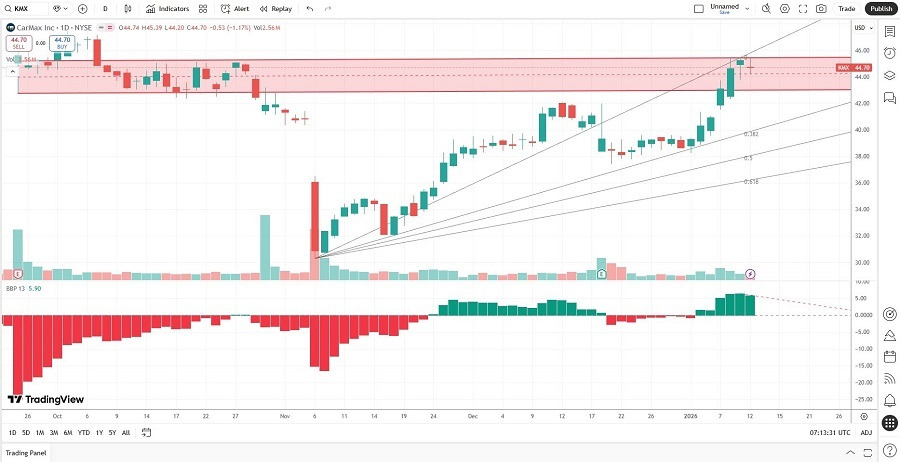
My KMX Short Stock Levels and R/R
- KMX Entry Level: Between $44.20 and $45.53
- KMX Take Profit: Between $31.95 and $33.45
- KMX Stop Loss: Between $48.86 and $49.84
- Risk/Reward Ratio: 2.63
Ready to trade our analysis of CarMax? Here is our list of the best stock brokers worth checking out.