


Short Trade Idea
Enter your short position between $55.79 (Friday's intra-day low) and $56.61 (Friday's intra-day high).
Market Index Analysis
- Bank of America (BAC) is a member of the S&P 100 and the S&P 500.
- Both indices are in bearish chart patterns with decreasing bullish trading volumes, which does not confirm the recent uptrend.
The US equity market landscape presents a mixed technical environment heading into the new year. While the S&P 500 and broader market indices display concerning technical signals—including decreasing bullish trading volumes and a bearish chart pattern—the Bull Bear Power Indicator suggests early bullish momentum with a significant negative divergence warning of potential short-term pullbacks. This creates a divergent environment where momentum indicators conflict with volume confirmation, raising questions about the sustainability of recent gains. For Bank of America investors, this broader market weakness is particularly relevant, as financial stocks have underperformed during periods of economic uncertainty and Fed policy tightening. The financial sector's performance typically tracks closely with US Treasury yields and Fed policy expectations, making macro conditions critical to BAC's near-term trajectory.
Market Sentiment Analysis
Market sentiment toward the financial sector has grown increasingly cautious following mixed signals from Fed policy and inflation data. While broader investor optimism remains elevated—with BofA's own fund manager survey showing sentiment at 7.4 out of 10 (the highest in 4.5 years)—this consensus bullishness masks significant headwinds specific to traditional banking. The recent Fed rate pause, and signals of potential future rate cut,s have pressured Net Interest Margin (NIM) expectations for 2026, a critical earnings driver for banks. Additionally, rising concerns about credit quality, asset quality deterioration, and potential recession fears have dampened institutional enthusiasm for financial stocks. The upcoming January 14 earnings announcement is viewed as a critical catalyst that could either validate current valuations or expose earnings disappointment, with analyst expectations suggesting a high bar to meet. Market participants are heavily focused on management guidance for 2026, particularly regarding net interest income growth, loan growth, and potential loan loss provision increases.
Bank of America Fundamental Analysis
Bank of America is a financial services holding company that handles roughly 10% of all US deposits. It is one of the Big Four US banking institutions and one of eight systemically important financial institutions. The company operates approximately 4,300 retail banking locations and maintains a substantial investment banking, wealth management, and trading business.
Why I'm Bearish on BAC After Its Breakdown
Several concerning fundamental factors weigh heavily on Bank of America's near-term outlook despite the stock's significant 24.1% gain in 2025:
Overvalued Shares with Limited Upside Potential
While BAC trades at a P/E of 15.26 compared to the S&P 500's 31.24, the apparent discount is misleading when considering forward earnings visibility. The recent analyst price target revisions tell a cautionary tale—Barclays aggressively raised its target to $71 on January 5, while Morgan Stanley simultaneously downgraded its forecast to $68 on December 12 with lower EPS projections. This divergence reflects uncertainty about earnings quality and durability, suggesting current valuations may not offer the margin of safety investors assume. The stock's parabolic 2025 performance has largely priced in optimistic scenarios, leaving limited upside potential relative to downside risks.
Inflation and Cooling Labor Market Pressuring Consumer Business
The consumer lending division faces significant headwind. as persistent inflation and a cooling labor market deteriorate borrower credit profiles. BofA's own guidance acknowledges rising concerns about asset quality, with the company cautiously monitoring the impact of higher rates on loan portfolios. Loan delinquencies are rising across the banking sector, and BAC's substantial consumer lending exposure means this segment will face margin compression. The recent jobs data and wage growth moderation suggest consumer stress is beginning to materialize, which typically takes 3-6 months to manifest fully in credit metrics.
Declining Profit Margins Despite Revenue Growth
While BAC reported solid Q3 earnings (EPS of $1.06 vs. $0.93 expected), the company faces structural margin pressure going forward. Net Interest Margin (NIM) compression from potential Fed rate cuts will directly reduce the interest income spread on the company's $2.3+ trillion in interest-bearing liabilities. Trading and investment banking revenues, while recovering from lows, face headwinds from reduced deal flow and market volatility. Operating cost inflation, particularly in digital banking infrastructure and cybersecurity investments, continues to erode operational leverage despite revenue growth.
Deteriorating Asset Quality and Worsening Loan Loss Provisions
Bank of America's credit costs are escalating. Provisions surged 115% in 2022, 72.8% in 2023, and 32.5% in 2024, reflecting management's acknowledgment of deteriorating credit conditions. Net charge-offs increased 74% in 2023 and 58% in 2024—trends that accelerate as borrower stress increases. Management is signaling heightened caution about credit deterioration in the near term, which means loan loss provisions will likely remain elevated or increase further, directly reducing bottom-line profitability.
Elevated Leverage and Solvency Concerns in Macro Downturn Scenario: While BAC reports strong regulatory capital ratios, the bank's overall leverage (total assets to equity) remains substantial at approximately 8.8x. In a severe credit downturn scenario, the company's enormous exposure to loan losses could quickly erode its capital cushion. The debt-to-total-capital ratio of approximately 53% is structurally elevated, meaning the bank has limited financial flexibility if credit conditions deteriorate more sharply than current projections. During financial crises, deposit flight risk becomes material for even "systemically important" institutions.
Downbeat Earnings Outlook for 2026: While BAC projects 5-7% growth in net interest income for 2026, this assumes favorable loan growth and contained rate cuts—both questionable assumptions. Analyst consensus for 2026 EPS is $4.00-4.10, which leaves minimal room for earnings surprises to the downside. Any disappointing guidance on loan growth, NIM trajectory, or credit costs could trigger a substantial valuation re-rating downward.
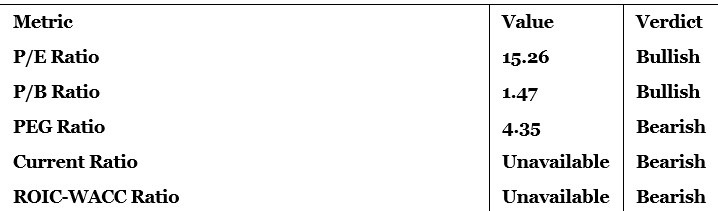
Bank of America Fundamental Analysis Snapshot
The price-to-earnings (P/E) ratio of 15.26 makes BAC appear inexpensive relative to the S&P 500's 31.24. However, this valuation multiple compression reflects legitimate earnings risks specific to the banking sector. Banking valuations typically trade at discounts to the broader market during periods of economic uncertainty and rising credit risk, suggesting the current discount adequately compensates investors for these risks.
The average analyst price target for BAC is currently $62.11 (with recent revisions ranging from $68 to $71). Critically, this represents only 11.1% upside from current levels, while downside risks have risen significantly given credit quality concerns and potential earnings disappointment. The asymmetric risk-reward profile favors the downside, particularly if January 14 earnings disappoint on credit guidance.
Bank of America Technical Analysis
Today's BAC Signal
The technical setup for BAC on January 12th, 2026 presents a compelling short entry opportunity following the stock's breakdown from key technical levels. BAC has formed a bearish reversal pattern after failing to sustain momentum above the $56.50 resistance zone established in late 2025. The stock's 1.59% decline on January 11th, combined with the subsequent minimal after-market recovery of 0.09%, demonstrates weak conviction among buyers despite the extended 2025 rally.
(1) The breakdown below the recent consolidation zone ($56.50-58.00) with declining volume suggests institutional distribution rather than retail liquidation;
(2) Friday's range of $55.79-$56.61 represents a tight trading envelope within the broader 2025 uptrend, indicating exhaustion after the parabolic 2025 advance;
(3) Major technical support levels are located at $54.80 (200-day moving average), $52.50 (key support from November), and $50.00 (psychological level);
(4) The Relative Strength Index (RSI) shows a bearish divergence with the stock hitting new 52-week highs in November-December while RSI failed to reach overbought territory, a classic warning signal of trend exhaustion.
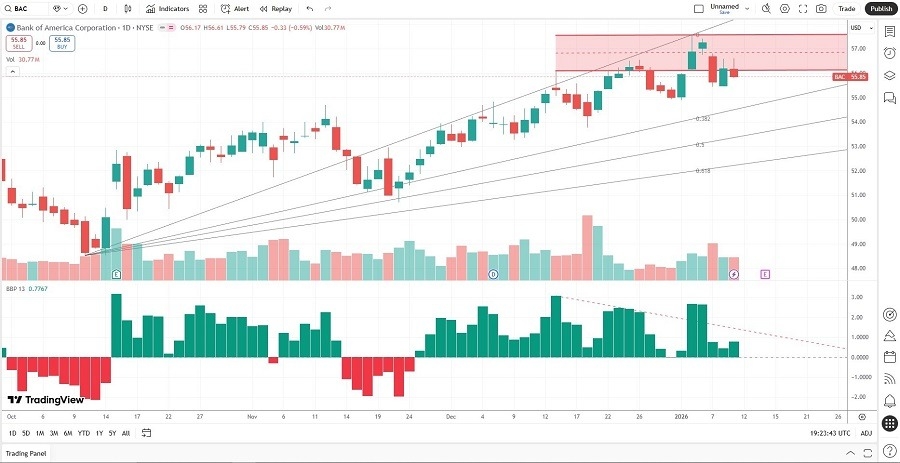
From a technical perspective, the setup suggests a lower-risk short entry in the $55.79-$56.61 band with defined stop-loss above recent highs. The probability of a pullback toward the $50-52 level is elevated given the technical breakdown and bearish divergence patterns. The January 14 earnings catalyst adds volatility risk but also provides a potential catalyst for downside acceleration if guidance disappoints.
My BAC Short Stock Levels and R/R
- BAC Entry Level: Between $55.79 and $56.61
- BAC Take Profit: Between $42.15 and $44.75
- BAC Stop Loss: Between $62.11 and $63.97
- Risk/Reward Ratio: 2.16
Ready to trade our analysis of Bank of America? Here is our list of the best stock brokers worth reviewing.