







Kenya is the third-largest economy in sub-Saharan Africa, behind Nigeria & South Africa, and one of the most-productive economies across Africa.
Kenya is considered the East African business, finance, & technology hub. Online Forex trading in Kenya is regulated by the Capital Markets Authority (CMA).
Read this guide to make the right decision. Updated in September 2026.




Comparison of the Best Forex Brokers in Kenya
| | | |
Regulators | FCA, FSC Belize | ASIC, CySEC, FCA, FSA | FMA, FSA |
Year Established | 2015 | 2009 | 2014 |
Execution Type(s) | ECN/STP, Market Maker | ECN/STP, Market Maker | ECN/STP, No Dealing Desk |
Minimum Deposit | |||
Average Trading Cost EUR/USD | 1.6 pips | 1.0 pips | 1.1 pips |
Average Trading Cost GBP/USD | 1.8 pips | 1.2 pips | 1.55 pips |
Average Trading Cost Gold | States variable | $0.12 | 0.12 pips |
Trading Platform(s) | MetaTrader 4, MetaTrader 5 | MetaTrader 4, MetaTrader 5, Trading View, TradeLocker, Other+ | MetaTrader 4, MetaTrader 5, cTrader, Trading View |
Islamic Account | |||
Negative Balance Protection | |||
| Visit Website | Visit Website | Visit Website |
Anzo Capital
In Summary Competitive ECN pricing on MT4/5, high leverage, and fast account setupAnzo Social Trading caters to copy traders and signal providers, and pairs well with the Anzo Capital App, allowing copy traders to manage their portfolios wherever they are. The MT4/MT5 platforms are also available, ideal for algorithmic traders, upgradeable via 25,000 and 10,000 custom templates, EAs, and scripts, while multi-account management is possible through the MAM module. The minimum deposit starts at $10 but varies by payment processor. The maximum leverage for accounts below $5,000 is 1:1000, and 1:500 for portfolios above $5,000, and Anzo Capital provides negative balance protection.
The asset selection features liquid trading instruments, ensuring low fees, covering Forex, commodities, indices, and stocks. Beginners can benefit from educational content on the broker’s blog, market analytics, and the Anzo AI companion, which improves traders’ performance through personalized coaching, analysis of strengths and weaknesses, and easy-to-follow tips. This places Anzo Capital among the best Forex brokers in Kenya.
Pros & Cons
- Leading Kenyan choice for copy trading via Anzo Social Trading
- CMA‑regulated, offers negative balance protection and crypto deposits
- MT4/MT5, MAM, and liquid multi‑asset coverage for diverse strategies
- Minimum deposit depends on payment method, complicating funding expectations
- Copy‑trading focus may not satisfy research‑driven discretionary traders
Eightcap
In Summary 1:500 maximum leverage and cutting-edge trading toolsEightcap ensures traders have a distinct competitive edge few brokers can match. It lowers the bar for algorithmic trading, a vital tool for profitable Forex traders. Eightcap also upgrades MT5 with the FlashTrader plugin and offers its AI-powered economic calendar. Therefore, I rate Eightcap among the best Kenya Forex brokers.
The well-balanced asset selection of liquid assets includes 100+ cryptocurrency CFDs. Eightcap connects social trades with 50M+ peers to TradingView. Commission-based trading fees start with spreads from 0.0 pips for a $7.00 commission per 1.0 round lot.
Pros & Cons
- Low minimum deposit and high leverage of up to 1:500
- Competitive cost structure
- Excellent technology infrastructure and seasoned management team
- Daily research and quality educational content
- Limited leverage in some areas
BlackBull Markets
In Summary 1:500 maximum leverage with ultra-low trading fees and deep liquidityBlackBull Markets upgrades the MT4/MT5 with the Autochartist plugin and has no minimum deposit requirement. Traders can deposit and withdraw using cryptocurrencies, making BlackBull Markets one of the most accessible and best Kenya Forex brokers on my listing. Besides MT4/MT5, traders can also use cTrader. The industry-leading asset selection includes 200+ currency pairs with deep liquidity.
Copy traders get the proprietary BlackBull Markets CopyTrader, the embedded MT4/MT5/cTrader services, ZuluTrade, and Myfxbook Autotrade. BlackBull Markets also connects social traders to TradingView, where 50M+ peers share and discuss trading ideas. VPS hosting supports algorithmic traders with 24/5 low-latency Forex trading.
Pros & Cons
- ECN/NDD execution model with deep liquidity
- Institution-grade pricing for retail traders via proprietary price aggregation
- ZuluTrade and Myfxbook for social trading
- Leverage of up to 1:500
- Limited deposit options
Understanding the Forex Market in Kenya
The young and tech-savvy population is eager to drive its economy forward, many international companies locate regional headquarters to Kenya, and Forex trading in Kenya is swiftly increasing in popularity, amid low capital requirements. The payment processor M-Pesa, launched in 2007 by UK-based Vodafone and Kenyan Safaricom, is a mobile phone-based money transfer, payments, and micro-financing service, targeting the unbanked, further enables access to the financial system. It became the most successful mobile-phone-based financial service in the developing world by 2010.
Forex trading is growing in popularity across Kenya, especially trading on mobile phones. The trend accelerated since the successful launch of M-Pesa, which connected millions of unbanked in Kenya to the formal financial system. There are not many licensed Forex brokers in Kenya, with EGM Securities, the first non-dealing online Forex broker operating out of Nairobi, and SCFM Limited, the second one. While financial pyramid schemes and other scams exist, as with most frontier markets, the Central Bank of Kenya, and the Capital Markets Authority (CMA) are equipped to ensure a trustworthy environment. It positions Kenya as an excellent growth market.
Is Forex Legal in Kenya?
Yes, Forex is legal in Kenya. There are no restrictions on Kenyan traders to open accounts with international brokers, which do not require a CMA license to operate in the country.
Forex Trading Regulations in Kenya
The Forex market in Kenya is primarily regulated by the Capital Markets Authority (CMA), while the Central Bank of Kenya may introduce regulation for the CMA to enforce. The CMA drafted new rules to tighten regulation, including requiring all international brokers to apply for a license, confirm minimum capital requirements, and file quarterly and annual reports with the regulator. It is a further sign of the growth of Forex trading across Kenya.
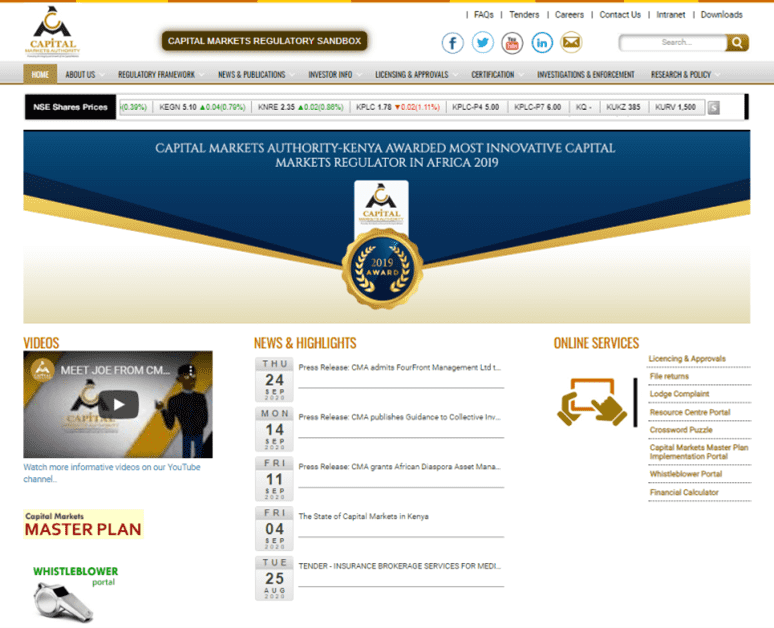
The CMA (Capital Market Authority)
The CMA has regulated Forex brokers in Kenya since 1989. It grants three licenses, Dealing Foreign Exchange Broker, Non-Dealing Foreign Exchange Broker, and Money Manager. In 2019, the CMA received the Most Innovative Capital Markets Regulator in Africa award. To date, only two Kenyan brokers hold a CMA license.
How to Verify Your Broker is Regulated
Checking that your broker is regulated is an important part of keeping your money safer. Being regulated means a government body is responsible for checking that the broker follows standard client money procedures and money-handling processes. In Kenya, the main regulatory body is the Capital Markets Authority (CMA).
Regulation can help stop scams and ensure your money is better protected.
Here is a step-by-step process you can follow to verify a broker's regulatory status:
- Check the Broker's Website Footer: The fastest way to start is to scroll to the very bottom of the broker's homepage. Regulated brokers almost always display their license numbers and the names of the regulatory bodies, such as "Licensed by the CMA of Kenya" or "Regulated by the FCA." Make a note of these details.
- Verify on the Official Regulator's Website: Do not blindly rely upon what the broker says on their site. You should confirm it from the website of the broker’s regulator(s), for example the CMA Kenya. On that official site, use their search bar to type in the broker's name or license number. This will show you if the broker's license is real and active. If the claimed regulatory license is not listed there, the broker might be lying. It is common for brokers to use different company and “trade” names though, so do check carefully to see whether the broker is listed, but under another name.
- Confirm the Regulatory Scope: Ensure the broker's specific entity that you are examining is the one that is regulated, where the broker has more than one regulatory license. For example, broker might have a license from the FCA in the UK, but its Kenyan operations might fall under a different entity. Check the 'Legal' or 'About Us' section of the broker's website to see which corporate entity you are dealing with.
- Look for the Investor Compensation Fund (ICF) Details (if Kenya regulated): In Kenya, the CMA oversees the Investor Compensation Fund (ICF). Check if the broker is a participant. This fund can protect you, up to a certain limit (e.g., 500,000 Kenyan shillings), if the broker fails due to unlawful activity. Knowing you have this protection can provide significant peace of mind. Some other regulatory jurisdictions also offer investor protection or compensation funds, although these are usually relatively limited in scope.
How to Choose a Forex Broker as a Kenyan Trader
Picking a good Forex broker is a big step for Kenya-resident traders. You need to look for more than just competitive trading fees. You need a broker you can trust for the long haul. The main things you should look for in a Forex broker in Kenya are:
- Regulation: Your broker should ideally be regulated by Kenya's CMA (Capital Markets Authority). It is even better if they are regulated in other countries too. This means a government body is watching the broker to make sure they follow the law, take care of their clients, and handle your deposited funds correctly.
- Local payments integration (M-Pesa): You must be able to easily deposit and withdraw funds from your brokerage account. Find a broker that uses M-Pesa as a payment gateway. This is usually the easiest way to deposit and withdraw funds in Kenya.
- Trading Platforms: A trading platform is the interface you use to execute trades. Whichever one you use, it is important you feel comfortable with it, so you don’t make mistakes. If you are thinking about using a new trading platform, you could try it with a demo account to get used to it before trading real money with it.
- Trading Costs: It costs money to place trades. These costs reduce your overall profit (or increase your overall loss), mostly through spreads. Spread is the difference between the bid and ask prices offered at the same time in a particular asset. The smaller the spread (and commission if charged), the less cost for you. Another trading cost is the overnight rollover (sometimes called “swap” or “carry”). These tend to be negative, so you usually pay a small cost for every day you hold a trade open over 5pm New York time. The best brokers will sometimes have positive swaps where you will receive a payment and not a charge when you are long a currency with a high interest rate and short of a currency with a low interest rate.
- Customer Support: If you encounter a technical problem, you need to talk to someone to get it fixed. Test the support team before you open an account with real money, send them a message. See if they answer quickly and are helpful. Local help is best – if the broker offers support in Swahili and has an office in Kenya, that is a good sign.
Trading Fees & Commissions
A broker’s cost structure will have a significant impact on your profitability and requires careful consideration.
- Spreads are the difference between the bid and ask prices. They are the most basic cost in Forex trading. Commission-free spreads can be as low as 0.4 pips, while commission-based commence from 0.0 pips. Anything above 1.0 pips, on liquid currency pairs, represents an excessive mark-up.
- Swaps are costs related to leveraged overnight positions, and transparent brokers list their swap rates on their website and the order ticket. MT4/MT5 traders can obtain them directly from the trading platform. They differ across assets and can change frequently.
- Commissions apply to Forex accounts with access to raw spreads, charged per lot, and to equity traders in the percentage of the order value.
- Other fees can consist of deposit/withdrawal fees, currency conversion costs, and inactivity charges.
Trading Platforms
The MT4 trading platform, once upgraded with add-ons, remains the best trading platform for most traders. It fully supports automated trading and has over 20,000 upgrades to improve the trading environment. Some brokers offer excellent proprietary alternatives, while online Forex trading in Kenya is also heavily conducted on mobile phones, for which traders should consider customized mobile apps.
Account Types
Trading from the right account type is essential and will have a significant impact on your trading results.
- The Micro Account is best suited for deposits below $500, where 1.0 lot equals 1,000 currency units. It is excellent to learn trading and test strategies in a live account.
- The Mini Account is ideal for portfolios below $10,000, and 1.0 lot is equal to 10,000 currency units. Most retail traders should manage portfolios from this account.
- The Standard Account is for professional traders and retail traders with deposits above $10,000, with 1.0 lots totaling 100,000 currency units. It usually offers the best trading conditions, a fact to consider.
- The Islamic account does not charge swap rates but can demand higher minimum deposits and wider spreads to cover the shortfall. Make sure to read the terms and conditions.
The Best Time to Trade Forex in Kenya
Interesting Forex trading opportunities can appear at any time while the Forex market is open. However, the best time to trade Forex is usually during the most liquid market hours, and the time of highest liquidity in the Forex market for most currency pairs typically occurs during the London / New York overlap. In Kenya, which is usually two hours ahead of London, these hours occur between 3 p.m. and 7 p.m. local time Monday to Friday. The most liquid days of the week are usually Wednesday and Thursday. The time zone location of the Philippines means that trading Forex in the late afternoon after work can be a great way to get started. If these specific hours are inconvenient, the Forex market is also relatively liquid during the remainder of the New York session, which stretches from 7 p.m. until 11 p.m. local time.
Do Forex Traders Pay Tax in Kenya?
Kenyan tax residents are obliged to pay income tax on all their worldwide income and gains to Revenue Kenya, even if derived from trading with an offshore Forex broker. Income tax in Kenya is charged at marginal rates ranging from 10% to 30%, which is relatively low tax in global terms. During the 2021 tax year, 10% marginal rate was charged on annual income up to 288,000 shillings, and the 30% bank was charged on annual income in excess of 388,000 shillings.
How Can I Start Forex Trading in Kenya?
The key to starting your Forex trading journey in Kenya is to begin with education and practice before you risk any real money.
With the integration of M-Pesa, funding your account has become instant and convenient, allowing you to focus on learning the markets.
Follow these steps to go from a total novice to placing your first trade with real funds:
- Choose Your Regulated Broker: Use the steps you just learned to choose a broker that is regulated. Look for one that meets your minimum requirements and offers the things you want to trade. For example, you might want a broker which lets you start with a small amount of money (like $1 or 500 KSh), deposit with M-Pesa, and has a trading platform you find easy to use.
- Open and Verify Your Trading Account: Go to the broker's website and click to open a real trading account. They will ask for your personal details and some documents to prove who you are, like a copy of your ID card. This is a normal security check that all reputable brokers perform.
- Practice with a Demo Account: Before you deposit any real money, open a free practice account. Use it to learn how the trading platform works and to test your trading ideas. There is no risk of losing real money. Practice for a few weeks or even months until you feel ready.
- Deposit Funds: When you feel certain you are ready to trade with real money, log in to your trading account. Find the "Deposit" section and choose M-Pesa, or another appropriate option if you prefer. Type in the amount you want to add (make sure it is more than the broker's minimum). You will get a message on your phone to confirm the payment for M-Pesa and certain other types of deposit. After confirming, the money should show up in your trading account right away.
- Place Your First Trade: Start with a very small amount of money: you should never risk more than a very small amount of your account equity on a single trade. You should use a hard stop loss. You might want to choose a fixed profit target or use a trailing stop or some other take profit strategy. Once you have closed the trade, ask yourself whether anything strange or unexpected happened, and if so, try to troubleshoot it, then try again. Contact your broker if there is a problem. At the end of this process, you have a better evaluation about how both you and your broker handle trading with real money.
When is the Forex Market Open in Kenya?
Kenya is two hours ahead of London time, and London is the global centre of the Forex market. This means that Kenya is truly very well-positioned to enjoy the most active and liquid Forex trading sessions.
The London session runs from 10am to 7pm Kenya time.
The New York session runs from 3pm to Midnight Kenya time.
The London / New York session overlap, which is usually the most liquid time in the Forex market and the best time to be day trading Forex, runs from 3pm to 7pm Kenya time.
The Tokyo session runs from 1am to 10am Kenya time.
Forex Brokers Accepting M-Pesa
M-Pesa launched in Kenya in 2007 as a joint venture between UK-based Vodafone Group PLC and Kenyan-based Safaricom, the country’s largest mobile network operator. It grew into the most successful mobile money service in Africa and the biggest FinTech platform regionally. It serves over 20 million users in Kenya, allowing swift transactions from mobile devices, access to the financial system for the unbanked, and ensuring vast availability of the Forex market with easy access.
While the availability of M-Pesa is not widespread with many international Forex brokers, a growing number offer it. Skrill, WebMoney, DusuPay, iPay, MTN Mobile Money, Tigo Pesa, and Airtel Money allow money transfers to M-Pesa in Kenya, offering an alternative to consider. Therefore, traders should check if Forex brokers support any of them if they do not list M-Pesa. The very best Forex brokers in Kenya will ensure that M-Pesa is available, as it represents the most convenient option for Kenyans. With more than 918,500 agents across its network and a total of almost 50 million users in seven countries, M-Pesa booked over 15 billion transactions in 2020.
Kenya heavily depends on agriculture, an underdeveloped sector in the country, with many unbanked citizens. M-Pesa grants access to individuals via a non-bank system by using mobile phones. The young and tech-savvy population relies heavily on mobile phones, making Forex brokers with proprietary mobile apps and support for M-Pesa ideal candidates for Kenyan traders. Forex brokers that accept M-Pesa ensure a broader client reach and penetration while adding another service to the expanding Kenyan financial service sector.
Since M-Pesa relies on a stable mobile network, traders in urban areas will have no issues. Rural areas have coverage, where Safaricom remains the network provider with the broadest access. The success of M-Pesa is likely to result in more Forex brokers that accept M-Pesa.
Customer Service
Most Forex brokers explain all products and services on their website, while an FAQ section attempts to answer the most common questions. For other matters, live customer support resolves issues. Most support is in English, but many brokers deploy multi-lingual staff, per their client-base. Most traders will never require additional assistance at well-managed brokers but having swift access to customer service is essential.
Methodology
We reviewed over 100 brokers based on eleven criteria for more than 200,000 words of dedicated research compiled over 1,000 hours to find the best Forex brokers in Kenya.
