







The best high leverage Forex brokers combine above-average Forex leverage with competitive fees, reliable execution, strong trading platforms and appropriate regulatory protections. Updated in September 2026.
We compared brokers with high leverage based on their maximum Forex leverage, regulation, negative balance protection, trading costs and overall trading conditions. Maximum leverage varies by broker, account type, regulatory entity and trader location.
Our team of researchers looks at the brokers in the retail Forex / CFD industry offering highly leveraged trading and selects the very best ones. We choose these high-leverage brokers by researching and judging all aspects of their offerings, giving greater weight to the most important factors, such as fees and regulatory status. We only feature the high-leverage brokers that top the list, highlighting the areas where they are especially strong.










For over a decade, DailyForex has been the trusted Forex broker authority, helping traders identify the best platforms to meet their specific needs. Our broker ratings are compiled using a rigorous comparison process that examines regulation, trading conditions, and unique features. Whether you're looking for brokers in your region or those offering cutting-edge tools like copy trading or algorithmic strategies, our curated lists are designed to simplify your broker search.
All Round Best High Leverage Forex / CFD Broker
At DailyForex, we rate the overall best high leverage broker as IFC Markets, because it offers:
- High maximum leverage of 1:400.
- Negative balance protection.
- Very competitive trading fees on major Forex currency pairs.
- A full range of asset classes to trade.
Best High Leverage Forex / CFD Trading Brokers Comparison
| | | | | |
Regulators | BVI, FSA, FSCA | CMA (Kenya), FCA, FSC Mauritius, FSCA, SCA | ASIC, FSC Mauritius, FSCA | ASIC, VFSC | CMA (Kenya), CMA (U.A.E.), CySEC, DFSA, FSA, FSC Belize, FSCA |
Year Established | 2006 | 2011 | 2016 | 2014 | 2009 |
Execution Type(s) | ECN/STP | ECN/STP, Market Maker | ECN/STP, Market Maker | ECN/STP | Market Maker |
Minimum Deposit | |||||
Average Trading Cost EUR/USD | $4.00 | 0.1 pips | 0.8 pips | 0.1 pip | 0.1 pips |
Average Trading Cost GBP/USD | $10.00 | 0.2 pips | 1.0 pips | 0.3 pips | 0.2 pips |
Average Trading Cost Gold | $25.00 | $0.18 | $0.18 | 0.15 points | $0.19 |
Trading Platform(s) | MetaTrader 4, MetaTrader 5, Proprietary platform, NetTradeX | MetaTrader 4, MetaTrader 5, Proprietary platform | MetaTrader 5 | MetaTrader 4, MetaTrader 5, Proprietary platform, Web-based | MetaTrader 4, MetaTrader 5, Proprietary platform |
Islamic Account | |||||
Negative Balance Protection | N/A | N/A | N/A | ||
| Visit Website | Visit Website | Visit Website | Visit Website | Visit Website |
IFC Markets
In Summary A well-regulated broker with an extensive synthetic asset library & low feesI rank IFC Markets first among the best high leverage Forex brokers for its combination of leverage up to 1:400, negative balance protection, competitive trading conditions and flexible platform choice. Higher leverage is available on eligible Nano and Micro accounts, while leverage limits can vary according to account structure, instrument and regulatory entity.
IFC Markets supports MT4 and MT5 alongside its proprietary NetTradeX platform and offers a broad multi-asset selection. Its Portfolio Quoting Method also allows traders to create synthetic instruments, adding flexibility beyond standard Forex pairs. The relatively low entry requirement makes IFC Markets accessible to traders who want higher leverage without a large initial deposit.
Pros & Cons
- Forex leverage up to 1:400
- Negative balance protection
- MT4, MT5 and NetTradeX with a low minimum deposit
- Maximum leverage varies by account type
- NetTradeX has a smaller user ecosystem than MT4 or MT5
FXTM
In Summary Best all-around broker with high floating leverage and fast executionFXTM is one of the strongest additions for traders seeking ultra-high Forex leverage, with eligible accounts offering floating leverage of up to 1:5000. The actual leverage available depends on account type, trading instrument and overall position exposure, and decreases as notional trading volume rises.
This dynamic structure gives smaller positions access to very high leverage while reducing leverage as exposure increases. FXTM supports MT4 and MT5 and offers Forex alongside metals, indices, equities and other CFDs. Traders should check the leverage schedule carefully rather than assuming the maximum 1:5000 ratio applies to every trade.
Pros & Cons
- Best for ultra-high forex leverage up to 1:5000
- Dynamic leverage adjusts to overall exposure
- MT4 and MT5 support
- Maximum leverage does not apply uniformly to all positions
- Floating leverage becomes lower as trading exposure increases
iux.com
In Summary A leading algorithmic Forex broker offering a highly competitive core trading environment.IUX stands out among high leverage Forex brokers with maximum leverage of up to 1:3000 on eligible accounts. Its leverage model is dynamic, meaning the actual ratio can change according to account equity, trading volume, instrument and periods when higher margin requirements apply.
The broker provides MT5 alongside its proprietary WebTerminal and mobile app, giving traders a combination of established and in-house trading technology. IUX is particularly relevant to traders who want very high leverage but should be comfortable with leverage limits changing as account exposure and market conditions evolve.
Pros & Cons
- Best for flexible forex leverage up to 1:3000
- MT5 plus proprietary web and mobile platforms
- Dynamic leverage can support smaller-account traders
- Maximum leverage decreases under certain equity or risk conditions
- Higher margin requirements can apply during volatile periods
FXT
In SummaryFXTrading.com offers a tiered leverage structure that can provide Forex leverage up to 1:2000 for eligible accounts with lower equity. As account equity increases, maximum leverage progressively falls, making the broker a good example of why high-leverage traders should consider the rules behind the headline ratio rather than the maximum alone.
Trading is available through MT4, MT5 and the broker's web and mobile platforms. FXTrading.com also offers negative balance protection under eligible conditions, an important feature for traders using higher leverage. Actual leverage and protections depend on regulatory entity, account balance and instrument.
Pros & Cons
- Best for tiered high leverage up to 1:2000
- Tiered structure provides higher leverage to smaller accounts
- MT4 and MT5 alongside web and mobile platforms
- Maximum leverage falls as account equity increases
- Trading conditions differ between regulatory entities
XM
In Summary Exception range of assets + negative balance protectionXM combines Forex leverage up to 1:1000 with a well-established MT4 and MT5 trading environment. Its leverage framework is designed to remain flexible across different account balances and trading conditions, although the maximum available ratio still depends on client location, regulatory entity and account eligibility.
The broker also provides negative balance protection and a broad selection of Forex pairs and CFDs. XM is particularly suitable for traders who want higher leverage from a widely established multi-asset broker rather than an ultra-high-leverage specialist.
Pros & Cons
- Stable high-leverage Forex Trading up to 1:1000
- Negative balance protection
- MT4, MT5 and proprietary mobile app
- 1:1000 is not available through every regulatory entity
- Maximum leverage can vary by account equity and instrument
MultiBank Group
In Summary Deep liquidity with no trading restrictionsMultiBank complies with ten regulators and operates from more than twenty-five global offices. Active traders can benefit from a volume-based cashback program that decreases final trading fees, while beginners get withdrawable bonuses of up to $40,000 per trader. They also receive twelve well-structured multi-lesson courses and eleven e-books. Therefore, I rank MultiBank among the best Forex brokers.
The cutting-edge trading environment and superb asset selection are available with a $50 minimum deposit requirement, and MultiBank has a growing presence in the cryptocurrency sector. Algorithmic traders can use the MT4/MT5 platforms, and passive traders can diversify via the in-house MultiBank copy trading service.
Pros & Cons
- 20,000 assets offering broad coverage of financial markets
- Raw spreads from 0 pips and maximum leverage of 1:1000
- Regulated by 17+ financial authorities, including multiple Tier 1 bodies
- ECN trading with deep liquidity and no requotes
- Access to raw spreads requires a $10,000 minimum deposit on the ECN account
BlackBull Markets
In Summary 1:500 maximum leverage with ultra-low trading fees and deep liquidityBlackBull Markets combines Forex leverage up to 1:500 with ECN-style execution and one of the broadest trading-platform selections among the brokers in this ranking. Traders can choose between MT4, MT5, cTrader and TradingView, making BlackBull particularly attractive to technical, algorithmic and multi-platform traders.
Its leverage structure depends on the instrument, account conditions and regulatory entity, so traders should verify the rate applicable to their account rather than assuming the maximum applies universally. The absence of a stated minimum opening deposit also makes BlackBull accessible to traders who want flexibility in how much capital they initially commit.
Pros & Cons
- Up to 1:500 leverage on major FX currency pairs and metals
- Scaled leverage structure for large positions
- Manual leverage adjustment
- Maximum leverage varies by instrument and entity
- Trading costs depend on the selected account structure
FP Markets
In Summary ECN trading with leverage up to 1:500FP Markets remains one of my preferred high leverage Forex brokers for traders who want competitive pricing alongside maximum Forex leverage of up to 1:500 under eligible international entities. The broker's Raw account combines tight spreads with commission-based pricing, making it particularly relevant to active and higher-volume Forex traders.
Platform choice is another major advantage. FP Markets supports MT4, MT5, cTrader and TradingView, alongside automated and copy-trading solutions. Traders should note that leverage varies considerably by regulatory entity, with lower limits applying to retail accounts in more restrictive jurisdictions.
Pros & Cons
- Forex leverage up to 1:500 under eligible entities
- Competitive Raw account pricing
- Competitive Raw account pricing
- Maximum leverage is substantially lower under some regulated entities
- Highest leverage is not available to all traders
Eightcap
In Summary 1:500 maximum leverage and cutting-edge trading toolsEightcap offers Forex leverage up to 1:500 through eligible international entities and combines it with a strong selection of trading platforms and third-party tools. Traders can use MT4, MT5 and TradingView, making Eightcap particularly attractive to those who rely heavily on charting, automation and integrated trading workflows.
The broker's leverage limits vary by regulatory entity, with retail clients in more restrictive jurisdictions receiving significantly lower maximum ratios. Eightcap therefore fits this listing best as a technology-focused high-leverage broker rather than as a broker competing solely on the highest available leverage.
Pros & Cons
- Best for high leverage with trading tools and integrations
- MT4, MT5 and TradingView
- Strong platform integrations and automated trading support
- Maximum leverage is not available in all jurisdictions
- Leverage on non-Forex assets may be considerably lower
Broker | Maximum Forex Leverage | How Leverage Applies | Trading Platforms | Best For |
|---|---|---|---|---|
IFC Markets | Up to 1:400 | Available on Nano/Micro accounts; Standard accounts generally have lower limits | MT4, MT5, NetTradeX | Best Overall for Flexible High-Leverage Trading |
FXTM | Up to 1:5000 | Floating leverage; maximum depends on account type, instrument and overall exposure | MT4, MT5 | Ultra-high Forex leverage |
IUX | Up to 1:3000 | Equity-based dynamic leverage; reduced as account capital increases and during HMR periods | MT5, WebTerminal, IUX App | Flexible ultra-high leverage |
FXT | Up to 1:2000 | Available through eligible international accounts; leverage varies by entity and conditions | MT4, MT5, WebTrader, App | High leverage with platform flexibility |
MultiBank Group | Up to 1:1000 | ECN leverage on selected major Forex pairs; progressively reduced for larger positions | MT4, MT5 | Tiered ECN leverage |
XM | Up to 1:1000 | Flexible leverage with stable margin requirements under the eligible XM entity | MT4, MT5, XM App | Stable high leverage |
FP Markets | Up to 1:500 | Maximum depends on regulatory entity and account eligibility | MT4, MT5, cTrader, TradingView | Low-cost high-leverage trading |
BlackBull Markets | Up to 1:500 | Available across its main trading accounts; instrument-specific limits apply | MT4, MT5, cTrader, TradingView | ECN execution and platform choice |
Eightcap | Up to 1:500 | Available through its eligible international entity; lower limits apply elsewhere | MT4, MT5, TradingView, TradeLocker | Trading tools and integrations |
*Maximum leverage varies by regulatory entity, account type, account equity, position size and financial instrument. The figures above represent the highest Forex leverage available under eligible trading conditions and may not be available to all traders or in all jurisdictions.
We compared high leverage Forex brokers based on maximum Forex leverage, regulation, negative balance protection, trading costs, execution quality and platform choice. Traders specifically looking for a fixed 1:500 ratio can also see our dedicated comparison of 1:500 leverage brokers.
What is High Leverage?
The first question is, what is leverage?
Leverage is when your broker lends you money to trade with, and you trade a position size bigger than the money or value (account equity) in your account.
For example, let's say I have $1,000 cash in my account. I buy 0.01 lots of the USD/CAD currency pair, where 1 lot is worth $100,000. I have purchased $1,000 worth of USD/CAD, the same as my account size, so I am unleveraged.
Now let’s image I still have $1,000 cash in my account, but I buy 1 lot of the USD/CAD currency pair. My real leverage now is 1:100, because for every $1 I have in my account, I bought $100 worth of USD/CAD, up to the total amount of $100,000.
I would lose my entire account if the trade went against me with just a 1% move. On the other hand, if the trade moved in my favour by 1%, it would double my account equity.
The second question is, what is high leverage? Consider that in the corporate world leverage of only 1:1.3 is considered normal. In the Forex industry, some traders consider anything over 1:3 as high, but it is more accurate to say Forex leverage higher than 1:30 is generally considered high.
Unfortunately, the Forex/CFD industry has a reputation of offering excessive leverage. The good news is, you don’t have to trade with extremely high leverage – it is under your control.
What Effect Can High Leverage Have?
Using leverage magnifies both your losses and wins – it is a double-edged sword.
For example, if your real leverage on a trade is 1:2, if you win, your win will be doubled. If you lose, your loss will be doubled.
What are the Risks of High Leverage?
- Amplified losses – at very high rates of leverage, it is possible to lose a quarter, half, or even all of your account on a single trade.
- Margin calls and forced liquidation – if you are highly leveraged and the trade goes significantly against you, your broker might ask you to close the position, and if you do not, your broker can close it for you.
- Increased sensitivity to market volatility – in volatile markets, high leverage can be catastrophic.
Tips for managing risks in high-leverage trading
- Consider using a guaranteed stop loss order. This can stop negative slippage causing you to lose more than you expected to. However, guaranteed stop losses can be quite expensive at the brokers which offer them.
- Always use a hard stop loss.
- Err on the side of caution. Be careful and always know exactly how much your real leverage on a trade is. If your trade position size is larger than your account equity, you are leveraged. Dividing trade size by account equity gives your real leverage factor.
- Do not enter high-leverage trades just before high-impact news events or when volatility is unusually high.
What are the Advantages of High Leverage?
There is one real advantage of high leverage: when you win, you can make a lot of money quicky compared to your account size. However, this is not without an equal risk of large losses.
Many traders who seek to generate large profits through prop firms might consider using a high leverage broker instead of a prop firm. After all, if you can trade in a way that passes the typical challenge of a prop firm, you could probably make just as much money trading your own money using high leverage.
Are there fees associated with high-leverage trading?
There are no special extra fees in high leverage trading, but keep in mind that as trade position sizes are unusually large for your account size when you use high leverage, proportionate trading fees are going to be high, such as:
- Spreads / Commissions
- Overnight Financing (Swap)
Note that by using a commission-based account, you might be able to get a better deal than by using an account which charges spreads alone.
How Much Leverage Should I Use?
It depends on your risk tolerance. One method many traders use to make this call is to calculate a worst-case scenario of losses and then scale that, so at most, it would cause a 20% loss. The scaling ratio then gives you your leverage.
For example, let's assume that I have an account with $1,000 and that the worst maximum drawdown (consecutive loss) I think I might have is 5%. I just divide 20% by 5%, which gives me a leverage ratio of 1:4.
Note that in corporate finance, a maximum leverage ratio of only 1:1.3 is typically considered a suitable maximum. Generally, most traders are too aggressive with leverage – you do not need to trade Forex at a relatively high 1:30 leverage to make money unless you are undercapitalised, which is a separate problem.
Remember that if you do not use a guaranteed stop loss – which is expensive – you should use a hard stop loss, if you are leverage. Yet slippage, where the price moves so quickly through your stop loss that it is only executed at a notably worse price, when combined with high leverage, can be very deadly.
If your account is small and represents only a fraction of your liquid wealth, if your broker offers negative balance protection, you might be relaxed about losing the entire account. In this situation, you might afford to use very high leverage.
Is It Important to Find a Regulated Broker When Trading with Leverage?
It is always important to use a regulated broker, and even more so when trading with high leverage, as your account is more vulnerable to losses. So, it will pay off to make sure your broker is not working against your interests, and this will probably be easier to ensure with well-regulated brokers.
Can I Lose More than my Initial Deposit in High-Leverage Trading?
Not if your broker, or at least the regulator regulating your account, offers negative balance protection. This has become more commonly offered since the 2015 Swiss Franc flash crash.
Are Spreads and Commissions More Important When Trading with High Leverage?
If you are trading position sizes which are large for your account, you will also be paying trading fees which are large for your account, such as spreads and commissions. Some brokers offer commission-based accounts which are capped, and this type of account might give better value on trading fees for highly leveraged traders.
Does Execution Speed Matter in High Leverage?
Execution speed itself is not especially important when trading with high leverage, but slow execution can allow slippage to happen. Slippage can be either negative (your trade is executed at a worse price) or positive (your trade is executed at a better price). Beware of negative slippage, which is more likely to happen in volatile or news-driven market conditions.
Which Countries Restrict Maximum Leverage?
There are several countries whose regulators have imposed limits on the maximum leverage that a broker can offer. These tends to be more developed countries. There are some other countries, which are often offshore centres, that allow brokers to offer any maximum leverage they want.
Brokers that are regulated in a country imposing maximum leverage will impose those limits on their clients.
Some brokers are regulated in different countries with different rules on maximum leverage. In these cases, much will depend upon where the client lives, with most brokers not allowing offshore accounts to traders living somewhere else where the broker is regulated.
If you live in a country with a maximum leverage cap, and you want to trade at a higher leverage, your best chance is to look for a broker that is not regulated where you live.
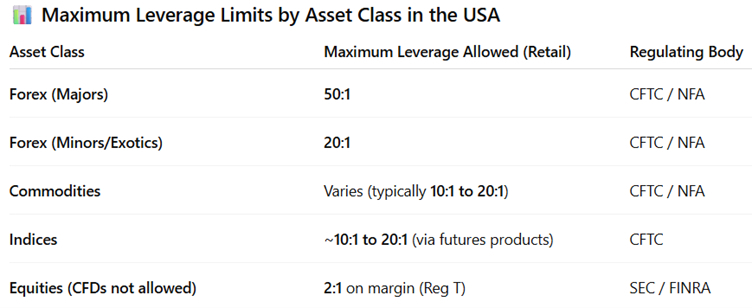
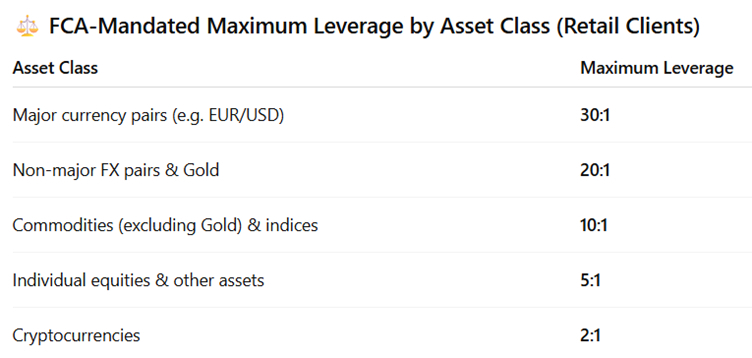
Note that where maximum leverage limits exist, they differ by asset class.
Let’s look at the most important jurisdictions where the regulator limits the maximum leverage.
Best High Leverage Forex Brokers in the USA
US traders have access to significantly lower Forex leverage than traders using some international broker entities. Under current NFA rules, Forex Dealer Members must maintain a minimum security deposit of 2% on specified major currencies and 5% on other currency transactions, equivalent to maximum leverage of approximately 1:50 and 1:20 respectively.
For traders searching for the best Forex broker in the USA with high leverage, this means the comparison should focus on US-authorized brokers offering the maximum leverage permitted under the CFTC/NFA framework rather than international brokers advertising 1:500, 1:1000 or higher. FOREX.com and OANDA are established options for US spot Forex trading, while futures brokers provide another form of leveraged currency exposure using a different margin structure. Our dedicated Best Forex Brokers in the USA guide compares the regulated options available to US residents
Leverage limits in the USA are quite strict and subject to several regulators:
- SEC (Securities and Exchange Commission)
- FINRA (Financial Industry Regulatory Authority)
- CFTC (Commodities Futures Trading Commission)
- NFA (National Futures Association)
Leverage in the EU / UK / Australia
Leverage limits in the UK are very strict and subject to regulation by the FCA (Financial Conduct Authority). The limits shown below are the same in the European Union, although each EU country has a separate regulator. The Australian regulator ASIC (Australian Securities and Investments Commission) copied the same limits, so the data below applies to all these jurisdictions.
How to Choose the Best High Leverage Forex Broker
Choosing the best high leverage Forex broker requires more than simply comparing the highest advertised leverage ratio. Traders should consider how leverage is calculated, which regulatory entity provides the account, the broker’s margin rules, trading costs, execution quality and the protections available if markets move sharply against an open position.
Maximum Forex leverage: Check the maximum leverage available specifically for Forex, rather than relying on a broker’s general headline leverage. Some brokers offer 1:500, 1:1000 or substantially higher Forex leverage, but the actual limit may depend on account equity, position size, currency pair, account type and regulatory entity. Higher advertised leverage does not automatically make a broker better.
Leverage by asset class: Maximum Forex leverage usually does not apply equally to every instrument. A broker may offer high leverage on major currency pairs while applying significantly lower limits to Gold, indices, shares or cryptocurrencies. Traders using several markets should compare the leverage available for each asset class separately.
Regulation and account entity: Check which legal entity will hold your trading account, as the same broker may operate under several regulators with different leverage limits and client protections. Retail leverage is generally restricted in jurisdictions such as the UK, EU and Australia, while international entities may offer considerably higher ratios. Regulation, compensation schemes and client-fund protections can also differ between entities.
Negative balance protection: Negative balance protection can prevent eligible traders from losing more than the funds available in their trading account. This protection is particularly relevant when using high leverage, since sudden market movements or price gaps can cause losses to develop rapidly. Confirm that negative balance protection applies to the specific regulatory entity and account type offering the higher leverage.
Margin call and stop-out levels: High leverage reduces the margin required to open a trade, but it can also bring an account closer to forced liquidation when positions move against the trader. Compare the broker’s margin-call level, stop-out level and any rules that increase margin requirements during periods of high volatility. Some brokers also reduce maximum leverage as account equity or position size increases.
Trading costs: Compare spreads, commissions, swap rates and any other account charges. High leverage can magnify the effect of trading costs because traders can control larger positions with relatively little capital. Active traders should pay particular attention to average spreads and commissions on the currency pairs they trade most frequently.
Execution quality: Fast and reliable execution becomes increasingly important when trading leveraged positions. Look for brokers offering competitive execution speeds, sufficient liquidity, transparent order-handling policies and limited requotes or slippage under normal market conditions. Scalpers and algorithmic traders should also check whether their preferred trading strategies are permitted.
Account types: Brokers may offer different leverage limits across Standard, Raw/ECN, Cent, Micro or professional accounts. Some high-leverage conditions are available only to smaller accounts or traders below specific equity thresholds. Compare minimum deposits, pricing structures, leverage rules and eligibility requirements before selecting an account.
Trading platforms and tools: A good high leverage Forex broker should provide reliable platforms and effective risk-management tools. Look for advanced charting, stop-loss and take-profit orders, price alerts, mobile trading, automated trading and integrations such as MT4, MT5, cTrader or TradingView. Tools for monitoring margin usage and account exposure are particularly useful when managing highly leveraged positions.
My Take
Ultimately, the best Forex broker with high leverage should offer a suitable balance between leverage, trading costs, execution, platform quality and account protection. Traders should compare the leverage available under the specific entity that will hold their account rather than choosing a broker based solely on its highest advertised ratio.
You might also be interested in reviewing the top brokers below :
