


Despite their historical correlation, Gold and Silver divide investors when it comes to trading and investment opportunities. Across digital and real commodity trading communities, comparisons between the two assets continue to grow. Which is a better asset to trade? Or which offers a better investment opportunity? In reality, a thin line separates the two, as each offers unique volatility, liquidity, and availability scenarios. Gold offers steadier, lower-risk opportunities; Silver is more volatile, offering bigger short-term moves and bigger risk. Active traders often prefer Silver's volatility, while Gold suits trend-following and hedging. While the Gold-Silver ratio presents a visual and mathematical comparison between both assets, whether Gold is a better investment than Silver or vice-versa depends on the investor and prevailing conditions.
In this article, we discuss the relationship between Gold and Silver as tradable commodities to give investors a clear view of which one offers better investment/trading opportunities for them.
Gold vs Silver at a Glance
The Gold vs Silver comparison spans utility, investment opportunity, trading, and real economic relevance. In terms of utility, Gold ranks as one of the most sought-after lustrous metals, while Silver is more pronounced in industrial applications. The latter presents Silver as an arguably more economically relevant asset; however, Gold leads the vast luxury market.
As tradable commodities, demand and supply for both assets create wide differences in price performance, trading experience, and investment returns. At $4,400 per troy ounce and $67 per troy ounce, respectively, in mid-September 2026, Gold commands a significantly larger market than Silver. This is driven partly by historically higher demand for real Gold and its reputation as a stable safe haven for traders and investors. As a result, Gold offers better liquidity and tighter spreads for traders. Gold also responds more to macro trends and is often presented as a reflection of global economic conditions.
The 65.5 Gold-Silver ratio (at the time of writing) reflects the value gap that these differences have created over time. As a (relatively) less liquid asset, Silver sees more price swings and volatility; however, it has outperformed Gold over the past 5 years mid-September 2021 – 2026 (184% vs 147%) and appeals more to investors/traders with a higher taste for risk and profits.
Gold Vs Silver Comparison Table
Factor | Gold (XAU/USD) | Silver (XAG/USD) |
Primary demand driver(s) | Safe-haven and monetary/investment demand. High-end luxury item production | Industrial demand plus investment demand. |
Price per ounce | Much higher; ~$4,400* | Much lower, $67* |
Liquidity/spread | Deep liquidity, tighter spread | Thinner order book, wider spread |
Trading costs | Tighter spread and deep liquidity reduces slippage and overall trading cost | Wider spread and thinner liquidity may increase slippage and trading cost. |
Volatility | More stable. Less unexpected price swings. Lower slippage | Less stable, higher volatility. |
Key Signal | Gold–Silver ratio, USD, real yields | Gold–Silver ratio, industrial cycle |
Best suited for | Relatively lower-volatility exposure; often used for macro positioning and hedging. | Higher-volatility exposure; often favoured by active traders seeking larger price moves. |
*Mid-September 2026
Top Regulated Brokers
Which Is More Volatile, Gold or Silver?
Over the five-year period measured for this article, Silver’s annualized realized volatility was roughly twice Gold’s: about 37% for Silver versus 18% for Gold. The gap varies across market cycles, measurement windows, and the price series used. The implied volatility index for Gold was 27 as of September 8th 2026, according to the CBOE, versus 46 for Silver. Gold historically trades within the 10–18% annualized volatility range over the long term and often reverts toward that range after intermittent spikes. Silver, however, is more prone to swings in the short and long term. This is partly driven by Silver’s industrial and monetary dual role, which can produce larger moves in both directions and a thinner order book than Gold on trading platforms.
Silver’s established volatility makes it a higher risk-reward option for investors. The price swings present more opportunities to lock in significant profits at intervals. Consequently, traders are expected to manage their positions to avoid losses from unexpected price swings. Gold, on the other hand, is a more stable investment option. Gold has lost just 2% of its value year-to-date (to mid-September 2026), while Silver has dropped 6% with repeated sharp spikes over the same period. Gold is therefore best suited for trades with low risk tolerance and as a hedge against inflation.
The Gold–Silver Ratio: The Key ‘Which to Trade’ Signal
What is the Gold-Silver ratio?
The Gold-Silver ratio answers the question: “How many ounces of Silver does it take to buy one ounce of Gold?” It puts the current prices of Gold and Silver side by side. With Gold trading at $4,410–$4,425/oz and Silver around $67.3–$67.5/oz as of September 10, 2026, the Gold-Silver ratio is 65.5. This means that one ounce of Gold can buy 65.5 ounces of Silver
For live market levels, see the current Gold price and forecast and the current Silver price and forecast. This article uses the ratio as an explanatory signal rather than a live ticker.
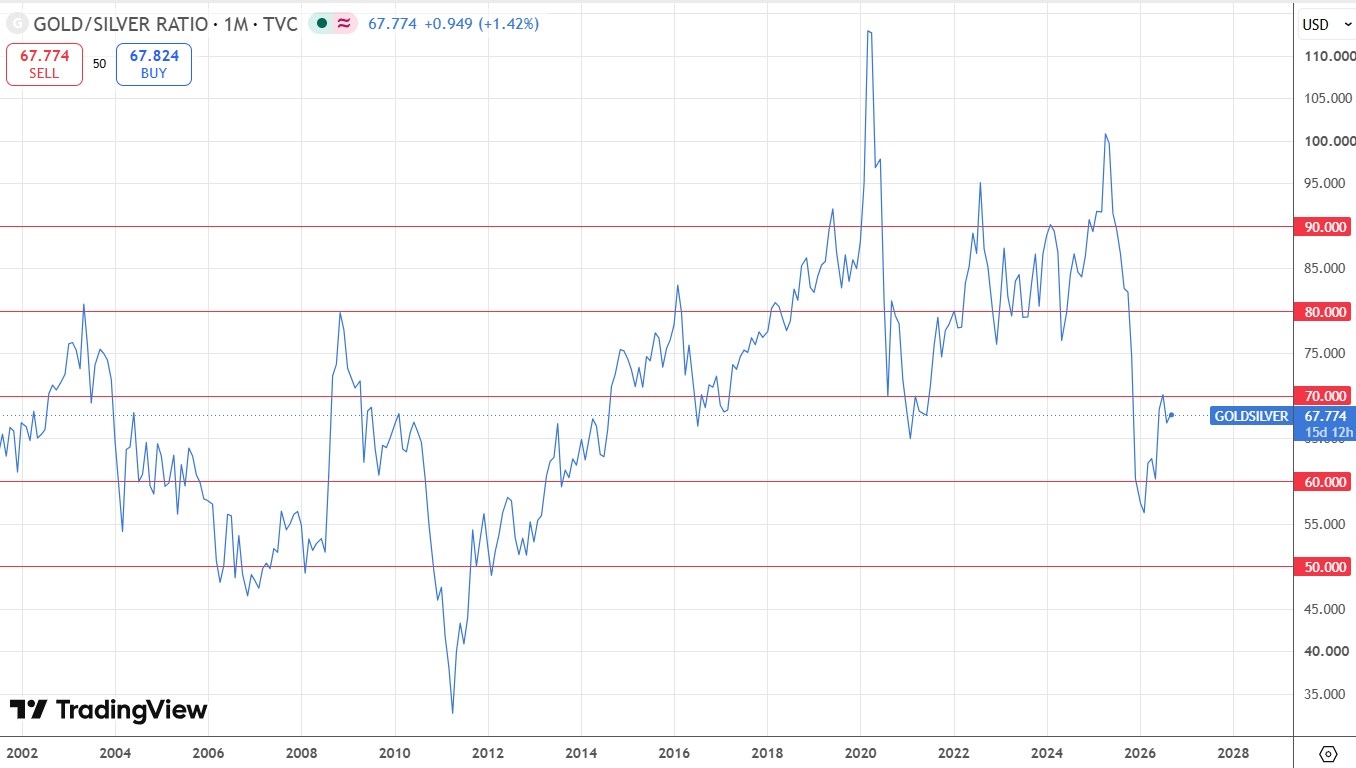
Historical Gold–Silver Ratio 2002-2026
The Gold–Silver ratio has moved through wide ranges over time. A high ratio can indicate that Silver is cheap relative to Gold, while a low ratio can indicate the reverse; neither signal is a guarantee of mean reversion.
How to Calculate the Gold-Silver Ratio
The Gold-Silver ratio is obtained by dividing the current price of an ounce of Gold by the current price of an ounce of Silver.
That is:
Gold–Silver ratio=Gold price per troy ounce/Silver price per troy ounce
What is the Relevance of the Gold-Silver Ratio for Investors?
The Gold-Silver ratio is a key signal for traders and investors. Historical data shows a strong correlation between the ratio and the price development of both assets.
A high ratio (historically ~80+) shows that Gold is outperforming Silver. This often occurs when investors hedge against macro trends, for instance, during international conflicts. A high Gold-Silver ratio suggests that Silver is cheap relative to Gold. This may push stackers and relative-value traders toward Silver.
A low ratio (historically ~50 or below) shows that Silver has been outperforming Gold. This occurs when industrial/speculative demand is strong. A low Gold-Silver ratio suggests Silver is expensive relative to Gold and may push traders toward Gold.
The middle band (~50–80) is the practical “neutral zone” and suggests no strong relative-value edge. Gold and Silver spent most post-1971 trading days in the middle band.
Mean-Reversion in the Gold-Silver Ratio
The Gold-Silver ratio is mean-reverting; that is, it often returns to a common average over the long term. Therefore, traders and physical buyers use it as a rotation signal. Reversion can happen in three ways: Silver outperforms a rising Gold price, Silver rises while Gold is flat/down, or Gold falls more than Silver.
Traders’ usual reaction to the Gold-Silver ratio is as follows
Above 80 (some use 85–90): favor Silver. Consider swapping Gold for Silver.
Below 60 (some use 50): favor Gold. Consider swapping Silver for Gold.
Between those levels: Evaluate other factors to buy any or both Gold and Silver.
A ratio level alone is not a trading instruction. Combine it with trend, real yields, the US dollar, Silver’s industrial-demand outlook, position sizing, and a defined stop-loss plan.
Liquidity, Spreads & Cost of Trading Each
On most brokerages and digital trading platforms, Silver is liquid enough for most retail and institutional use. However, spreads are wider in basis points, books are thinner, and extreme market conditions may cause irregular fluctuations. Gold offers deeper liquidity and tighter spreads across trading venues. Silver's lower liquidity and wider spreads may mean higher slippage when trading Silver than Gold.
Retail physical bullion commonly involves dealer premiums and wider buy/sell spreads than exchange-traded or broker-delivered products. Costs vary by product, dealer, location, and order size. Buyers may pay a premium over the prevailing spot price, while sellers normally receive a dealer bid.
The cost of trading Gold and Silver is influenced highly by the trading method, platform, and volume. ETFs attract maintenance fees; futures and spot attract trading fees; CFDs attract platform fees. These, along with possible hidden fees, make up the full trading costs for each asset.
Silver often carries higher all-in trading costs than Gold because of wider spreads, thinner liquidity, and potentially greater slippage. Actual costs vary by venue, broker, contract size, trading hours, and financing terms.
Trading costs for Gold vs Silver across different venues:
Physical: Silver. Coin premiums often ~8–24% vs Gold ~1–8%; fabrication is a bigger slice of a cheaper ounce.
ETFs: Silver. SLV 0.50% / SIVR 0.30% vs Gold 0.07–0.40%; SLV spreads are also a bit wider.
Futures: Silver. Same-style commissions, but a 1-tick spread is ~8 bps vs Gold ~2 bps; books thin faster.
CFDs: Silver. Wider spreads (~9 vs ~2 bps) and larger dollar swaps/slippage on a standard lot.
How to Trade Gold and Silver (CFDs, Futures, ETFs, Spot)
You can trade Gold and Silver digitally through several avenues, including Spot, derivatives, ETFs (Exchange Traded Funds), and CFDs (Contracts for Difference). Each method offers different ownership, costs, leverage, liquidity, complexity, and suitability. Brokerages may offer more than one of these trading venues.
Trading Gold and Silver via Spot
Spot trading offers direct exposure to the Gold and Silver market. The prices of Gold (XAU/USD) and Silver (XAG/USD) on spot markets are a representation of the actual prices of the same quantity of real precious metal. When you buy Gold or Silver on the spot market, you accrue profits when the value of the asset increases and losses when its value drops.
Precious metals spot markets may be physical/fully funded or broker-delivered. physical/fully funded spot markets offer no leverage; however, they're the most straightforward way to gain exposure to the Gold and Silver market. Depending on the platform and trading agreement, your Gold and Silver spot positions may also give you a claim to the real commodity.
Broker-delivered Gold and Silver spot markets may be margined and leveraged, allowing investors to gain more market exposure than their initial capital. However, leveraged spot markets usually do not give traders a claim to the real asset and may trigger liquidation.
For a platform-specific walkthrough, see our guide on how to trade Silver.
Trading Gold and Silver futures
Gold and Silver futures are standardized exchange-traded contracts that provide leveraged long or short price exposure. Most traders close or roll positions before delivery, so futures are commonly used for trading and hedging rather than acquiring bullion. Futures provide exchange-traded price exposure rather than direct ownership of the underlying asset. Exchange and clearing requirements set baseline margins, while brokers may impose higher house margins.
Before trading Gold or Silver futures, verify contract size, expiry, exchange and clearing margin, any broker house-margin requirement, liquidity, delivery terms, and liquidation policy. See our Gold trading strategies guide for examples of how traders structure commodity positions.
Trading Gold and Silver ETFs
Gold and Silver ETFs are exchange-traded fund shares issued by a fund sponsor or trust. Depending on the product, the fund may hold physical metal through an appointed custodian or use futures and other instruments to track prices. ETFs generally do not use leverage in the base product, have no expiry, and can be held in tax-advantaged accounts where local rules permit.
Note that ETF issuers may charge annualized maintenance fees.
Popular Gold and Silver ETFs include:
Gold: SPDR Gold Shares (GLD, higher expense ratio ~0.40%, very liquid and large AUM), iShares Gold Trust (IAU, ~0.25%), SPDR Gold MiniShares (GLDM, ~0.10%).
Silver: iShares Silver Trust (SLV, ~0.50%), abrdn Physical Silver Shares (SIVR, lower expense ~0.30%).
Trading Gold and Silver CFDs.
A CFD is a contract with a broker to exchange the difference in price of an asset over a period of time. Gold and Silver CFDs do not give you access to the real assets; however, you benefit from fluctuations in their value. Brokerages may offer spot-style (no expiry) Gold/Silver CFDs, as well as futures-style versions.
Consider these before trading Gold and Silver
Legitimacy of the trading platform: We recommend trading Gold and Silver on regulated brokerages. For traders in the US, use CFTC-approved and NFA-regulated brokerages. Read our review of top Gold brokerages
Your trading capital: Traders with low capital may trade Gold and Silver futures and use leverage to boost their profitability. However, leverage is risky and may lead to liquidation if you don't monitor it.
Trading experience: If you are new to trading, we recommend trading Gold and Silver via Spot or ETFs. Futures are best suited for experienced traders/investors.
Your trading strategy: If you want to invest in Gold or Silver long-term, spot, CFDs, and ETFs may suit you best. Futures are best for day trading, trend-following, and other short-term trading/investment strategies.
Risk tolerance: High-leverage futures suit risk-savvy traders. If your risk tolerance is low, consider trading spot with low capital.
Gold vs Silver as a Long-Term Investment
Gold is often preferred by long-term investors seeking relatively lower volatility and a more established safe-haven role. Silver may appeal to investors willing to accept larger drawdowns in exchange for potentially greater upside during favourable industrial and precious-metals cycles. Gold’s demand structure includes investment and safe-haven demand, central-bank accumulation, crisis hedging, and jewellery demand.
While Silver outperformed Gold over the past five years, largely due to the 2025 rally, the gap closes when you consider 20-25 years’ performance. Industrial utility (electronics, solar, EVs) accounts for most demand for Silver. This demand fluctuates consistently, and Silver is therefore prone to deeper drawdowns
In summary, Gold’s stability makes it more appealing for investors who seek slow, steady returns over a long period, while more risk-savvy investors may prefer Silver regardless of how long they plan to hold their investment.
So, Which Should You Choose?
Gold and Silver have been historically proven to be solid investment options. Each one offers unique advantages for different classes of traders. As a day trader, Silver’s volatility may appeal more than Gold’s stability. Significant intra-day price swings create opportunities to profit without holding a position for multiple days.
Gold has historically been widely used as a portfolio hedge during periods of financial stress and inflation concern, although it can still experience substantial price declines and extended drawdowns. For this reason, institutions and investors seeking a hedge against global and national crises, or to cushion the effect of inflation, may find Gold a more suitable investment.
Regardless, both assets are still prone to swings in response to prevailing economic and industrial factors, respectively. Therefore, swing traders should consider these factors, including the Gold-Silver ratio, in relation to their investment strategy.
Summary table for which asset to choose between Gold and Silver according to trader/investor profile.
Investment/trading strategy | Potential fit | Reason |
Day trader | Silver | Higher intraday volatility can create larger moves, but requires stricter risk controls |
Swing trader | Depends on setup | Use the Gold–Silver ratio, USD/real-yield trend, industrial-demand outlook, liquidity, and planned stop distance. |
Long-term investor | Gold | Notably more stable and more aligned with wealth preservation/hedging. |
Crisis or inflation hedge | Gold | More established safe-haven and monetary-demand role |
Your choice as regards which of the two assets offers a better investment opportunity should be influenced by your trading goals, strategy, and risk tolerance. Either way, ensure you trade with legitimate brokerages and monitor your investments closely.
